

 Tweet
Tweet
 My Hero
Ernesto "Che" Guevara (June 14,1928 – October 9, 1967), commonly known as Che Guevara, El Che, or simply Che, was an Argentine Marxist revolutionary, politician, author, physician, military theorist, and guerrilla leader. After his death, his stylized image became a ubiquitous countercultural symbol worldwide.
As a young medical student, Guevara traveled throughout Latin America and was transformed by the endemic poverty he witnessed. His experiences and observations during these trips led him to conclude that the region's ingrained economic inequalities were an intrinsic result of monopoly capitalism, neo-colonialism, and imperialism, with the only remedy being world revolution. This belief prompted his involvement in Guatemala's social reforms under President Jacobo Arbenz, whose eventual CIA-assisted overthrow solidified Guevara's radical ideology.
Later, in Mexico, he met Fidel Castro and joined his 26th of July Movement. In December 1956, he was among the revolutionaries who invaded Cuba under Castro's leadership with the intention of overthrowing U.S.-backed Cuban dictator Fulgencio Batista. Guevara soon rose to prominence among the insurgents, was promoted to Comandante, and played a pivotal role in the successful guerrilla campaign that deposed Batista.Following the Cuban revolution, Guevara reviewed the appeals of those convicted as war criminals during the revolutionary tribunals.
Later he served as minister of industry and president of the national bank, before traversing the globe as a diplomat to meet an array of world leaders on behalf of Cuban socialism. He was also a prolific writer and diarist, composing a seminal manual on the theory and practice of guerrilla warfare, along with an acclaimed memoir about his motorcycle journey across South America. Guevara left Cuba in 1965 to incite revolutions first in an unsuccessful attempt in Congo-Kinshasa and then in Bolivia, where he was captured with the help of the CIA and executed.
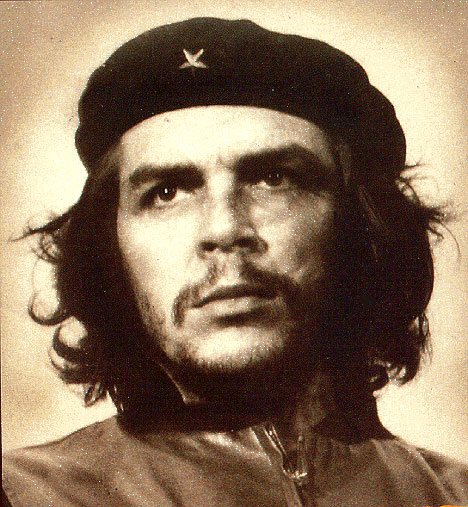
Both notorious for his harsh discipline and revered for his unwavering dedication to his revolutionary doctrines, Guevara remains an admired, controversial, and significant historical figure. As a result of his death and romantic visage, along with his invocation to armed class struggle and desire to create the consciousness of a "new man" driven by "moral" rather than "material" incentives,Guevara evolved into a quintessential icon of leftist-inspired movements as well as a global merchandising sensation. He has been mostly venerated and occasionally reviled in a multitude of biographies, memoirs, books, essays, documentaries, songs, and films. Time Magazine named him one of the 100 most influential people of the 20th century,while an Alberto Korda photograph of him entitled Guerrillero Heroico (shown), was declared "the most famous photograph in the world."
Félix Rodríguez, a CIA operative, claims that he headed the hunt for Guevara in Bolivia.On October 7, an informant apprised the Bolivian Special Forces of the location of Guevara's guerrilla encampment in the Yuro ravine. They encircled the area, and Guevara was wounded and taken prisoner while leading a detachment with Simeón Cuba Sarabia. Che biographer Jon Lee Anderson reports Bolivian Sergeant Bernardino Huanca's account: that a twice wounded Guevara, his gun rendered useless, shouted "Do not shoot! I am Che Guevara and worth more to you alive than dead."
Guevara was tied up and taken to a dilapidated schoolhouse in the nearby village of La Higuera. Early on October 9, the day after his capture, Bolivian President René Barrientos ordered that he be killed. The executioner was Mario Terán, a sergeant in the Bolivian army who had drawn a short straw after arguments over who would get to shoot Guevara broke out among the soldiers. To make the bullet wounds appear consistent with the story the government planned to release to the public, Félix Rodríguez ordered Terán to aim carefully to make it appear that Guevara had been killed in action during a clash with the Bolivian army.
Moments before Guevara was executed he was asked if he was thinking about his own immortality. "No," he replied, "I'm thinking about the immortality of the revolution."Che Guevara also allegedly said to his executioner, "I know you've come to kill me. Shoot, coward, you are only going to kill a man."Terán hesitated, then pulled the trigger of his semiautomatic rifle, hitting Guevara in the arms and legs. Guevara writhed on the ground, apparently biting one of his wrists to avoid crying out. Terán shot him again, this time hitting him fatally in the chest – at 1:10 pm, according to Rodríguez.
His body was then lashed to the landing skids of a helicopter and flown to nearby Vallegrande where photographs were taken, showing a figure described by some as "Christ-like" lying on a concrete slab in the laundry room of the Nuestra Señora de Malta hospital.
A declassified memorandum dated October 11, 1967 to US President Lyndon B. Johnson from his senior adviser, Walt Rostow, called the decision to kill Guevara "stupid" but "understandable from a Bolivian standpoint."After the execution, Rodríguez took several of Guevara's personal items, including a watch which he continued to wear many years later, often showing them to reporters during the ensuing years.Today, some of these belongings, including his flashlight, are on display at the CIA.
After a military doctor amputated his hands, Bolivian army officers transferred Guevara's cadaver to an undisclosed location and refused to reveal whether his remains had been buried or cremated. The hands were preserved in formaldehyde to be sent to Buenos Aires for fingerprint identification. (His fingerprints were on file with the Argentine police.) They were later sent to Cuba. On October 15, Castro acknowledged that Guevara was dead and proclaimed three days of public mourning throughout the island.On October 18, Castro addressed a crowd of almost one million people in Havana and spoke about Guevara's character as a revolutionary.
French intellectual Régis Debray who was captured in April 1967 while with Guevara in Bolivia, gave a jailhouse interview in August of 1968, where he extrapolated on the reasons for Guevara's demise. Debray who had lived with Guevara's band of guerrillas for a short time, espoused that in his view they were "victims of the forest" and thus "eaten by the jungle."
Debray described a destitute situation where Guevara's men suffered malnutrition, lack of water, absence of shoes, and only possessed six blankets for twenty-two men. Debray also recounts that Guevara and the others had been suffering an "illness" which caused their hands and feet to swell into "mounds of flesh" to the point where you could not discern the fingers on their hands.
Despite the futile situation, Debray described Guevara as "optimistic about the future of Latin America" and remarked that Guevara was "resigned to die in the knowledge that his death would be a sort of renaissance", noting that Guevara perceived death "as a promise of rebirth" and "ritual of renewal."
Che Guevara's Monument and Mausoleum in Santa Clara, Cuba.While researching his biography Che Guevara: A Revolutionary Life, author Jon Lee Anderson happened to discover the hidden location of Guevara's burial. Thus in 1997, the skeletal remains of a handless body were exhumed from beneath an air strip near Vallegrande, identified as those of Guevara by a Cuban forensic team at the scene, and returned to Cuba. On October 17, 1997, his remains, with those of six of his fellow combatants, were laid to rest with military honours in a specially built mausoleum in the city of Santa Clara, where he had won the decisive battle of the Cuban Revolution.
Also removed when Guevara was captured was his diary, which documented events of the guerrilla campaign in Bolivia.The first entry is on November 7, 1966 shortly after his arrival at the farm in Ñancahuazú, and the last is dated October 7, 1967, the day before his capture. The diary tells how the guerrillas were forced to begin operations prematurely due to discovery by the Bolivian Army, explains Guevara's decision to divide the column into two units that were subsequently unable to re-establish contact, and describes their overall unsuccessful venture. It also records the rift between Guevara and the Bolivian Communist Party that resulted in Guevara having significantly fewer soldiers than originally expected and shows that Guevara had a great deal of difficulty recruiting from the local populace, due in part to the fact that the guerrilla group had learned Quechua, unaware that the local language was actually Tupí-Guaraní.
As the campaign drew to an unexpected close, Guevara became increasingly ill. He suffered from ever-worsening bouts of asthma, and most of his last offensives were carried out in an attempt to obtain medicine.
The Bolivian Diary was quickly and crudely translated by Ramparts magazine and circulated around the world.There are at least four additional diaries in existence—those of Israel Reyes Zayas (Alias "Braulio"), Harry Villegas Tamayo ("Pombo"), Eliseo Reyes Rodriguez ("Rolando")and Dariel Alarcón Ramírez ("Benigno")—each of which reveals additional aspects of the events. In July of 2008, the Bolivian government unveiled Guevara's formerly sealed diaries composed in two frayed notebooks, along with a logbook and several black-and-white photographs. At this event, Bolivia's vice minister of culture Pablo Groux, expressed that there were plans to publish photographs of every handwritten page later in the year.
As a young medical student, Guevara traveled throughout Latin America and was transformed by the endemic poverty he witnessed. His experiences and observations during these trips led him to conclude that the region's ingrained economic inequalities were an intrinsic result of monopoly capitalism, neo-colonialism, and imperialism, with the only remedy being world revolution. This belief prompted his involvement in Guatemala's social reforms under President Jacobo Arbenz, whose eventual CIA-assisted overthrow solidified Guevara's radical ideology.
Later, in Mexico, he met Fidel Castro and joined his 26th of July Movement. In December 1956, he was among the revolutionaries who invaded Cuba under Castro's leadership with the intention of overthrowing U.S.-backed Cuban dictator Fulgencio Batista. Guevara soon rose to prominence among the insurgents, was promoted to Comandante, and played a pivotal role in the successful guerrilla campaign that deposed Batista.Following the Cuban revolution, Guevara reviewed the appeals of those convicted as war criminals during the revolutionary tribunals.
Later he served as minister of industry and president of the national bank, before traversing the globe as a diplomat to meet an array of world leaders on behalf of Cuban socialism. He was also a prolific writer and diarist, composing a seminal manual on the theory and practice of guerrilla warfare, along with an acclaimed memoir about his motorcycle journey across South America. Guevara left Cuba in 1965 to incite revolutions first in an unsuccessful attempt in Congo-Kinshasa and then in Bolivia, where he was captured with the help of the CIA and executed.
Both notorious for his harsh discipline and revered for his unwavering dedication to his revolutionary doctrines, Guevara remains an admired, controversial, and significant historical figure. As a result of his death and romantic visage, along with his invocation to armed class struggle and desire to create the consciousness of a "new man" driven by "moral" rather than "material" incentives,Guevara evolved into a quintessential icon of leftist-inspired movements as well as a global merchandising sensation. He has been mostly venerated and occasionally reviled in a multitude of biographies, memoirs, books, essays, documentaries, songs, and films. Time Magazine named him one of the 100 most influential people of the 20th century,while an Alberto Korda photograph of him entitled Guerrillero Heroico (shown), was declared "the most famous photograph in the world."
Félix Rodríguez, a CIA operative, claims that he headed the hunt for Guevara in Bolivia.On October 7, an informant apprised the Bolivian Special Forces of the location of Guevara's guerrilla encampment in the Yuro ravine. They encircled the area, and Guevara was wounded and taken prisoner while leading a detachment with Simeón Cuba Sarabia. Che biographer Jon Lee Anderson reports Bolivian Sergeant Bernardino Huanca's account: that a twice wounded Guevara, his gun rendered useless, shouted "Do not shoot! I am Che Guevara and worth more to you alive than dead."
Guevara was tied up and taken to a dilapidated schoolhouse in the nearby village of La Higuera. Early on October 9, the day after his capture, Bolivian President René Barrientos ordered that he be killed. The executioner was Mario Terán, a sergeant in the Bolivian army who had drawn a short straw after arguments over who would get to shoot Guevara broke out among the soldiers. To make the bullet wounds appear consistent with the story the government planned to release to the public, Félix Rodríguez ordered Terán to aim carefully to make it appear that Guevara had been killed in action during a clash with the Bolivian army.
Moments before Guevara was executed he was asked if he was thinking about his own immortality. "No," he replied, "I'm thinking about the immortality of the revolution."Che Guevara also allegedly said to his executioner, "I know you've come to kill me. Shoot, coward, you are only going to kill a man."Terán hesitated, then pulled the trigger of his semiautomatic rifle, hitting Guevara in the arms and legs. Guevara writhed on the ground, apparently biting one of his wrists to avoid crying out. Terán shot him again, this time hitting him fatally in the chest – at 1:10 pm, according to Rodríguez.
His body was then lashed to the landing skids of a helicopter and flown to nearby Vallegrande where photographs were taken, showing a figure described by some as "Christ-like" lying on a concrete slab in the laundry room of the Nuestra Señora de Malta hospital.
A declassified memorandum dated October 11, 1967 to US President Lyndon B. Johnson from his senior adviser, Walt Rostow, called the decision to kill Guevara "stupid" but "understandable from a Bolivian standpoint."After the execution, Rodríguez took several of Guevara's personal items, including a watch which he continued to wear many years later, often showing them to reporters during the ensuing years.Today, some of these belongings, including his flashlight, are on display at the CIA.
After a military doctor amputated his hands, Bolivian army officers transferred Guevara's cadaver to an undisclosed location and refused to reveal whether his remains had been buried or cremated. The hands were preserved in formaldehyde to be sent to Buenos Aires for fingerprint identification. (His fingerprints were on file with the Argentine police.) They were later sent to Cuba. On October 15, Castro acknowledged that Guevara was dead and proclaimed three days of public mourning throughout the island.On October 18, Castro addressed a crowd of almost one million people in Havana and spoke about Guevara's character as a revolutionary.
French intellectual Régis Debray who was captured in April 1967 while with Guevara in Bolivia, gave a jailhouse interview in August of 1968, where he extrapolated on the reasons for Guevara's demise. Debray who had lived with Guevara's band of guerrillas for a short time, espoused that in his view they were "victims of the forest" and thus "eaten by the jungle."
Debray described a destitute situation where Guevara's men suffered malnutrition, lack of water, absence of shoes, and only possessed six blankets for twenty-two men. Debray also recounts that Guevara and the others had been suffering an "illness" which caused their hands and feet to swell into "mounds of flesh" to the point where you could not discern the fingers on their hands.
Despite the futile situation, Debray described Guevara as "optimistic about the future of Latin America" and remarked that Guevara was "resigned to die in the knowledge that his death would be a sort of renaissance", noting that Guevara perceived death "as a promise of rebirth" and "ritual of renewal."
Che Guevara's Monument and Mausoleum in Santa Clara, Cuba.While researching his biography Che Guevara: A Revolutionary Life, author Jon Lee Anderson happened to discover the hidden location of Guevara's burial. Thus in 1997, the skeletal remains of a handless body were exhumed from beneath an air strip near Vallegrande, identified as those of Guevara by a Cuban forensic team at the scene, and returned to Cuba. On October 17, 1997, his remains, with those of six of his fellow combatants, were laid to rest with military honours in a specially built mausoleum in the city of Santa Clara, where he had won the decisive battle of the Cuban Revolution.
Also removed when Guevara was captured was his diary, which documented events of the guerrilla campaign in Bolivia.The first entry is on November 7, 1966 shortly after his arrival at the farm in Ñancahuazú, and the last is dated October 7, 1967, the day before his capture. The diary tells how the guerrillas were forced to begin operations prematurely due to discovery by the Bolivian Army, explains Guevara's decision to divide the column into two units that were subsequently unable to re-establish contact, and describes their overall unsuccessful venture. It also records the rift between Guevara and the Bolivian Communist Party that resulted in Guevara having significantly fewer soldiers than originally expected and shows that Guevara had a great deal of difficulty recruiting from the local populace, due in part to the fact that the guerrilla group had learned Quechua, unaware that the local language was actually Tupí-Guaraní.
As the campaign drew to an unexpected close, Guevara became increasingly ill. He suffered from ever-worsening bouts of asthma, and most of his last offensives were carried out in an attempt to obtain medicine.
The Bolivian Diary was quickly and crudely translated by Ramparts magazine and circulated around the world.There are at least four additional diaries in existence—those of Israel Reyes Zayas (Alias "Braulio"), Harry Villegas Tamayo ("Pombo"), Eliseo Reyes Rodriguez ("Rolando")and Dariel Alarcón Ramírez ("Benigno")—each of which reveals additional aspects of the events. In July of 2008, the Bolivian government unveiled Guevara's formerly sealed diaries composed in two frayed notebooks, along with a logbook and several black-and-white photographs. At this event, Bolivia's vice minister of culture Pablo Groux, expressed that there were plans to publish photographs of every handwritten page later in the year.
Comment