

 Tweet
Tweet
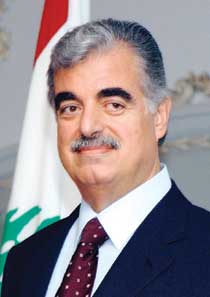
The investigation into his assassination is still ongoing and it is conducted under the supervision of the UN and led by the independent investigator Serge Brammertz. It has been widely speculated that the Syrian government and its allies in Lebanon are somehow linked to the assassination. The latest progress report by Brammertz has indicated that DNA evidence collected from the crime scene strongly suggests that the assassination might be the act of a young male suicide bomber.
Syria had extensive military and intelligence influence in Lebanon at the time of Hariri's murder, but Damascus has claimed repeatedly it had no knowledge of the bombing. A United Nations report sponsored by the US and UK found converging evidence of Syrian and Lebanese involvment in this attack. The UN Security Council voted unanimously to demand full Syrian cooperation with UN investigators in the matter, and Serge Brammertz's last two reports praised Syria's full co-operation.
With the help of the Syrian Regime, Hariri returned to Lebanon in 1992 as prime minister. He put the country back on the financial map through the issuing of Eurobonds and won plaudits from the World Bank for his plan to borrow reconstruction money as the country's debt grew to become the largest per capita in the world.
Hariri served as Prime Minister of Lebanon from 1992 to 1998, then again from 2000 until late 2004 operating under the wishes of the Syrian government. However, amid the political crisis brought on by the extension of President Emile Lahoud's term, Hariri resigned as Prime Minister, saying: "I have... submitted the resignation of the government, and I have declared that I will not be a candidate to head the (next) government."
Hariri's contributions were numerous. Among the most notable is the fact that he educated 30,000 Lebanese students inside and outside of Lebanon, and spent millions of dollars of his own personal money to redefine the face of social hierarchies in Lebanon.
He donated a great deal of money to charity, and invested in Lebanon when few others were willing to risk doing so. Like all prime ministers since the end of the French mandate in 1943, he was a Sunni Muslim. He worked towards unity of the different religious and ethnic groups and rebuilding.
His economic record was mixed: his ambitious borrow-and-build schemes resulted in massive public debt and budget deficits, which pushed up interest rates and hampered economic growth. He was accused of ignoring the poor as a matter of public policy, despite his long personal record of funding charitable causes.
He was also accused of using and abusing his political position to benefit his family's fortunes, and the fortunes of his allies and cronies. Harriri was also criticized of turning a blind eye to corruption committed by his allies, and only punishing his political rivals.
During a BBC interview in 2001,Harīrī was asked by Tim Sebastian why he refused to hand over members of Hezbollah that were accused by America of being terrorists. He responded that Hezballah were the ones protecting Lebanon against the Israeli occupation and called for implementation of passed United Nations resolutions against Israel.
He was further accused of making the American coalition in the War on Terrorism worthless and asked if he was ready for the consequences of his refusal, reminding him that George W. Bush had said : "Either you are with us, or you are with the terrorists".He replied that he had hoped that there would be no consequences, but would deal with them if they arrive. Hariri further said that he opposed the killing of all humans Israeli, Palestinian, Syrian or Lebanese and believed in dialogue as a solution.
He further went on to say that Syria will have to stay in Lebanon for protection of Lebanon until they are no longer needed and Lebanon asks them to leave.
On June 22, 2005, Beirut International Airport was renamed Rafic Hariri International Airport in honor of Rafīq Harīrī. Israel bombed the airport in the 2006 Lebanon War.
Comment