Announcement

Collapse
No announcement yet.

Minneapolis bridge collapse

Collapse
X
 
  • Filter
  • Time
  • Show
Clear All
new posts

  • Minneapolis bridge collapse

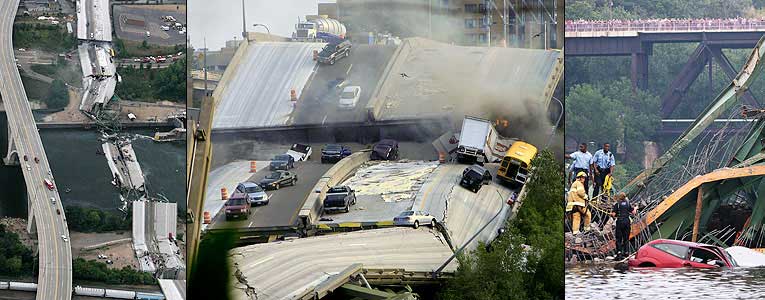
    An interstate bridge suddenly broke into huge sections and collapsed into the Mississippi River during bumper-to-bumper traffic Wednesday, killing at least six people and sending vehicles, tons of concrete and twisted metal crashing into the water.

    The Interstate 35W bridge, a major link between Minneapolis and St. Paul, was in the midst of being repaired when it collapsed.

    "There were two lanes of traffic, bumper to bumper, at the point of the collapse. Those cars did go into the river," Minneapolis Police Lt. Amelia Huffman. "At this point there is nothing to suggest that this was anything other than a structural collapse."

    Jamie Winegar of Houston said she was sitting in traffic when all of a sudden she started hearing "boom, boom, boom and we were just dropping, dropping, dropping, dropping."

    The car she was riding in landed on top of a smaller car but did not fall into the water. She said her nephew yelled, "'It's an earthquake!' and then we realized the bridge was collapsing."


    Other hospitals also were treating the injured. Clinton said at least one of the victims had drowned.

    The arched bridge, which was built in 1967, rises about 64 feet above the river. An estimated 50 vehicles plunged into the water and onto the land below, the Star-Tribune reported.

    A burning truck and a school bus clung to one slanted slab. The bus had just crossed the bridge before it crumpled into pieces, and broadcast reports indicated the children on the bus exited out the back door.
    Christine Swift's 10-year-old daughter, Kaleigh, was on the bus, returning from a field trip to Bunker Hills in suburban Blaine. She said her daughter called her about 6:10 p.m.

    "She was screaming, 'The bridge collapsed,'" Swift said.
    She said a police officer told her all the kids got off the bus safely.
    Dozens of vehicles were scattered and stacked on top of each other amid the rubble. Some people were stranded on parts of the bridge that aren't completely in the water.

    Melissa Hughes, 32, of Minneapolis said she was driving home across the bridge when she went down when the western edge in the collapse.
    "You know that free fall feeling? I felt that twice," said Hughes, who was not injured.

    A pickup ended up on top of her car, partially crushing the top and back end.

    "I had no idea there was a vehicle on my car," she said. "It's really very surreal."


    Many motorist could have been headed to the Minnesota Twins game scheduled not far from the bridge, but the game was postponed, team president Dave St. Peter said.

    Ramon Houge told the St. Paul Pioneer Press that he was on his way home from work on the bridge when he heard a rumbling noise, saw the ground collapse and cars go down.

    Traffic was bumper to bumper and hundreds of people would have been involved, he said. He said cars backed up as best they could and he parked in a construction zone and was finally able to turn around and drive off the bridge. "It didn't seem like it was real," he said.

    Local television stations captured video of injured people being carried up the riverbank. There was no official word on injuries, but dozens of rescue vehicles were there. Divers were also in the water.

    Workers have been repairing the 40-year-old bridge's surface as part of improvements along that stretch of the interstate, the Minneapolis Star-Tribune reported on its Web site.
    Homeland Security Department spokesman Russ Knocke also said the collapse did not appear to be terrorism-related.
    Last edited by abadani69; 08-01-2007, 07:57 PM.

  • #2

    Comment


    • #3
      This is so sad!!!!!!! they haven't said anything about any terrorist attack, thanks God. They have been blaming on the construction that was going on over the bridge.

      Comment


      • #4

        Comment


        • #5

          Comment


          • #6

            Comment


            • #7
              نه غزه نه لبنان جانم فدای ایران


              صادق هدايت؛ بوف کور

              Comment


              • #8
                Minnesota officials were warned as early as 1990 that the bridge that plummeted into the Mississippi River was "structurally deficient," yet they relied on a strategy of patchwork fixes and stepped-up inspections.

                "We thought we had done all we could," state bridge engineer Dan Dorgan told reporters not far from the mangled remains of the span. "Obviously something went terribly wrong."

                Questions about the cause of the collapse and whether it could have been prevented arose Thursday as authorities shifted from rescue efforts to a grim recovery, searching for bodies that may be hidden beneath the river's swirling currents.

                The official death count from Wednesday's rush-hour collapse stood at four, with another 79 injuries. But police said the death count would surely grow because bodies had been spotted in the water and as many as 30 people were still reported missing.

                In 1990, the federal government gave the I-35W bridge a rating of "structurally deficient," citing significant corrosion in its bearings. That made it one of 77,000 bridges in that category nationwide, 1,160 in Minnesota alone.

                The designation means some portions of the bridge needed to be scheduled for repair or replacement, and it was on a schedule for inspection every two years.

                During the 1990s, later inspections found fatigue cracks and corrosion in the steel around the bridge's joints. Those problems were repaired. Starting in 1993, the state said, the bridge was inspected annually instead of every other year.

                A 2005 federal inspection also rated the bridge structurally deficient, giving it a 50 on scale of 100 for structural stability.

                White House, press secretary Tony Snow said while the inspection didn't indicate the bridge was at risk of failing, "If an inspection report identifies deficiencies, the state is responsible for taking corrective actions."

                Gov. Tim Pawlenty responded Thursday by ordering an immediate inspection of all bridges in the state with similar designs, but said the state was never warned that the bridge needed to be closed or immediately repaired.

                "There was a view that the bridge was ultimately and eventually going to need to be replaced," he said. "But it appears from the information that we have available that a timeline for that was not immediate or imminent, but more in the future."

                The eight-lane Interstate 35W bridge was Minnesota's busiest bridge, carrying 141,000 vehicles a day. It was in the midst of mostly repaving repairs when it buckled during the evening rush hour. Dozens of cars plummeted more than 60 feet into the Mississippi River, some falling on top one of another. A school bus sat on the angled concrete.

                Engineers wondered whether heavy traffic might have contributed to the collapse. Studies of the bridge have raised concern about cracks caused by metal fatigue.

                "I think everybody is looking at fatigue right now, fatigue due to heavy traffic," said Kent Harries, an assistant professor of civil and environmental engineering in the University of Pittsburgh's School of Engineering. "This is an interstate bridge that sees a lot of truck traffic."

                When conducting inspections, Dorgan said, inspectors get within an arm's length of various components of a bridge. If they spot cracks, that leads to more hands-on testing to determine the depth and extent of the fissures.

                The collapsed bridge's last full inspection was completed June 15, 2006. The report shows previous inspectors' notations of fatigue cracks in the spans approaching the river, including one 4 feet long that was reinforced with bolted plates. A 1993 entry noted 3,000 feet of cracks in the surface of the bridge; they were later sealed.

                That inspection and one a year earlier raised no immediate concerns about the bridge, which wasn't a candidate for replacement for another 13 years.

                In a 2001 report from the University of Minnesota's Department of Civil Engineering, inspectors found some girders had become distorted. Engineers also saw evidence of fatigue on trusses and said the bridge might collapse if part of the truss gave way under the eight-lane freeway.

                "A bridge of that vintage you always have to be concerned about that," said Richard Sause, director of the Advanced Technology for Large Structural Systems Center at Lehigh University. "In a steel bridge of that age, sure you'd be concerned about those kind of things and be diligent about looking after it. And it seems like they were."

                It takes time for a fatigue crack to develop, but a crack can then expand rapidly to become a fracture, Garrett said. "If you get a crack that goes undetected it would be something that appears to happen more rapidly."

                At the scene, about 15 divers and a dozen boats were in the water, but the search was proceeding slowly because of strong currents and low visibility. By mid-afternoon, they had located four submerged cars besides the dozen or so visible from the surface.

                "We have a number of vehicles that are underneath big pieces of concrete, and we do know we have some people in those vehicles," Dolan said. "We know we do have more casualties at the scene."

                Meanwhile, relatives who couldn't find their loved ones at hospitals gathered in a hotel ballroom for any news, hoping for the best.

                Ronald Engebretsen, 57, was searching for his wife, Sherry. His daughter last heard from her when she left work Wednesday in downtown Minneapolis. Her cell phone has picked up with voice mail ever since.

                "We are left with the hope that there is a Jane Doe in a hospital somewhere that's her." Sherry Engebretsen was later confirmed as one of the dead.

                Comment


                • #9
                  Minnesota officials were warned as early as 1990 that the bridge that collapsed into the Mississippi River was "structurally deficient," yet they relied on patchwork repairs and stepped-up inspections that unraveled amid a thunderous plunge of concrete and automobiles.

                  "We thought we had done all we could," state bridge engineer Dan Dorgan told reporters not far from the mangled remains of the span. "Obviously something went terribly wrong."

                  Questions about the cause of the collapse and whether it could have been prevented arose Thursday as authorities shifted from rescue efforts to a grim recovery operation, searching for bodies that may be hidden beneath the river's swirling currents.

                  The official death count from Wednesday's rush-hour collapse stood at four, with another 79 injuries. But police said the death count would surely grow because bodies had been spotted in the water and as many as 30 people were still reported missing.

                  The Army Corps of Engineers lowered the river level a foot to help recovery efforts, said agency spokeswoman Shannon Bauer.

                  In 1990, the federal government gave the I-35W bridge a rating of "structurally deficient," citing significant corrosion in its bearings. The bridge is one of about 77,000 bridges in that category nationwide, 1,160 in Minnesota alone.

                  The designation means some portions of the bridge needed to be scheduled for repair or replacement, and it was on a schedule for inspection every two years.

                  Dorgan said the bearings could not have been repaired without jacking up the entire deck of the bridge. Because the bearings were not sliding, inspectors concluded the corrosion was not a major issue.

                  During the 1990s, later inspections found fatigue cracks and corrosion in the steel around the bridge's joints. Those problems were repaired. Starting in 1993, the state said, the bridge was inspected annually instead of every other year.

                  A 2005 federal inspection also rated the bridge structurally deficient, giving it a 50 on a scale of 100 for structural stability.

                  White House press secretary Tony Snow said while the inspection didn't indicate the bridge was at risk of failing, "if an inspection report identifies deficiencies, the state is responsible for taking corrective actions."

                  Gov. Tim Pawlenty responded Thursday by ordering an immediate inspection of all bridges in the state with similar designs, but said the state was never warned that the bridge needed to be closed or immediately repaired.

                  "There was a view that the bridge was ultimately and eventually going to need to be replaced," he said. "But it appears from the information that we have available that a timeline for that was not immediate or imminent, but more in the future."

                  Federal officials alerted states to immediately inspect all bridges similar to the one that collapsed.

                  The eight-lane Interstate 35W bridge was Minnesota's busiest bridge, carrying 141,000 vehicles a day. It was in the midst of mostly repaving repairs when it buckled during the evening rush hour. Dozens of cars plummeted more than 60 feet into the Mississippi River, some falling on top one of another. A school bus sat on the angled concrete.

                  Engineers wondered whether heavy traffic might have contributed to the collapse. Studies of the bridge have raised concern about cracks caused by metal fatigue.

                  "I think everybody is looking at fatigue right now," said Kent Harries, an assistant professor of civil and environmental engineering in the University of Pittsburgh's School of Engineering. "This is an interstate bridge that sees a lot of truck traffic."

                  After a study raised concern about cracks, the state was given two alternatives: Add steel plates to reinforce critical parts or conduct a thorough inspection of certain areas to see if there were additional cracks. They chose the inspection route, beginning that examination in May.

                  Dorgan said officials considered the cracks on parts of the bridge to be stable and not expanding.

                  When conducting inspections, Dorgan said, inspectors get within an arm's length of various components of a bridge. If they spot cracks, that leads to more hands-on testing to determine the depth and extent of the fissures.

                  Although concern was raised about cracks, some experts theorized it's no coincidence the collapse happened when workers and heavy equipment was on the bridge. The construction work involved resurfacing and maintenance on guardrails and lights, among other repairs.

                  "I would be stunned if this didn't have something to do with the construction project," said David Schulz, director of the Infrastrucure Tecchnology Institute at Northwestern University. "I think it's a major factor."

                  The collapsed bridge's last full inspection was completed June 15, 2006. The report shows previous inspectors' notations of fatigue cracks in the spans approaching the river, including one 4 feet long that was reinforced with bolted plates. A 1993 entry noted 3,000 feet of cracks in the surface of the bridge; they were later sealed.

                  That inspection and one a year earlier raised no immediate concerns about the bridge, which wasn't a candidate for replacement until 2020.

                  In a 2001 report from the University of Minnesota's Department of Civil Engineering, inspectors found some girders had become distorted. Engineers also saw evidence of fatigue on trusses and said the bridge might collapse if part of the truss gave way under the eight-lane freeway.

                  "A bridge of that vintage you always have to be concerned about that," said Richard Sause, director of the Advanced Technology for Large Structural Systems Center at Lehigh University. "In a steel bridge of that age, sure you'd be concerned about those kind of things and be diligent about looking after it. And it seems like they were."

                  It takes time for a fatigue crack to develop, but a crack can then expand rapidly to become a fracture, said James Garrett, co-director of the Center for Sensed Critical Infrastructure Research at Carnegie Mellon University. "If you get a crack that goes undetected it would be something that appears to happen more rapidly."

                  At the scene, about 15 divers and a dozen boats were in the water, but the search was proceeding slowly because of strong currents and low visibility. By mid-afternoon, they had located four submerged cars besides the dozen or so visible from the surface.

                  "We have a number of vehicles that are underneath big pieces of concrete, and we do know we have some people in those vehicles," Police Chief Tim Dolan said. "We know we do have more casualties at the scene."

                  Meanwhile, relatives who couldn't find their loved ones at hospitals gathered in a hotel ballroom for any news, hoping for the best.

                  Ronald Engebretsen, 57, spent the day searching for his wife, Sherry. His daughter last heard from her when she left work Wednesday in downtown Minneapolis. Afterward, her cell phone picked up only with voice mail.

                  By Thursday evening, the Hennepin County Medical Examiner's Office announced that Sherry Engebretsen was confirmed dead. The other three were Julia Blackhawk, 32, of Savage; Patrick Holmes, 36, of Moundsview; and Artemio Trinidad-Mena, 29, of Minneapolis.

                  In brief telephone interview, Ronald Engebretsen said he and his family had huddled to try to come to grips with his wife's death.

                  "She's a great person. She's a person of great conviction, great integrity, great honesty and great faith in her God," he said. "We're just hoping and praying here."

                  Comment

                  Working...
                  X