

 Tweet
Tweet
 Rafi Pitts Is Iranian
Date of Birth
1967, Mashhad, Iran
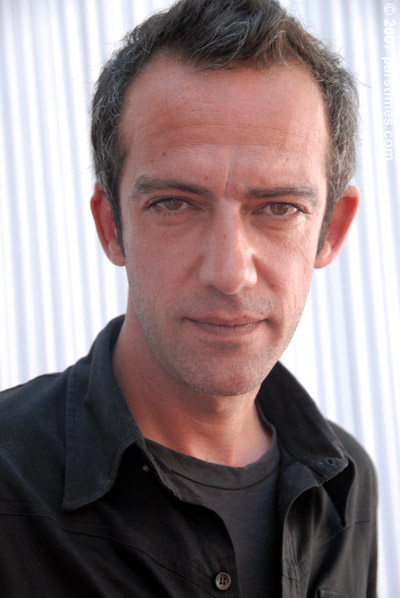
Height
5' 10" (1.78 m)
Born in Iran in 1967, Rafi Pitts spent his childhood in Tehran, where he lived, in a basement flat, underneath a Post-Production Studio. With The Cuckoo (1975), Pitts started his career as a child actor in a neo-realist film by Varuzh Karim-Masihi. In 1981, during the War between Iran and Iraq, Pitts fled the country and moved to Britain.
He graduated in 1991 from Harrow College - Polytechnic of Central London, with a BA(Hons) Degree in Film and Photography. His first short film, In Exile (1991), was presented at the London International Film Festival, in the same year. In the 90s, Pitts, moved to Paris and worked as Assistant Director. His collaborations include Leos Carax, Jean-Luc Godard, Jacques Doillon.
His second short film, Salandar (1994), shot in Russia, was inspired by the War in Bosnia, and co-produced by Nikita Mikhalkov screenwriter, Rustam Ibragimbekov. Pitts's first feature film, The Fifth Season (1997), adapted from a book by Bahram Beizai, is a comedy about feuding villagers and a Romeo Julietish romance. It was the first Franco-Iranian co-production since the Iranian Revolution.
This film was released at the 54th Venice International Film Festival in 1997. Sanam (2000), his second feature, was hailed by French critics, as the Iranian 400 Blows. In 2003, the Locarno Film Festival presented his controversial feature documentary, "Cinéma, de notre temps: Abel Ferrara: Not Guilty" (2003), produced by Janine Bazin and André S. Labarthe . It's Winter (2006), shot in Tehran, his fourth feature film, is inspired from a book by Mahmoud Dowlatabadi, (The Trip).
The story depicts the struggle to survive of a generation torn between wanting to leave its country yet bound by blood to home. This film was nominated for the Golden Bear at the 56th Berlin International Film Festival in 2006. In 2007, the Seattle International Film Festival honoured Rafi Pitts, with the Emerging Master Award.
Influenced by his Iranian and English origins, Rafi Pitts began his career as a filmmaker in London in 1991 with the short film In exile. He then returned to his roots with his first feature, The Fifth Season (1997), which represented Iran at the Venice Festival. In 2003, Locarno screened his Abel Ferrara: Not Guilty from the Janine Bazin and André S. Labarthe series Cinéma, de notre temps. This year his Zemastan (It's Winter) was presented in competition at Berlin Festival.
Director:
2000s
1990s
It's Winter (2006)
... aka It's Winter (UK) (USA: festival title)
... aka Zemestan (Iran: Farsi title)
"Cinéma, de notre temps" (1 episode, 2003)
- Abel Ferrara: Not Guilty (2003) TV Episode
Sanam (2000)
The Fifth Season (1997)
... aka Cinquième saison, La (France)
... aka Season Five (Canada: English title)
Salandar (1994)
In Exile (1991)
Writer:
2000s
1990s
It's Winter (2006)
... aka It's Winter (UK) (USA: festival title)
... aka Zemestan (Iran: Farsi title)
"Cinéma, de notre temps" (1 episode, 2003)
- Abel Ferrara: Not Guilty (2003) TV Episode
Sanam (2000)
The Fifth Season (1997)
... aka Cinquième saison, La (France)
... aka Season Five (Canada: English title)
Salandar (1994)
In Exile (1991)
Producer:
2000s
1990s
It's Winter (2006) (producer)
... aka It's Winter (UK) (USA: festival title)
... aka Zemestan (Iran: Farsi title)
Sanam (2000) (producer)
In Exile (1991) (producer)
Contre l'oubli (1991) (line producer)
... aka Écrire contre l'oubli
... aka Against Oblivion
... aka Lest We Forget
Editor:
Salandar (1994)
In Exile (1991)
Production Manager:
Amants du Pont-Neuf, Les (1991) (assistant production manager)
... aka Lovers on the Ninth Bridge (Australia: video title)
... aka Lovers on the Pont Neuf (Australia: cable TV title)
... aka The Lovers on the Bridge (USA)
Contre l'oubli (1991) (post-production supervisor)
... aka Écrire contre l'oubli
... aka Against Oblivion
... aka Lest We Forget
Actor:
Isabelle (1998 (VG) .... Georges
Casting Department:
Jeune Werther, Le (1993) (casting and director team)
... aka Young Werther
Has the positive reception to It's Winter surprised you in any way?
It's always fascinating to be met with a positive response, because when I originally made the film I wasn't thinking in terms of having an outside world see it. The story concerns us Iranians a great deal, so you can never know what someone else will feel. The realisation that the feeling you are trying to express has no borders is probably the most satisfying experience you can feel.
How do you feel about the current perception of Iranian cinema outside Iran?
What I find fascinating is that what is often called Iranian cinema outside of the country is only a fraction of our actual cinema, as we also have commercial cinema, formalist cinema and neorealist cinema. Neorealist cinema is more prominent outside Iran as it gives people a glimpse of what it's like to be there. Having said that, none of the neorealist filmmakers resemble each other in any way. For example, Kiarostami approaches his films by showing us the reality of a person and the story will stem from there. I, on the other hand, have a story and look for real emotion from there.
You've spent a significant part of your life outside Iran, having returned to it in 1997 to shoot your first feature. Do you think this has affected your perception of your country in any way?
The reason I went back in 1997 is because I feel any filmmaker has to be themselves if they wants their feelings to come through in their films. In my first film all of the characters were played by people I grew up with, even the cinematographer was my friend. I've never thought of cinema as national in any way. For me filmmaking is about points of view. Cultural backgrounds are fascinating but not the key. I also don't think at any point in the history of cinema has there been a film which someone could say represents a certain country. It only represents the point of view of a filmmaker that happened to be in a certain place at a certain time.
A common thread in your films is the presence of non-professional actors. What do you think they bring to your films that you couldn't get from someone professionally trained?
I never consciously search for a non-professional. I always look for the person, the character. The actors in my country live in a different world to the characters from my films, they don't have the same problems and they can't relate to them. Besides, you could say these people have acted all of their lives just to survive. There are moments when they are being themselves, others where they are acting out a scene. The scene, for example, where Marhab meets the girl, an otherwise well known commercial actress in Iran, is real and honest because they hadn't met before the shoot. In a way, they all somehow play parts of themselves in the film.
In It's Winter, everything is shot on location. Did you feel the presence of a camera was a barrier between you the people you were filming and working with?
For me that's the most difficult part of my job. The scene I just told you about was one of the hardest to film. The only way for the "actor" to snap out of location was to not allow him to meet the actress before the shoot. The night before the shoot, he knew she was in the hotel but wasn't allowed to meet her. Once that scene was shot, he was all over her as any normal human being meeting a famous actress would be. In this case, the moment would have been lost had they met before and there would have been no way for me to get him to act out the scene again.
Is it difficult making films in Iran nowadays?
It's not easy to make films anywhere. In Iran, for example, you have artistic freedom but then there is censorship. Abroad, I get a feeling there is economical censorship and therefore artistic freedom is limited. So it ends up being the same, just different pressures. Any filmmaker is always struggling to say what he wants to say within the boundaries given to him by the system he's in.
Do you think films like yours raise certain social issues in Iran as well as they do outside of it?
That's what I hope. I want my films to be seen in Iran so I work within the bounds of censorship. The reason I chose a commercially well-known actress as the lead was to attract the working class and show them their life, their reality. That said, I don't think filmmaking should be made for a particular group or circle only.
Is there a director that has particularly influenced you and whom you keep going back to?
Cassavettes, definitely.
What are you currently working on? Are there any plans or ideas you could reveal?
I'm still writing, I can't say anything definite. The only thing I'm sure of is that the character is someone who doesn't fit in a box because they're the ones that interest me the most and because we live in a world where marginal people are being allowed to exists less and less.
1967, Mashhad, Iran
Height
5' 10" (1.78 m)
Born in Iran in 1967, Rafi Pitts spent his childhood in Tehran, where he lived, in a basement flat, underneath a Post-Production Studio. With The Cuckoo (1975), Pitts started his career as a child actor in a neo-realist film by Varuzh Karim-Masihi. In 1981, during the War between Iran and Iraq, Pitts fled the country and moved to Britain.
He graduated in 1991 from Harrow College - Polytechnic of Central London, with a BA(Hons) Degree in Film and Photography. His first short film, In Exile (1991), was presented at the London International Film Festival, in the same year. In the 90s, Pitts, moved to Paris and worked as Assistant Director. His collaborations include Leos Carax, Jean-Luc Godard, Jacques Doillon.
His second short film, Salandar (1994), shot in Russia, was inspired by the War in Bosnia, and co-produced by Nikita Mikhalkov screenwriter, Rustam Ibragimbekov. Pitts's first feature film, The Fifth Season (1997), adapted from a book by Bahram Beizai, is a comedy about feuding villagers and a Romeo Julietish romance. It was the first Franco-Iranian co-production since the Iranian Revolution.
This film was released at the 54th Venice International Film Festival in 1997. Sanam (2000), his second feature, was hailed by French critics, as the Iranian 400 Blows. In 2003, the Locarno Film Festival presented his controversial feature documentary, "Cinéma, de notre temps: Abel Ferrara: Not Guilty" (2003), produced by Janine Bazin and André S. Labarthe . It's Winter (2006), shot in Tehran, his fourth feature film, is inspired from a book by Mahmoud Dowlatabadi, (The Trip).
The story depicts the struggle to survive of a generation torn between wanting to leave its country yet bound by blood to home. This film was nominated for the Golden Bear at the 56th Berlin International Film Festival in 2006. In 2007, the Seattle International Film Festival honoured Rafi Pitts, with the Emerging Master Award.
Influenced by his Iranian and English origins, Rafi Pitts began his career as a filmmaker in London in 1991 with the short film In exile. He then returned to his roots with his first feature, The Fifth Season (1997), which represented Iran at the Venice Festival. In 2003, Locarno screened his Abel Ferrara: Not Guilty from the Janine Bazin and André S. Labarthe series Cinéma, de notre temps. This year his Zemastan (It's Winter) was presented in competition at Berlin Festival.
Director:
2000s
1990s
It's Winter (2006)
... aka It's Winter (UK) (USA: festival title)
... aka Zemestan (Iran: Farsi title)
"Cinéma, de notre temps" (1 episode, 2003)
- Abel Ferrara: Not Guilty (2003) TV Episode
Sanam (2000)
The Fifth Season (1997)
... aka Cinquième saison, La (France)
... aka Season Five (Canada: English title)
Salandar (1994)
In Exile (1991)
Writer:
2000s
1990s
It's Winter (2006)
... aka It's Winter (UK) (USA: festival title)
... aka Zemestan (Iran: Farsi title)
"Cinéma, de notre temps" (1 episode, 2003)
- Abel Ferrara: Not Guilty (2003) TV Episode
Sanam (2000)
The Fifth Season (1997)
... aka Cinquième saison, La (France)
... aka Season Five (Canada: English title)
Salandar (1994)
In Exile (1991)
Producer:
2000s
1990s
It's Winter (2006) (producer)
... aka It's Winter (UK) (USA: festival title)
... aka Zemestan (Iran: Farsi title)
Sanam (2000) (producer)
In Exile (1991) (producer)
Contre l'oubli (1991) (line producer)
... aka Écrire contre l'oubli
... aka Against Oblivion
... aka Lest We Forget
Editor:
Salandar (1994)
In Exile (1991)
Production Manager:
Amants du Pont-Neuf, Les (1991) (assistant production manager)
... aka Lovers on the Ninth Bridge (Australia: video title)
... aka Lovers on the Pont Neuf (Australia: cable TV title)
... aka The Lovers on the Bridge (USA)
Contre l'oubli (1991) (post-production supervisor)
... aka Écrire contre l'oubli
... aka Against Oblivion
... aka Lest We Forget
Actor:
Isabelle (1998 (VG) .... Georges
Casting Department:
Jeune Werther, Le (1993) (casting and director team)
... aka Young Werther
Has the positive reception to It's Winter surprised you in any way?
It's always fascinating to be met with a positive response, because when I originally made the film I wasn't thinking in terms of having an outside world see it. The story concerns us Iranians a great deal, so you can never know what someone else will feel. The realisation that the feeling you are trying to express has no borders is probably the most satisfying experience you can feel.
How do you feel about the current perception of Iranian cinema outside Iran?
What I find fascinating is that what is often called Iranian cinema outside of the country is only a fraction of our actual cinema, as we also have commercial cinema, formalist cinema and neorealist cinema. Neorealist cinema is more prominent outside Iran as it gives people a glimpse of what it's like to be there. Having said that, none of the neorealist filmmakers resemble each other in any way. For example, Kiarostami approaches his films by showing us the reality of a person and the story will stem from there. I, on the other hand, have a story and look for real emotion from there.
You've spent a significant part of your life outside Iran, having returned to it in 1997 to shoot your first feature. Do you think this has affected your perception of your country in any way?
The reason I went back in 1997 is because I feel any filmmaker has to be themselves if they wants their feelings to come through in their films. In my first film all of the characters were played by people I grew up with, even the cinematographer was my friend. I've never thought of cinema as national in any way. For me filmmaking is about points of view. Cultural backgrounds are fascinating but not the key. I also don't think at any point in the history of cinema has there been a film which someone could say represents a certain country. It only represents the point of view of a filmmaker that happened to be in a certain place at a certain time.
A common thread in your films is the presence of non-professional actors. What do you think they bring to your films that you couldn't get from someone professionally trained?
I never consciously search for a non-professional. I always look for the person, the character. The actors in my country live in a different world to the characters from my films, they don't have the same problems and they can't relate to them. Besides, you could say these people have acted all of their lives just to survive. There are moments when they are being themselves, others where they are acting out a scene. The scene, for example, where Marhab meets the girl, an otherwise well known commercial actress in Iran, is real and honest because they hadn't met before the shoot. In a way, they all somehow play parts of themselves in the film.
In It's Winter, everything is shot on location. Did you feel the presence of a camera was a barrier between you the people you were filming and working with?
For me that's the most difficult part of my job. The scene I just told you about was one of the hardest to film. The only way for the "actor" to snap out of location was to not allow him to meet the actress before the shoot. The night before the shoot, he knew she was in the hotel but wasn't allowed to meet her. Once that scene was shot, he was all over her as any normal human being meeting a famous actress would be. In this case, the moment would have been lost had they met before and there would have been no way for me to get him to act out the scene again.
Is it difficult making films in Iran nowadays?
It's not easy to make films anywhere. In Iran, for example, you have artistic freedom but then there is censorship. Abroad, I get a feeling there is economical censorship and therefore artistic freedom is limited. So it ends up being the same, just different pressures. Any filmmaker is always struggling to say what he wants to say within the boundaries given to him by the system he's in.
Do you think films like yours raise certain social issues in Iran as well as they do outside of it?
That's what I hope. I want my films to be seen in Iran so I work within the bounds of censorship. The reason I chose a commercially well-known actress as the lead was to attract the working class and show them their life, their reality. That said, I don't think filmmaking should be made for a particular group or circle only.
Is there a director that has particularly influenced you and whom you keep going back to?
Cassavettes, definitely.
What are you currently working on? Are there any plans or ideas you could reveal?
I'm still writing, I can't say anything definite. The only thing I'm sure of is that the character is someone who doesn't fit in a box because they're the ones that interest me the most and because we live in a world where marginal people are being allowed to exists less and less.