Announcement

Collapse
No announcement yet.

Computer printer

Collapse
X
 
  • Filter
  • Time
  • Show
Clear All
new posts

  • Computer printer

    A computer printer, or more commonly just a printer, is a device that produces hard copy (permanent human-readable text and/or graphics of documents stored in electronic form, usually on physical print media such as paper or transparencies). Many printers are primarily used as computer peripherals, and are permanently attached to a computer which serves as a document source. Other printers, commonly known as network printer, have built-in network interfaces (typically wireless or Ethernet), and can serve as a hardcopy device for any user on the network. In addition, many modern printers can directly interface to electronic media such as memory sticks or memory cards, or to image capture devices such as digital cameras, scanners; some printers are combined with a scanners and/or fax machines in a single unit. A printer which is combined with a scanner can essentially function as a photocopier.

    Printers are designed for low-volume, short-turnaround print jobs; requiring virtually no setup time to achieve a hard copy of a given document. However, printers are generally slow devices (10 pages per minute is considered fast; and many consumer printers are far slower than that), and the cost-per-page is relatively high, In contrast, the printing press (which serves much the same function), is designed and optimized for high-volume print jobs such as newspaper print runs--printing presses are capable of hundreds of pages per minute or more, and have an incremental cost-per-page which is a fraction of that of printers. The printing press remains the machine of choice for high-volume, professional publishing. However, as printers have improved in quality and performance, many jobs which used to be done by professional print shops are now done by users on local printers; see desktop publishing.

    The world's first computer printer was a 19th-century mechanically driven apparatus invented by Charles Babbage for his Difference Engine.


    Printers are routinely classified by the underlying print technology they employ; numerous such technologies have been developed over the years. The choice of print engine has a substantial effect on what jobs a printer is suitable for, as different technologies are capable of different levels of image/text quality, print speed, low cost, noise; in addition, some technologies are inappropriate for certain types of physical media (such as carbon paper or transparencies).
  • #2
    Modern print technology
    The following printing technologies are routinely found in modern printers, as of April 2006:

    Toner-based printers
    Toner-based printers work in the same fashion as many photocopiers, by adhering toner to the media. The most common type of toner-based printer is the laser printer, which uses precision lasers to cause adherence. Laser printers are known for high quality prints, good print speed, and a low cost-per-copy; they are the most common printer for many general-purpose office applications. They are far less commonly used as consumer printers due to a high initial cost.

    Laser printers are available in both color and monochrome varieties.

    Another toner based printer is the LED printer which uses an array of LEDs instead of a laser to cause toner adhesion.

    Inkjet printers spray very small, precise amounts (usually a few picolitres) of ink onto the media. Inkjet printing (and the related bubble-jet technology) are the most common consumer print technology; as high-quality inkjet printers are inexpensive to produce. Virtually all modern inkjet printers are color devices; some, known as photo printers, include extra pigments to better reproduce the color gamut needed for high-quality photographic prints (and are additionally capable of printing on photographic card stock, as opposed to plain office paper).

    Inkjet printers consist of nozzles that produce very small ink bubbles that turn into tiny droplets of ink. The dots formed are the size of tiny pixels. Ink-jet printers can print high quality text and graphics. They are also almost silent in operation. Inkjet printers have a much lower initial cost than do laser printers, but have a much higher cost-per-copy, as the ink needs to be frequently replaced. In addition, consumer printer manufacturers have adapted a business model similar to that employed by manufacturers of razors; the printers themselves are frequently sold below cost, and the ink is then sold at a high markup. Various legal and technological means are employed to try and force users to only purchase ink from the manufacturer (thus leading to vendor lock-in); however there is a thriving aftermarket for such things as third-party ink cartridges (new or refurbished) and refill kits.

    Inkjet printers are also far slower than laser printers. Inkjet printers also have the disadvantage that pages must be allowed to dry before being aggressively handled; premature handling can cause the inks (which are adhered to the page in liquid form) to run.

    Comment


    • #3
      Solid Ink printers, also known as phase-change printers or crayon-jet printers, are a type of thermal transfer printer. They use solid sticks of CMYK colored ink (similar in consistancy to candle wax), which are melted and fed into a piezo crystal operated print-head. The printhead sprays the ink on a rotating, oil coated drum. The paper then passes over the print drum, at which time the image is transferred, or transfixed, to the page.

      Solid Ink printers are most commonly used as color office printers, and are excellent at printing on transparencies and other non-porous media. Solid inkjet printers can produce excellent results, and are commonly found in office environments. Acquisition and operating costs are similar to laser printers. Drawbacks of the technology include high power consumption and long warm-up times from a cold state. Also, some users complain that the resulting prints are difficult to write on (the wax tends to repel inks from pens), and are difficult to feed through Automatic Document Feeders, however these traits have been significantly reduced in later models. In addition, this type of printer is only available from one manufacturer, Xerox, manufactured as part of their Phaser office printer line. Previously, solid inkjet printers were manufactured by Tektronix, but Tek sold the printing business to Xerox in 2000.

      A dye-sublimation printer (or dye-sub printer) is a printer which employs a printing process that uses heat to transfer dye to a medium such as a plastic card, printer paper or poster paper. The process is usually to lay one color at a time using a ribbon that has color panels. Dye-sub printers are intended primarily for high-quality color applications, including color photography; and are less well-suited for text. While once the province of high-end print shops, dye-sublimation printers are now increasingly used as dedicated consumer photo printers.

      Comment


      • #4
        Dot-matrix printers

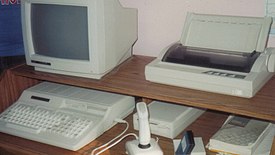
        In the general sense many printers rely on a matrix of pixels, or dots, that together form the larger image. However, the term dot matrix printer is specifically used for impact printers that use a matrix of small pins to create precise dots. The advantage of dot-matrix over other impact printers is that they can produce graphical images in addition to text; however the text is generally of poorer quality than impact printers that use letterforms (type).


        Dot-matrix printers can be broadly divided into two major classes:

        Ballistic wire printers (discussed in the dot matrix printers article)
        Stored energy printers
        Dot matrix printers can either be character-based or line-based (that is, a single horizontal series of pixels across the page), referring to the configuration of the print head.

        At one time, dot matrix printers were one of the more common types of printers used for general use - such as for home and small office use. Such printers would have either 9 or 24 pins on the print head. 24 pin print heads were able to print at a higher quality. Once the price of inkjet printers dropped to the point where they were competitive with dot matrix printers, dot matrix printers began to fall out of favor for general use.

        Some dot matrix printers, in example the NEC P6300, can be upgraded to print in color. This is achieved through the use of a four-color ribbon mounted on a mechanism (provided in an upgrade kit that replaces the standard black ribbon mechanism after installation) that rises and lowers the ribbons as needed. Color graphics are generally printed in 4 passes at standard resolution, thus slowing down printing considerably. As a result, color graphics can take up to 4 times longer to print than standard monochrome graphics, or up to 8-16 times as long at high resolution mode.

        Dot matrix printers are still commonly used in low-cost, low-quality applications like cash registers, or in demanding, very high volume applications like invoice printing. The fact that they use an impact printing method allows them to be used to print multi-part documents using carbonless copy paper (like sales invoices and credit card receipts), whereas other printing methods are unusable with paper of this type. Dot-matrix printers are now (as of 2005) rapidly being superseded even as receipt printers.

        Comment


        • #5
          eyvall taze inja omadam chizai bahalia darbareye computer
          Nicknamam Awaz shode Az Afshin_dubai_8 Shode be Atef_Dubai

          Comment

          Working...
          X