Announcement

Collapse
No announcement yet.

What Happend To Yaser Arafat ?

Collapse
X
 
  • Filter
  • Time
  • Show
Clear All
new posts

  • What Happend To Yaser Arafat ?

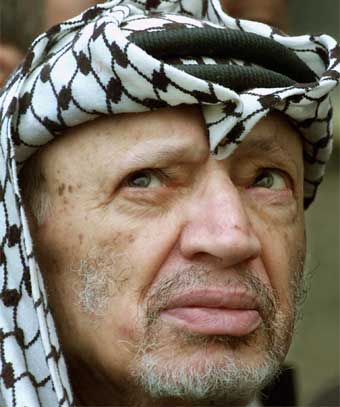
    Was Yasser Arafat assassinated ?


    Haemorrhage killed Arafat

    A "MASSIVE brain haemorrhage" killed Yasser Arafat, the Palestinian leader, last year, although it remains unclear what led to the rapid deterioration in his health, according to French medical records made public yesterday.

    The records, from the Percy Military Training Hospital in Paris, where Mr Arafat died last November, offered the first independent glimpse of Arafat's final days.

    Mr Arafat's wife, Suha, and Palestinian officials have never given a definitive cause of death and kept the leader's medical records a closely guarded secret. Ms Arafat also rejected calls for an autopsy.

    The medical dossier was initially obtained by the New York Times and two Israeli media outlets, which conducted separate reviews of the information.

    "The mystery around Yasser Arafat will only grow bigger and bigger after reading this report," said Avi Isacharoff, the Israel Radio reporter who obtained the medical records with the Israeli daily Haaretz.

    The Palestinian foreign minister, Nasser al-Kidwa, a nephew of Mr Arafat and one of the few people who had access to him and his doctors in France, said the new reports shed no new light and the cause of death remains unknown.

    Mr Arafat, 75, fell ill in his compound in the West Bank town of Ramallah a month before his death.

    He spent his last two weeks in the French hospital.

    According to French doctors, Mr Arafat developed a digestive ailment about 30 days before he died. He also suffered an "acute" case of a blood disorder, disseminated intravascular coagulation.

    Senior Palestinian officials have accused Israel of poisoning their leader - an allegation Israeli officials reject.

    "Israel was not in any way involved in what happened with Arafat. The Palestinians know this, the Arabs know this, Arafat's family knows this," said Silvan Shalom, the Israeli foreign minister.

    "But it's always convenient for certain people to heap accusations on Israel." He urged the French doctors and Ms Arafat to make the records public.

    Mr Arafat became ill with nausea, abdominal pain and diarrhoea after eating dinner . The symptoms continued for more than two weeks before he was evacuated to France. He died on 11 November.

    But...

    Two years after the death of Yasser Arafat , that the Sharon General presented like the principal obstacle at peace, the dead end is total : not only Israel continues colonization, but the everyday life of the Palestinians remains very difficult - even in the prison which became Gaza " released ". Worse : the civil war that the raïs wanted to avoid threat. It is in this context that the media evoke the assumption of a poisoning...
    6
    Yes,By Israel (was poisoned)
    33.33%
    2
    Yes,By U.S.A (deceased AIDS)
    0.00%
    0
    No,He Died Because,He was Very Sick
    33.33%
    2
    I Don't Know
    33.33%
    2
    Last edited by Rasputin; 11-14-2006, 12:16 PM.

  • #2
    President of the Palestinian Authority (AP) and the Palestine Liberation Organization (PLO), Yasser Arafat died out just a year ago, November 11, 2004, at 3. 30 of the morning, the military hospital Percy, in Clamart, in the south of Paris. Admittedly, the state of Abou Ammar - as call it the Palestinians - had brutally worsened during last weeks. Admittedly also, the seat by the Israeli army of its headquarters of Mouqata' has, with Ramallah, since December 2001, had constrained it to live under psychological and physical conditions extremely testing. But, for many Palestinian leaders, who made state of it publicly, among the Arab opinions and beyond, the business was heard : the raïs had been poisoned by the Israelis. It is also the opinion of its personal doctor (Jordanian), Dr. Ashraf Al-Kourdi.

    With what was up to that point only one intimate conviction and a rumour, the Israeli media brought, these last weeks, a certain credibility : they considered the possibility of a " liquidation " of the Palestinian president. This brutal term was employed, for example, September 30, 2005, by Yoram Binur, the correspondent for the occupied territories of the second chain of television.

    Three weeks earlier, the weekly supplement of the daily newspaper Haaretz had titrated : " Arafat is deceased AIDS or was poisoned ". But, in their article, the journalists Amos Harel and Avi Isacharoff, quoting an Israeli expert, qualified " very small " possibility that Arafat contracted the AIDS, while stressing that, for many doctors, the symptoms rather made think of a poisoning. In a work published in October 2005 in Paris and heading the Seventh War of Israel , these two authors consider in fact, without slicing between them, three assumptions : poisoning, AIDS or simple infection. And one of the joint authors, in deprived, privileges the first...

    Comment


    • #3
      " A dead man who walks "


      What said the doctors of the hospital Percy, one of best in Europe as regards hematology ? Signed on November 19, 2004 by the head doctor of the services, Dr. Bruno Pats, the confidential medical report/ratio concluded : " At the thirteenth day of its hospitalization at the hospital of instruction of the Percy armies and with the eighth day of its hospitalization in the intensive care unit, M. Yasser Arafat is deceased of a massive hemorrhagic cerebral accident vascular. This cerebral haemorrhage complicated a clinical picture gathering four syndromes (...). the consultation of a great number of multiple experts of specialities and the results of the examinations carried out did not make it possible to retain a framework nosologic explaining the association of the syndromes. "

      This medical " blur" is not the single base of the rumour launched by the Palestinians : those are also based on the intention openly posted by Israeli the Prime Minister, M. Ariel Sharon, to eliminate Yasser Arafat. From spring 2002, the Sharon General threatens again. Only the promise which it had to make to president George W. Bush prevents it from passing to the act. At the time of the Jewish New Year 2004, the Prime Minister hammers : " Arafat will be expelled of the territories. "Expelled or killed ? M. Sharon points out that Israel killed Sheik Ahmed Yassin, spiritual chief of Hamas, then her successor Abdel Aziz Al-Rantissi. Is there a difference between Arafat, Yassin and Rantissi ? Answer : " I do not see any of it. Just like we acted against these assassins, we will act against Arafat . "

      At the beginning of November 2004, the journalist Ouri daN, a confidant of the Prime Minister, writes that the latter " announced to Bush that it was not considered more as committed by what it had promised to him at the time of their first meeting in March 2001 : not to carry reached to Arafat. President Bush pointed out that it is perhaps preferable to leave the fate of Arafat between the hands of the Almighty, with what Sharon answered that sometimes the Almighty had to be helped ".

      In Mouqata' has, one had all the more taken with serious the these declarations that the unit of elite of the Israeli army, Sayeret Matkal, was involved for a possible attack of the HQ of Arafat and, if necessary, for the liquidation of this one. The Sharon General would have even attended the one of these exercises. And no one is not unaware of that its great regret is " to have missed " Arafat at the time of the seat by Beirut, in 1982. The Minister for defense Shaul Mofaz and the Sylvan Shalom Foreign Minister also recommended his elimination. And the military correspondent of the second chain, Rony Daniel, described Yasser Arafat like " a dead man who walks "...

      Also convincing it, the will of the Israeli leaders is to get rid of the Palestinian chief would not know, with it only, to show poisoning. It is thus necessary to return to the health of the raïs.

      August 18, 2004, I personally attended the speech of president Arafat in front of the Palestinian legislative Council, joined together in Mouqata' has. Two hours during, it reviewed the problems of the hour, repeating two or three times - as with its practice - the sentence-keys of its intervention. Upright, the strong voice, it did not have the sick air.

      September 28, at the time of the fourth birthday of Intifada Al-Aqsa, I re-examine it for the last time. It greets me with the usual accodance and takes my news. " All is well, Al-hamdou Li-llah, but you, Abou Ammar, you lost much weight in little time. " Its face is thinned down, and it seems to float in its clothing. " It is nothing ", answers it. During the lunch, it actively takes share with the conversation while eating - as always - very little. Suddenly, its Nabil Abou Roudeina spokesman slips to me with the ear : " It is to better finish, because Abou Ammar needs to rest. " Arafat embraces me again, and we separate.

      Comment


      • #4
        In October, its health is degraded. The 12, four hours after the dinner, it starts to suffer from evils of belly, vomiting and diarrhoeas. Looked after for an intestinal influenza, it does not react to the drugs. The examinations of blood reveal that the number of plates is very low, but that of the leucocytes stable. 27, sudden aggravation : it loses consciousness during fifteen minutes. The ex-minister of the culture Yasser Abed Rabbo, which has just visited him, entrusts to me : " Its state is very serious, very serious. "

        The following day arrive of the Egyptian doctors, then Tunisian and finally Jordanian. Not managing to determine the origin of the evil, they suggest transferring the patient towards a French hospital. The Elysium gives its agreement immediately. The Sharon General, by the means of his principal private secretary Dov Weissglas, accepts not only his departure, but also its return once cured, and, by a strange reversal, proposes to send Israeli doctors in Paris. October 29, in the morning, its assistants transport Abou Ammar of the building in which it had been locked up for thirty-five month in one of the two helicopters sent by Jordan. Instead of its eternal keffieh, the raïs wears a hat of fur and smiles curiously : it is not the Arafat whom I know since our first meeting in August 1982, in Beirut-West besieged. Tears run on the cheeks of its close relations when the helicopter flies away for Amman, from where a French military medical plane takes along it to Paris.

        To Clamart, it arrives conscious, but very weakened. The first examinations highlight neither leukaemia nor tumours, but a serious ignition of the digestive tract, that the doctors fight with strong antibiotic amounts and anti-inflammatory drugs. Its state improves : it goes a little in its room, speaks with the telephone with president Jacques Chirac and several Palestinian leaders. But, November 3, it sinks suddenly in the coma. It suffers from a series of serious symptoms, allotted to an unknown toxin that the French doctors do not manage to detect. Only a miracle can save it, known as its entourage. Two weeks after his arrival, president Yasser Arafat closes the eyes for always.

        To explain this sudden death, the Israeli press, it was seen, evoked three causes : infection, AIDS or poisoning. The thesis of the infection misses medical base : no French, Palestinian doctor, Egyptian, Tunisian nor Jordanian affirmed to have discovered a trace of infection at the time of the examinations. There moreover, if such had been the cause of its disease, Arafat could have faced the assistance of antibiotics.

        The thesis of the AIDS seems to be advanced at only end to dirty the image of the raïs. Because the article already quoted of Haaretz does not bring the least convincing element. An investigation of new York Times excluded from start this assumption. The French doctors do not even mention it. The Tunisian doctors carried out a test HIV : negative. " It is inconceivable, ensures an Israeli expert, that a disease which lasted two weeks, with terrible diarrhoeas, vomiting violent one, serious problems of the digestive system, and which produced serious phenomena of coagulation was caused by the AIDS . " Actually, no medical document mentions this disease, reveals Dr. Al-Kourdi, personal doctor of Arafat during more than twenty years.

        Poisoning ? The Israeli authorities qualify the " stupid ones " and " evil disposed " such charges. Palestinian side, one recalls the attempted murder in Amman, September 25, 1997, of one of the leaders of Hamas, M. Khaled Meshal : two agents of Mossad had injected to him, in full street, a poison in the ear. Insane of rage, king Hussein required that Israel provide the antidote immediately, or else it would take the responsability for a major crisis between the two countries. The Prime Minister Benyamin Nétanyahou agreed to deliver the antidote and, to calm the play, released seventy Palestinian prisoners, of which Cheikh Yassin.

        Comparison is not reason : the doctors of the Percy hospital affirm, in their report/ratio, not to have found traces of known poison. They, in addition, asked two other laboratories - those of the gendarmerie and the armies - to seek some : in vain. However, certain experts estimate that one can easily manufacture not indexed toxic products, from which some disappear after having made their effect...

        Israeli leaders, of which M. Ehoud Barak, consider the physical elimination of the Palestinian president only if this one does not leave " any Israeli print ". From where the recourse to a undetectable poison : " It is undoubtedly what occurred ", it ensures. A raftered Israeli journalist, who also prefers to preserve anonymity to him, told with several fellow-members that, hardly the disease of the Palestinian chief known, it was persuaded that the raïs had been poisoned. More : three personalities of the sector of safety would have discussed with him, separately, of the best method to be used to finish some with Arafat, and would have arrived at the same conclusion : the poison. It was at the beginning of 2004...

        Doctor of the kings hachémites, Jordanian Ashraf Al-Kourdi also followed Abou Ammar, of which he was familiar with by c?ur the medical case. He also, little after the death of its patient, stated to perceive indices of poisoning. It had examined Arafat during the critical phase of its disease, before its transfer in France, and was unaware of all the blood problems which would have embanked it. This is why it required the creation of an independent board of inquiry to proceed finally to an autopsy which would determine the causes of its death. Pains in the kidneys and the stomach, total absence of appetite, reduction in the plates, considerable loss of weight, red spots on the face, yellow skin : " Any doctor will say to you that they are there symptoms of poisoning . " Only such a commission would allow, indeed, to know if, yes or not, Arafat died assassinated .

        Yasser Arafat wished to be buried in Jerusalem on the esplanade of the Mosques, third holy place of Islam. The Israeli authorities being opposed to it, the Palestinian direction chose Mouqata' has, theatre of the last stage of the fight of Abou Ammar for the creation of an independent Palestinian State. Is a tomb of the " father " of the nation in his HQ devastated by an occupying army, there - his/her fellow travellers underline - more poignant symbol ? As of the following day of funerals, innumerable Palestinians, individuals and groups, tourists and hosts official, undertook to carry out a kind of pilgrimage there.

        The heritage of Yasser Arafat, said in February 2005 the French Minister for the Foreign Affairs of the time, M. Michel Barnier, at the time of a visit in Mouqata' has, belongs to the Palestinian people and to the history. But Israelis ? " They are deluded with illusions if they believe that their aimings will be carried out in after-Arafat ", Palestinian the Prime Minister Ahmad declared. And to add : " One day, they will regret Arafat. "

        Comment


        • #5
          Aftermath


          Comment


          • #6
            The Death of Arafat


            By George Friedman


            That Yasser Arafat's death marks the end of an era is so obvious that it hardly bears saying. The nature of the era that is ending and the nature of the era that is coming, on the other hand, do bear discussing. That speaks not only to the Arab-Israeli conflict but to the evolution of the Arab world in general.

            In order to understand Arafat's life, it is essential to understand the concept "Arab," and to understand its tension with the concept "Muslim," at least as Arafat lived it out. In general, ethnic Arabs populate North Africa and the area between the Mediterranean and Iran, and between Yemen and Turkey. This is the Arab world. It is a world that is generally -- but far from exclusively -- Muslim, although the Muslim world stretches far beyond the Arab world.

            To understand Arafat's life, it is much more important to understand the Arab impulse than to understand the Muslim impulse. Arafat belonged to that generation of Arab who visualized the emergence of a single Arab nation, encapsulating all of the religious groups in the Arab world, and one that was essentially secular in nature. This vision did not originate with Arafat but with his primary patron, Gamal Abdul Nasser, the founder of modern Egypt and of the idea of a United Arab Republic. No sense can be made of Arafat's life without first understanding Nasser's.

            Nasser was born into an Egypt that was ruled by a weak and corrupt monarchy and effectively dominated by Britain. He became an officer in the Egyptian army and fought competently against the Israelis in the 1948 war. He emerged from that war committed to two principles: The first was recovering Egyptian independence fully; the second was making Egypt a modern, industrial state. Taking his bearing from Kamal Ataturk, who founded the modern Turkish state, Nasser saw the military as the most modern institution in Egypt, and therefore the instrument to achieve both independence and modernization. This was the foundation of the Egyptian revolution.

            Nasser was personally a practicing Muslim of sorts -- he attended mosque -- but he did not see himself as leading an Islamic revolution at all. For example, he placed numerous Coptic Christians in important government positions. For Arafat, the overriding principle was not Islam, but Arabism. Nasser dreamed of uniting the Arabs in a single entity, whose capital would be Cairo. He believed that until there was a United Arab Republic, the Arabs would remain the victims of foreign imperialism.

            Nasser saw his prime antagonists as the traditional monarchies of the Arab world. Throughout his rule, Nasser tried to foment revolutions, led by the military, that would topple these monarchies. Nasserite or near-Nasserite revolutions toppled Iraqi, Syrian and Libyan monarchies. Throughout his rule, he tried to bring down the Jordanian, Saudi and other Persian Gulf regimes. This was the constant conflict that overlaid the Arab world from the 1950s until the death of Nasser and the rise of Anwar Sadat.

            Geopolitics aligned Nasser's ambitions with the Soviet Union. Nasser was a socialist but never a Marxist. Nevertheless, as he confronted the United States and threatened American allies among the conservative monarchies, he grew both vulnerable to the United States and badly in need of a geopolitical patron. The Soviets were also interested in limiting American power and saw Nasser as a natural ally, particularly because of his confrontation with the monarchies.

            Nasser's view of Israel was that it represented the intrusion of British imperialism into the Arab world, and that the conservative monarchies, particularly Jordan, were complicit in its creation. For Nasser, the destruction of Israel had several uses. First, it was a unifying point for Arab nationalism. Second, it provided a tool with which to prod and confront the monarchies that tended to shy away from confrontation. Third, it allowed for the further modernization of the Egyptian military -- and therefore of Egypt -- by enticing a flow of technology from the Soviet Union to Egypt. Nasser both opposed the existence of Israel and saw its existence as a useful tool in his general project.

            It is important to understand that for Nasser, Israel was not a Palestinian problem but an Arab problem. In his view, the particular Arab nationalisms were the problem, not the solution. Adding another Arab nationalism -- Palestinian -- to the mix was not in his interest. The Zionist injustice was against the Arab nation and not against the Palestinians as a particular nation. Nasser was not alone in this view. The Syrians saw Palestine as a district of Syria, stolen by the British and French. They saw the Zionists as oppressors, but against the Syrian nation. The Jordanians, who held the West Bank, saw the West Bank as part of the Jordanian nation and, by extension, the rest of Palestine as a district of Jordan. Until the 1967 war, the Arab world was publicly and formally united in opposing the existence of Israel, but much less united on what would replace Israel after it was destroyed. The least likely candidate was an independent Palestinian state.

            Prior to 1967, Nasser sponsored the creation of the Palestine Liberation Organization under the leadership of Ahmed al Shukairi. It was an entirely ineffective organization that created a unit that fought under Egyptian command. Since 1967 was a disaster for Nasser, "fought" is a very loose term. The PLO was kept under tight control, careful avoiding the question of nationhood and focusing on the destruction of Israel.

            After the 1967 war, the young leader of the PLO's Fatah faction took control of the organization. Yasser Arafat was a creature of Nasser, politically and intellectually. He was an Arabist. He was a modernizer. He was a secularist. He was aligned with the Soviets. He was anti-American. Arafat faced two disparate questions in 1967. First, it was clear that the Arabs would not defeat Israel in a war, probably in his lifetime; what, therefore, was to be done to destroy Israel? Second, if the only goal was to destroy the Israelis, and if that was not to happen anytime soon, then what was to become of the Palestinians? Arafat posed the question more radically: Granted that Palestinians were part of the Arab revolution, did they have a separate identity of their own, as did Egyptians or Libyans? Were they simply Syrians or Jordanians? Who were they?

            Asserting Palestinian nationalism was not easy in 1967, because of the Arabs themselves. The Syrians did not easily recognize their independence and sponsored their own Palestinian group, loyal to Syria. The Jordanians could not recognize the Palestinians as separate, as their own claim to power even east of the Jordan would be questionable, let alone their claims to the West Bank. The Egyptians were uneasy with the rise of another Arab nationalism.

            Comment


            • #7
              Simultaneously, the growth of a radical and homeless Palestinian movement terrified the monarchies. Arafat knew that no war would defeat the Israelis. His view was that a two-tiered approach was best. On one level, the PLO would make the claim on behalf of the Palestinian people, for the right to statehood on the world stage. On the other hand, the Palestinians would use small-scale paramilitary operations against soft targets -- terrorism -- to increase the cost throughout the world of ignoring the Palestinians.

              The Soviets were delighted with this strategy, and their national intelligence services moved to facilitate it by providing training and logistics. A terror campaign against Israel's supporters would be a terror campaign against Europe and the United States. The Soviets were delighted by anything that caused pain and destabilized the West. The cost to the Soviets of underwriting Palestinian operations, either directly or through various Eastern European or Arab intelligence services, was negligible. Arafat became a revolutionary aligned with the Soviets.

              There were two operational principles. The first was that Arafat himself should appear as the political wing of the movement, able to serve as an untainted spokesman for Palestinian rights. The second was that the groups that carried out the covert operations should remain complex and murky. Plausible deniability combined with unpredictability was the key.

              Arafat created an independent covert capability that allowed him to make a radical assertion: that there was an independent Palestinian people as distinct as any other Arab nation. Terrorist operations gave Arafat the leverage to assert that Palestine should take its place in the Arab world in its own right.

              If Palestine was a separate nation, then what was Jordan? The Ha-shemite kingdom were Bedouins driven out of Arabia. The majority of the population were not Bedouin, but had their roots in the west - hence, they were Palestinians. If there was a Palestinian nation, then why were they being ruled by Bedouins from Arabia? In September 1970, Arafat made his move. Combining a series of hijackings of Western airliners with a Palestinian rising in Jordan, Arafat attempted to seize control of Jordan. He failed, and thousands of Palestinians were slaughtered by Hashemite and Pakistani mercenaries. (Coincidentally, the military unit dispatched to Jordan was led by then-Brigadier Zia-ul-Haq, who later ruled Pakistan from 1977 to 1988 as a military dictator.)

              Arafat's logic was impeccable. His military capability was less than perfect.

              Arafat created a new group -- Black September -- that was assigned the task of waging a covert war against the Israelis and the West. The greatest action, the massacre of Israeli athletes at the Munich Olympics in 1972, defined the next generation. Israel launched a counter-operation to destroy Black September, and the pattern of terrorism and counter-terrorism swirling around the globe was set. The PLO was embedded in a network of terrorist groups sponsored by the Soviets that ranged from Japan to Italy. The Israelis became part of a multinational counter-attack. Neither side could score a definitive victory.

              But Arafat won the major victory. Nations are frequently born of battle, and the battles that began in 1970 and raged until the mid-1990s established an indelible principle -- there is now, if there was not before, a nation called Palestine. This was critical, because as Nasser died and his heritage was discarded by Anwar Sadat, the principle of the Arab nation was lost. It was only through the autonomous concept of Palestinian nationalism that Arafat and the PLO could survive.

              And this was Arafat's fatal crisis. He had established the principle of Palestine, but what he had failed to define was what that Palestinian nation meant and what it wanted. The latter was the critical point. Arafat's strategy was to appear the statesman restraining uncontrollable radicals. He understood that he needed Western support to get a state, and he used this role superbly. He appeared moderate and malleable in English, radical and intractable in Arabic. This was his insoluble dilemma.

              Arafat led a nation that had no common understanding of their goal. There were those who wanted to recover a part of Palestine and be content. There were those who wanted to recover part of Palestine and use it as a base of operations to retake the rest. There were those who would accept no intermediate deal but wanted to destroy Israel. Arafat's fatal problem was that in the course of creating the Palestinian nation, he had convinced all three factions that he stood with them.

              Like many politicians, Arafat had made too many deals. He had successfully persuaded the West that (a) he genuinely wanted a compromise and (b) that he could restrain terrorism. But he had also persuaded Palestinians that any deal was merely temporary, and others that he wouldn't accept any deal. By the time of the Oslo accords, Arafat was so tied up in knots that he could not longer speak for the nation he created. More precisely, the Palestinians were so divided that no one could negotiate on their behalf, confident in his authority. Arafat kept his position by sacrificing his power.

              By the 1990s, the space left by the demise of pan-Arabism had been taken by the rise of Islamist religiosity. Hamas, representing the view that there is a Palestinian nation but that it should be understood as part of the Islamic world under Islamic law, had become the most vibrant part of the Palestinian polity. Nothing was more alien from Arafat's thinking than Hamas. It ran counter to everything he had learned from Nasser.

              However -- and this is Arafat's tragedy -- by the time Hamas emerged as a power, he had lost the ability to believe in anything but the concept of the Palestinians and his place as its leader. As Hamas rose, Arafat became entirely tactical. His goal was to retain position if not power, and toward that end, he would do what was needed. A lifetime of tactics had destroyed all strategy.

              His death in Paris was a farce of family and courtiers. It fitted the end he had created, because his last years were lived in a round of clever maneuvers leading nowhere. The Palestinians are left now without strategy, only tactics. There is no one who can speak for the Palestinians and be listened to as authoritative. He created the Palestinian nation and utterly disrupted the Palestinian state. He left a clear concept on the one hand, a chaos on the other.

              It is interesting to wonder what would have happened if Arafat had won in Jordan in 1970, while Nasser was still alive. But that wasn't going to happen, because Arafat's fatal weakness was visible even then. The concept was clear -- but instead of meticulously planning a rising, Arafat improvised, playing politics within the PLO when he should have been managing combat operations. The chaos and failure that marked Black September became emblematic of his life.

              Arafat succeeded in one thing, and perhaps that is enough -- he created the Palestinian nation against all enemies, Arab and non-Arab. The rest was the endless failure of pure improvisation.

              Comment


              • #8
                he was a scum piec of shatoo who was a two face fundu
                he stole money from eveyone especialy money from his own people the palastinians and gave it to his french girl friend to spend it
                he preached peace in one hand and called for jihad in the other
                we love you yasser arafat we love you
                he rejected the best deals the palastininas has ever gotton at camp david and chose to fight instead hahhahahahahahhahahahahah
                we love you arafat we love you


                G-d determines who walks into your life....It is up to you to decide who you let walk away, who you let stay, and who you refuse to let go.


                Comment


                • #9
                  hey probably had aids thogh

                  two bad israeli didnt assasinate him at the begening
                  that way their would be no waist of time


                  G-d determines who walks into your life....It is up to you to decide who you let walk away, who you let stay, and who you refuse to let go.


                  Comment


                  • #10
                    Palestinian government determined to unmask the causes of Arafat's death

                    Comment


                    • #11
                      Redwine, my Man, tanx for the (collection) work. I have been looking around in this site and everywhere I look I find quite a lot of educating quality stuffs and consequently lots of work (collecting and publishing). I must say that in an university scale you deserve a PhD, (if you already don't have one). keep the good work. There are lots of silent ppl. around who are eager to learn and so appriciate your work, even if they do not mention it. Cheers &Peace bro.
                      YOU! Wake up.

                      Comment


                      • #12

                        Comment


                        • #13
                          سر سختی عرفات


                          می گفتند عرفات آدم سازشکاری بوده ولی معلوم می شود انصافا در مذاکرات مقاومت جدی می کرد. در سالروز درگذشت عرفات این خاطره خواندنی است.

                          کلینتون از آخرین مذاکرات عرفات و باراک چنین روایت می کند:

                          "علیرغم اینکه فضای گفتگوها خوب بود، ولی نمی توانستیم بگوییم که رابطه بین عرفات و باراک هم همین طور است. من آنها را در اتاقهایی نزدیک به خود جای داده بودم و هر روز با آنها ملاقات می کردم، ولی آن دو نفر به دیدن یکدیگر نمی رفتند. عرفات همچنان ناراضی بود، باراک نمی خواست با عرفات تنها ملاقات کند، می ترسید به موضوعاتی قدیمی که باراک در مورد آنها کوتاه آمده بود، بپردازد. اهود بیشتر روز را در اتاق خود سر می کرد، و زمان را بیشتر پشت تلفن در تماس با اسرائیل می گذراند تا بتواند ائتلاف را در کنار یکدیگر نگاه دارد.

                          تفاوت های فرهنگی کار گروه ما را مشکل ساخته بود. آنها راهکارهای بسیاری برای از بین بردن این بن بست ها ارائه دادند و برخی از این راهکارها نیز پس از اینکه نمایندگان برای کار روی مسائل خاصی به گروههای مختلف تقسیم می شدند تعیین می شد، ولی هیچ یک از طرفین اجازه نداشت از نقطه مشخصی فراتر برود.

                          زمانی که فلسطینی ها در عوض اقداماتی که باراک در مورد اورشلیم و مرزها انجام داده بود هیچ کاری انجام ندادند، به دیدن عرفات رفتم. جلسه سختی بود و با این گوشزد به عرفات که بدون تردید به این مذاکرات پایان خواهم داد و خواهم گفت که عرفات مذاکره را خراب کرده است، مگر این که پیشنهادی به من ارائه بدهد تا برای باراک که درها را گشوده است ببرم، به جلسه پایان دادم. پس از مدت کوتاهی عرفات نامه ای به من داد حاکی از اینکه اگر باراک در مورد مسأله اورشلیم توافق کند، من می توانم آخرین پیشنهاد خود را در مورد مقدار زمینی که اسرائیلی ها برای خود نگاه داشته اند، ارائه دهم. نامه را نزد باراک بردم و زمان زیادی را صرف صحبت با او کردم.

                          سرانجام، ساعتی پس از نیمه شب، باراک همراه با پیشنهاداتی نزد من آمد. عجز و نا توانی او را در برابر عرفات درک می کردم، ولی نمی توانستم کاری انجام بدهم. این ماجرا می توانست تبدیل به فاجعه ای شود. این را به او گفتم. تا ساعت دو ونیم صبح صحبت کردیم. ساعت سه و ربع، بازگشت و یک ساعت دیگر تنها در پشت ایوان اتاق من، با یکدیگر حرف زدیم.

                          صبح روز هشتم، با انگیزه و امیدوار بودم؛ با انگیزه بودم، چون اجلاس گروه 8 در اوکیناوا برگزار می شد و مجبور بودم کمپ دیوید را ترک کنم، اما امیدوار بودم زیرا باراک اشتیاق فوق العاده نشان می داد.

                          عزیمت به اوکیناوا را یک روز به تعویق انداختم و با عرفات ملاقات کردم. عرفات در برابر عدم تسلط بر اورشلیم شرقی از جمله کوه های تمپل سر سختانه ایستادگی می کرد. پیشنهاد را رد کرد و من از او خواستم در مورد این مسأله فکر کند. از رهبران عرب دعوت کردم از ما حمایت کنند. بیشتر آنها چیزی نمی گفتند زیرا از عرفات می ترسیدند.

                          روز نهم، مهمترین تیر را به عرفات زدم. اسرائیل بیشتر از حد لازم امتیاز داده بود و عرفات حتی حاضر نبود حرکتهای آنها را به عنوان اصولی برای مذاکرات آینده بپذیرد. بار دیگر از رهبران عرب کمک خواستم. ملک عبد الله و رئیس جمهور تانزانیا بن علی کوشیدند عرفات را راضی کنند. آنها به من گفتند او از مصالحه می ترسد. این گونه به نظر می آمد که همه گفتگو ها بی فایده است."

                          Comment

                          Working...
                          X