Announcement

Collapse
No announcement yet.

Persian Art

Collapse
X
 
  • Filter
  • Time
  • Show
Clear All
new posts

  • Persian Art

    The long prehistoric period in Iran, is known to us mostly from excavation work carried out in a few key sites, which has led to a chronology of distinct periods, each one characterised by the development of certain types of pottery, artefacts and architecture. Pottery is one of the oldest Persian art forms, and examples have been unearthed from burial mounds (Tappeh), dating back from the 5th millennium BC.

    The "Animal style" which uses decorative animal motifs is very strong in the Persian culture first appearing in pottery, reappearing much later in the Luristan bronzes and again in Scythian art.

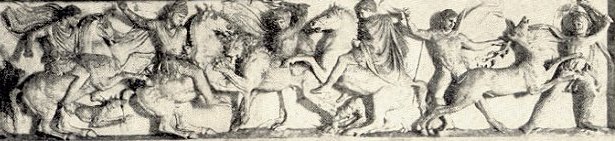
    During the Achaemenian and Sassanian periods, metal-work continued its ornamental development. Some of the most beautiful examples of metal-ware are gilded silver cups and dishes decorated with royal hunting scenes from the Sassanian Dynasty.

    The earliest known distinctive style of Persian painting dates back to the Seljuk period, which is often referred to as the "Baghdad School". Early painting was mainly used to decorate manuscripts and versions of the Holy Koran, though some 13th century pottery found near Tehran indicates an early, unique Persian style of art. During the Mongol period, paintings were used to decorate all sorts of books.

    Persian architecture has a very long and complex history, and is often regarded as the field in which Persia made its greatest contribution to the world's culture. Although Persian styles differ sharply from any other Islamic architecture, they have strongly influenced buildings throughout much of the Islamic world, especially in Central Asia, Afghanistan, Pakistan and India.

    The art of the Iranian world from its earliest beginnings exhibited a constant and unmistakable characteristic, in spite of the many trends and currents and the abundance of foreign influences.

  • #2
    NEOLITHIC

    The inhabitants of the Iranian plateau lived on the mountains encircling it, as the central depression, now a desert was filled with water at that time. Once the water receded, man descended into the fertile valleys, and set up settlements.

    Tappeh Sialk, near Kashan, was the first site to reveal Neolithic art. During this period, coarse potter's tools resulted in crude pottery and on these large irregularly shaped bowls horizontal and vertical lines were drawn imitating basket work.

    Over the years the potter's tools improved, and goblets, red in colour appeared, on which a series of birds, boars and ibexes (wild mountain goats) were drawn in simple black lines.


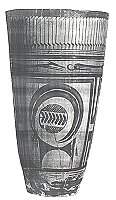
    The high point in the development of prehistoric Iranian painted pottery occurred around the fourth millennium BC. Several examples have survived, such as the painted Beaker from Susa c. 5000-4000 B.C which is today on display in the Louvre, Paris. The patterns on this beaker are highly stylized. The body of the ibex is reduced to two triangles and has become a mere appendage of the huge horns, the racing hounds above the ibex are little more than horizontal streaks while the waders circulating the mouth of the vase resemble musical notes.

    Comment


    • #3
      ELAMITE

      In the Bronze Age, while cultural centres certainly existed in various parts of Persia (e.g. Astrabad and Tappeh Hissar near Damghan in the north-east), the kingdom of Elam in the south-west, was the most important.

      Metal-work and the art of glazing bricks particularly flourished in Elam, and from inscribed tablets we can deduce that there was a great industry in weaving, tapestry, and embroidery. Elamite metal-work was particularly accomplished.


      These include for example, a life size bronze statue of Napirisha, wife of the 13th century BC ruler Untash-Napirisha, and the silver Paleo-Elamite vase from Marv-Dasht, near Persepolis. This piece is 19cm high and dates from the middle of 3rd millennium BC. Ornamented with the standing figure of a woman, wearing a long sheepskin robe carrying a pair of instruments resembling castanets, possibly summoning the faithful to her cylindrical goblet. The sheep skin robe of this woman resembles the Mesopotamian style.

      Other objects, found beneath the Temple of Inshushinak, built by the same ruler, include a pendant with an inscription in Elamite. The text records that the 12th century BC king Shilhak-Inshushinak had the stone engraved for his daughter Bar-Uli, and the accompanying scene shows him presenting it to her.

      Mesopotamia played a major role in Elamite art; however, Elam still maintained its independence especially in the highland areas, where the art can be sharply differentiated from that of Mesopotamia.

      Comment


      • #4
        THE ARRIVAL OF THE IRANIANS

        The Indo-European Aryans or Iranians arrived on the plateau during the second millennium BC, and it is at Tappeh Sialk that the remains of their most ancient dwellings have been found. The rich had jewels made of silver, and the poor of bronze or iron. Vast finds of pottery at Tappeh Sialk give us an insight into their art.


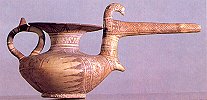
        The most representative type, a long spouted pitcher used in funeral rituals, was decorated with the head of an animal. The artist accentuated the resemblance of the animal by drawing around the spout. For example, if he wanted to increase the resemblance of a bird, the artist drew a series of triangles suggesting a collar of feathers or a pair of wings.

        This vessel with its elongated spout apparently remained in use on the plateau until the Achaemenian period.

        Comment


        • #5
          The art of Luristan in the west of Iran mainly covers the period from the 12th to the 8th centuries BC and has become famous for its engraved bronze artifacts and castings of horse trappings, weapons, and standards.

          The most common of the Luristan bronzes are probably the horse trappings and harness ornaments. The cheek pieces are often very elaborate, sometimes in the shape of ordinary animals such as horses or goats but also in the form of imaginary beasts like winged human-faced bulls.


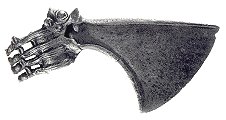
          A lion's head apparently became the most desired decoration on axes. To have the blade issue from the open jaws of a lion was to endow the weapon with the strength of the most powerful of beasts.


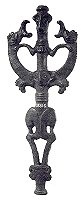
          Many of the standards show the so-called "master of animals", a Janus-headed human-like figure, in the centre fighting with two beasts. The role of these standards is unknown; however, they may have been used as household shrines.

          Luristan art neither shows the glorification of heroism nor the brutality of man, but delights in imaginary stylised monsters in which the call of this ancient Asiatic civilization is to be felt.
          It is believed that the Luristan bronzes were crafted by the Medes, an Indo-European people who, in close association with the Persians, began to infiltrate into Persia at about this period. However, this has never been proved, and others believe that they are connected with the Kassite civilization, or the Cimmerians or the Hurrians.

          Comment


          • #6
            MARLIK

            The green and fertile site of Marlik, to the south west of the Caspian (north of the Elburz Mountains), gave rise to a pastoral culture between the 12th and 10th centuries BC.

            Considerable riches were brought to light by an Iranian expedition in 1961 - these include golden vases and goblets, silver vessels, bronze artifacts, ceramics and weapons. The artists who fashioned these pieces were certainly from an advanced civilization and had a command of an elaborate technology.

            The vases are mostly decorated with the likeness of animals: winged bulls, griffins, eagles, and rams; and it seems likely that these beasts inhabited the mythology of this pastoral race.


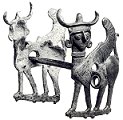
            The admirable hunch-backed bull in beautifully polished ceramic, and the bronze hunch-backed bull mounted on four wheels are further evidence of the pastoral way of life in these rich communities.


            The contrast of this area with the desert that stretches away to the south of the Elburz Mountains is dramatic. Rising like a wall, these mountains divert the clouds before they can reach the interior of the country. The importance of the bull to these settled pastoral farmers, in comparison with the semi-nomadic farmers of the plateau, must have been considerable.

            The discoveries made so far in this area of Iranian archaeology are only the beginning. This place may not be well endowed with spectacular monuments, but it is rich in treasure filled tombs.

            Comment


            • #7
              MANNAI

              Around the 8th century BC a provincial form of art, combining local Persian features with those of Assyria and Urartu (eastern Turkey and Soviet Armenia) evolved in the north-west corner of Persia, in the district anciently called Mannai, west of Lake Urumia.

              A splendid collection of gold, bronze and ivory objects were found in 1947 at Ziwiyeh (Sakkiz), right on the border of Azerbaijan and Kurdistan. It is particularly significant because it also contains elements, which seem to be the earliest examples of Scythian art.


              In the 7th century BC Mannai crumbled before the advances of the Scythians who had previously occupied Urartu and the area around Lake Van. When the Scythians arrived in Persia, they enriched their own art with the cultures they encountered, and the influences of Luristan and Urartu appears as one the most important components in their art.

              Scythian art remained, and continued to be profoundly attached to its subjects - the stag, the feline, and the bird.

              Comment


              • #8
                THE MEDES & THE ACHAEMENIANS

                The Medes first appeared on the historical scene around the 9th century BC, when they were mentioned in contemporary Assyrian texts. They were an Indo-European tribe who, like the Persians had entered western Iran at some earlier and as yet undetermined date. Very little of their artistry has survived, apart from a few rock tombs, some funerary reliefs and some pottery.

                The frustrating absence of remains attributable to the Medes is in marked contrast to the succeeding Achaemenians.

                ***

                The Achaemenian period may be said to begin in 549 BC when Cyrus the Great deposed the Median king Astyages. Cyrus (559-530 BC), the first great Persian king, created an empire extending from Anatolia to the Persian Gulf incorporating the former realms of both Assyria and Babylonia; and Darius the Great (522-486 BC), who succeeded him after various disturbances, extended the boundaries of the empire further still.

                Fragmentary remains of Cyrus' Palace at Pasargadae in Fars indicate that Cyrus favoured a monumental style of building. He incorporated decoration based partly on Urartian, partly on the older Assyrian and Babylonian art, as he wished his empire to seem to be the rightful heir of Urartu, Assur, and Babylon.


                Pasargadae covered an area almost 1.5 miles in length and included palaces, a temple and the tomb of the king of kings. Enormous winged bulls, which no longer survive flanked the entrance to the gate-house, but a stone relief on one of the door jams is still preserved. It is adorned with a bas-relief representing a four-winged guardian spirit in a long garment of Elamite type, whose head is surmounted by a complicated headdress of Egyptian origin. In the early 19th century an inscription over the figure could still be seen and deciphered: "I, Cyrus, king, the Achaemenian [have done this]."

                The central hall in one of the palaces had bas-reliefs showing the king followed by a pastoral bearer. Here for the first time on an Iranian sculpture appear garments with folds, in contrast to the straight-falling robe of the four winged guardian spirit, executed according to the traditions of ancient oriental art, which did not allow the slightest movement or life. Achaemenian art here marks the first step in the exploration of a means of expression that was to be developed by the artists of Persepolis.

                The rock cut tombs in Pasargadae, Naqsh-e Rustam, and elsewhere are a valuable source of information about the architectural forms used in the Achaemenian period. The presence of Ionic capitols in one of the earliest of these tombs suggests the serious possibility that this important architectural form was introduced into Ionian Greece from Persia, contrary to what is commonly supposed.


                Under Darius, the Achaemenian Empire embraced Egypt and Libya in the west and extended to the river Indus in the east. During his rule, Pasargadae was relegated to a secondary role and the new ruler quickly began to build other palaces, first at Susa and then at Persepolis.

                Susa was the most important administrative centre in Darius' Empire, its geographical location halfway between Babylon and Pasargadae was very favourable. The palace structure built at Susa was based on a Babylonian principle, with three large interior courts, around which were reception and living rooms. In the palace courtyard panels of polychrome glazed bricks decorated the walls. These included a pair of winged human-headed lions beneath a winged disk, and the so-called "Immortals". The craftsmen who made and arranged these bricks came from Babylon, where there was a tradition for this sort of architectural decoration.


                Comment


                • #9
                  THE ACHAEMENIANS CONTD

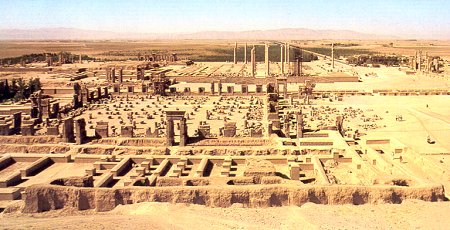
                  Although Darius constructed a number of buildings at Susa, he is better known for his work at Persepolis (the palace at Persepolis built by Darius and completed by Xerxes), 30-km south-west of Pasargadae.


                  The decoration includes the use of carved wall slabs representing the endless processions of courtiers, guards, and tributary nations from all parts of the Persian Empire. Sculptors working in teams carved these reliefs, and each team signed its work with a distinctive mason's mark.

                  These reliefs are executed in a dry and almost coldly formal, though neat and elegant, style which was henceforth characteristic of Achaemenian art and contrasts with the movement and zest of Assyrian and neo-Babylonian art. This art was supposed to capture the spectator by its symbolism, and convey a sense of grandeur; artistic values were therefore relegated to second place.


                  The king is the dominant figure in the sculpture at Persepolis, and it seems that the whole purpose of the decorative scheme was to glorify the king, his majesty and his power.

                  Here, also we can see that the Persepolis sculptures differ from the Assyrian reliefs, which are essentially narrative and aim to illustrate the achievements of the king. The similarities are such, though, that it is obvious much of the inspiration for this sort of relief must have come from Assyria. Greek, Egyptian, Urartian, Babylonian, Elamite and Scythian influences can also been seen in Achaemenian art. This is perhaps not surprising, in view of the wide range of people employed in the construction of Persepolis.


                  Achaemenian art, however, was also capable of influencing that of others and its impress is most noticeable in the early art of India, with which it probably came into contact through Bactria.

                  The realism of Achaemenian art manifests its power in the representation of animals, as can be seen in the many reliefs at Persepolis. Carved in stone or cast in bronze, the animals served as guardians to the entrances or, more often as supports for vases, in which they were grouped by threes, their union a revival of the old traditions of tripods with legs ending in a hoof or a lion's paw. The Achaemenian artists were worthy descendants of the animal sculptors of Luristan.


                  Silver-work, glazing, goldsmiths' work, bronze casting, and inlay work are all well represented in Achaemenian art. The Oxus treasure, a collection of 170 items of gold and silver found by the Oxus river date from the 5th to the 4th century BC. Among the best-known piece is a pair of gold armlets with terminals in the shape of horned griffins, originally inlaid with glass and coloured stones.


                  Achaemenian art is a logical continuation of what preceded it, culminating in the superb technical skill and unprecedented splendour so evident at Persepolis. The art of the Achaemenians is deeply rooted in the era when the first Iranians arrived on the plateau, and its wealth has accumulated throughout the centuries to constitute at last, the splendid realisation of Iranian art today.

                  Comment


                  • #10
                    THE HELLENISTIC PERIOD

                    After Alexander conquered the Persian Empire (331 BC), Iranian art underwent a revolution. Greeks and Iranians lived together in the same city, where mixed marriages became commonplace. Two profoundly different concepts of life and beauty thus came into confrontation with each other. On the one hand all interest focused on modeling the plasticity of the body and its gestures; while on the other, there was nothing but dryness and severity, a linear vision, rigidness, and frontality. Greco-Iranian art was the logical product of this encounter.


                    The victors, represented by the Seleucid dynasty of Macedonian origin, replaced the old Oriental art by Hellenistic forms in which space and perspective, gesture, drapery and other devices were used to suggest movement or various emotions, however, some Oriental features still remained.

                    Comment


                    • #11
                      THE PARTHIANS

                      In 250 BC a new Iranian people, the Parthians, proclaimed their independence from the Seleucids, and went on to re-establish an Oriental Empire which extended to the Euphrates.

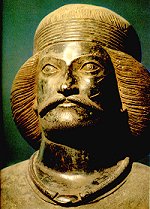
                      The re-conquest of the country by the Parthians brought a slow return to Iranian traditionalism. Its technique marked the disappearance of the plastic form. Stiff figures, often heavily bejeweled, wearing Iranian dress with its drapery emphasized mechanically and monotonously, were now shown systematically facing to the front, staring straight at the spectator. This was a device used in ancient Mesopotamian art only for figures of exceptional importance. The Parthians however, made it the rule for most figures, and from them it passed into Byzantine art. A fine bronze portrait statue (from Shami) and some reliefs (at Tang-i-Sarwak and Bisutun) highlight these features.


                      During the Parthian period the iwan became a widespread architectural form. This was a great hall, open on one side with a high barrel-vaulted roof. Particularly fine examples have been found at Ashur and Hatra. In the construction of these grandiose halls, fast setting gypsum mortar was used.

                      Perhaps allied to the increasing use of gypsum mortar was the development of gypsum stucco decoration. Iran was unfamiliar with stucco decoration before the Parthians, among whom it was in vogue for interior decoration together with mural painting. The mural at Dura-Europos, on the Euphrates, represents Mithras hunting a variety of animals.

                      In the Zagros area of western Iran many examples of Parthian 'clinky' ware, a hard red pottery which makes a clinky noise when tapped, can be found. Glazed pottery with a pleasing bluish or greenish lead glaze, painted on shapes of Hellenistic inspiration, are also frequently found.

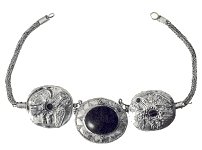
                      Ornate jewelry with large inlaid stones or glass gems made its appearance during this period.


                      Unfortunately, practically nothing that the Parthians may have written has survived, apart from some inscriptions on coins and accounts from Greek and Latin authors; however these accounts were far from objective.

                      Parthian coins are helpful in establishing the succession of kings, they referred to themselves on these coins as "Hellenophiles", but this was only true in that they were anti Roman.


                      The Parthian period was the start of a renewal in the Iranian national spirit. Their art forms an important transitional stepping-stone; which led on the one hand to the art of Byzantium, and on the other to that of the Sassanians, and India.

                      Comment


                      • #12
                        THE SASSANIANS

                        In many ways the Sassanian period (AD 224-633) witnessed the highest achievement of Persian civilization, and constituted the last great Iranian Empire before the Moslem conquest.

                        The Sassanian Dynasty, like the Achaemenian, originated in the province of Fars. They saw themselves as successors to the Achaemenians, after the Hellenistic and Parthian interlude, and perceived it as their role to restore the greatness of Iran.

                        At its peak, the Sassanian Empire stretched from Syria to north-west India; but its influence was felt far beyond these political boundaries. Sassanian motifs found their way into the art of central Asia and China, the Byzantine Empire, and even Merovingian France.

                        In reviving, the glories of the Achaemenian past, the Sassanians were no mere imitators. The art of this period reveals an astonishing virility. In certain respects it anticipates features later developed during the Islamic period. The conquest of Persia by Alexander the Great had inaugurated the spread of Hellenistic art into Western Asia; but if the East accepted the outward form of this art, it never really assimilated its spirit. Already in the Parthian period Hellenistic art was being interpreted freely by the peoples of the Near East and throughout the Sassanian period there was a continuing process of reaction against it. Sassanian art revived forms and traditions native to Persia; and in the Islamic period these reached the shores of the Mediterranean.


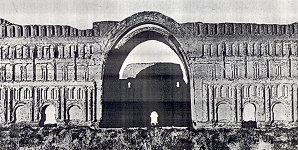
                        The splendour in which the Sassanian monarchs lived is well illustrated by their surviving palaces, such as those at Firuzabad and Bishapur in Fars, and the capital city of Ctesiphon in Mesopotamia. In addition to local traditions, Parthian architecture must have been responsible for a great many of the Sassanian architectural characteristics. All are characterised by the barrel-vaulted iwans introduced in the Parthian period, but now they reached massive proportions, particularly at Ctesiphon. The arch of the great vaulted hall at Ctesiphon attributed to the reign of Shapur I (AD 241-272) has a span of more than 80 ft, and reaches a height of 118 ft. from the ground. This magnificent structure facinated architects in the centuries that followed and has always been considered as one of the most important pieces of Persian architecture. Many of the palaces contain an inner audience hall which consists, as at Firuzabad, of a chamber surmounted by a dome. The Persians solved the problem of constructing a circular dome on a square building by the squinch. This is an arch built across each corner of the square, thereby converting it into an octagon on which it is simple to place the dome. The dome chamber in the palace of Firuzabad is the earliest surviving example of the use of the squinch and so there is good reason for regarding Persia as its place of invention.

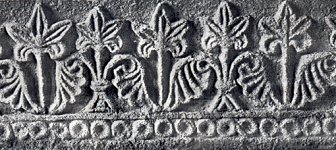
                        The unique characteristic of Sassanian architecture, was its distinctive use of space. The Sassanian architect conceived his building in terms of masses and surfaces; hence the use of massive walls of brick decorated with molded or carved stucco. Stucco wall decorations appear at Bishapur, but better examples are preserved from Chal Tarkhan near Rayy (late Sassanian or early Islamic in date), and from Ctesiphon and Kish in Mesopotamia. The panels show animal figures set in roundels, human busts, and geometric and floral motifs.


                        At Bishapur some of the floors were decorated with mosaics showing scenes of merrymaking as at a banquet; the Roman influence here is clear, and the mosaics may have been laid by Roman prisoners. Buildings were also decorated with wall paintings; particularly fine examples have been found at Kuh-i Khwaja in Sistan.

                        Comment


                        • #13

                          Comment


                          • #14
                            INTRODUCTION TO ISLAMIC ART

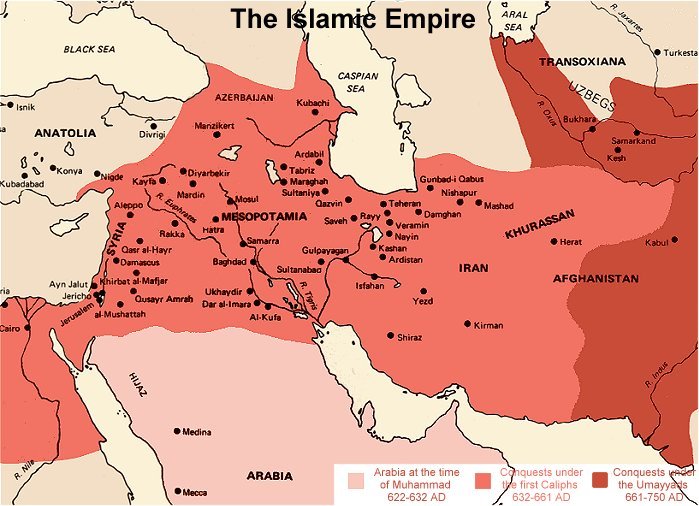
                            The Arab conquest in the 7th century AD brought Persia into the Islamic community; however, it was in Persia that the new movement in Islamic art met its severest test. Contact with a people of high artistic achievement and ancient culture made a deep impression on the conquering Moslems.


                            When the Abbasids made Baghdad their capital (near the former capital of the Sassanian rulers), a vast stream of Persian influences came pouring in. The caliphs accepted the Old Persian culture; a policy also followed at the courts of the relatively independent local principalities (The Samanids, The Buwayhids etc.), which led to a conscious revival of Persian traditions in art and literature.

                            Wherever possible, the cultural inheritance of Persian art was infused with new life, and customs thoroughly foreign to Islam were retained or newly introduced. Islamic art (paintings, metalwork etc.) was heavily influenced by Sassanian methods and Persian vaulting techniques were adopted in Islamic architecture. Few secular buildings of the early period have survived, but judging from the remains it is probable that they retained many features of the Sassanian palaces, such as the "domed audience chamber" and "the ground plan arranged around a central court".

                            The main change that this period brought to the development of art was to restrict the depiction of lifelike portraits, or true-life representations of historical events.

                            "On Resurrection Day, God will consider image-makers as the men most deserving of punishment"

                            Collection of sayings form the Prophet

                            As Islam did not tolerate the three dimensional representation of living creatures, Persian craftsmen developed and extended their existing repertory of ornamental forms, which they then rendered in stone or stucco. These provided a common stock on which, artists in other media drew. Many of the motifs can be traced back to the ancient civilizations of the Near East: they include fabulous beasts such as the human-headed sphinx with wings, griffins, phoenixes, wild beasts or birds at grips with their prey, and purely ornamental devices like medallions, grapevines, floral patterns and the rosette.

                            More tolerant Moslem believers were less stringent to the portrayal of figurative art and in bathing houses, paintings of hunting or love scenes for the entertainment of the patrons seldom aroused objection. However, in religious establishments, only indistinct hints of human or animal forms were tolerated.

                            The Persians were quick to appreciate the decorative value of the Arabic script and developed every variety of floral and abstract ornament. Persian ornament is usually distinguishable from that of other Islamic countries. The treatment of the arabesque tended to be freer in Persia than elsewhere and usually, though by no means always, retained natural and recognizable plant forms. Palmettes, Frets, Guilloches, Interlacings, and elaborate geometric figures such as the polygonal star also occur.

                            Comment


                            • #15
                              Calligraphy is the highest art form of the Islamic civilization, and like all forms of art that came into contact with Iran, the Persians enhanced and developed it. Ta'liq, "hanging script" (and its derivative Nasta'liq) was formalised in the 13th century; although it had been in existence for centuries prior to this, and it is claimed to be derived from the old pre-Islamic Sassanian script. The written page was also enriched by the art of the "Illuminator" and in some manuscripts by that of the painter, who added small-scale illustrations.


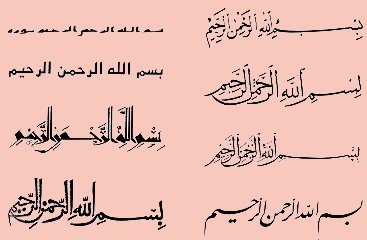
                              "In the name of God, the Merciful, the Compassionate". Almost every sura (chapter) in the Koran begins with this phrase, known as the bismillah ('in the name of God') from its opening three words. Here it is executed in some major Koranic hands: (left from top) early Kufic, square Kufic, eastern Kufic, Thuluth; (right from top) Naskhi, Muhaqqaq, Rihani, Ta'liq.

                              The tenacity of Persia's cultural tradition is such that, in spite of centuries of invasions and foreign rule by Arabs, Turks, Mongols, Afghans, etc., her art reveals a continuous development, while retaining its own identity. During Arab rule, the adherence of the local population to the Shi'ite sect of Islam, (which was opposed to rigid orthodox observance), played an important role in their resistance to Arab ideas. By the time orthodoxy gained a foothold, through conquest by the Seljuks in the 11th century, the Persian element had become so deeply entrenched that it could no longer be uprooted.

                              Comment

                              Working...
                              X