

 Tweet
Tweet
 Ancient Persia at War
When in 546 BC Cyrus the Great defeated an unholy alliance of Babylon, Egypt, and Sparta summoned by the legendry king of Lydia, Croesus (Harun, or Ghaaroon), it shook the ancient world at its core. No power dared to stand-up to these armies whose cruelties at times, to this day, rattles the pages of history.
Sparta had demolished and terrorised Asia Minor; Egypt was well- known for its inhumane treatment of its slaves, and the Babylonian army was unpopular for up-rooting their conquered subjects and separating them from their homelands, selling thousands into slavery while the unfortunate ones stayed in Mesopotamia itself, labouring for emperor Nabonidus under the scorching Babylonian sun.
Not only their defeat was shocking, but with it now came a revolution in human thought: The rather young Cyrus (35-45?) had achieved the impossible, and the result of his daring attacks were that for the first time in the history of humankind, the idea of Human Rights and equality were implemented by a 'world power', but above all they were promptly carried-out, accordingly.
Slavery was abolished, the Jews were freed from captivity in Babylon, and the Persian forces escorted the new freed Judeo tribes back to Israel, rebuilding (and in effect securing the future of) what would become the State of Israel.
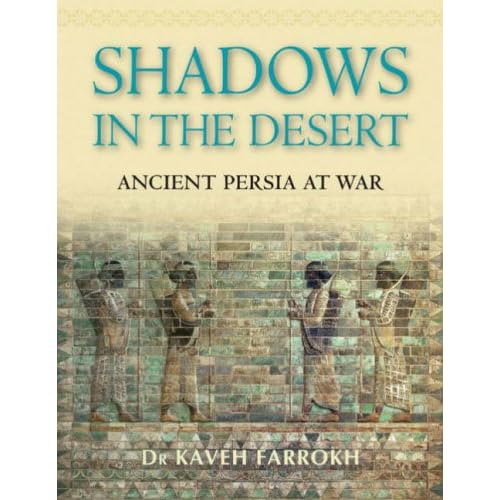
These events and much more are highlighted in detail by Dr. Kaveh Farrokh in his new book, Shadows in the Desert: Ancient Persia at War.
For the first time in the field of Iranian studies a hardcover book with illustrious illustrations that is truly on par with the ones published about Greece and Rome has been published. In a foreword by Prof. Richard Nelson Frye of Harvard titled .
`[The] Mighty Persian Warriors`, the renowned scholar 'congratulates' Osprey published who for the first time have published a book in the West that gives the 'other side`s' point of view [Iran`s].
Dr. Farrokh gives a complete narration of events covering the entire span of Persia's existence from the Achaemenids to the Sassanians, right before ancient Iran fell to invading armies, starting with the Arabs and ending with Russia, has been compiled and presented in one book.
There are comprehensive analysis not found within most books relating to the empires of Persia, and the reader will be introduced to many facets of ancient Persian customs, tactical warfare, as well as ancient Iranian ideologies.
Packed with sumptuous details, many readers for the first will learn how Darius (the Great to be), as part of 'the three horsemen', met at dawn to choose Persia's future king, in what the author describes as a 'ceremonial' gesture.
In an honest narration, Dr. Farrokh (born in Athens, Greece) gives it to both sides equally; he mentions the cruel treatment of captured Arab War Lords by some of the Sassanian kings, while praising Greece for her magnificent accomplishments.
And amid countless books giving us the same-old-same-old narrations on Greece and Rome, and warped conceptions of ancient Persia seen recently in fantasy motion pictures such as '300', this book is a refreshing change that aims to balance things a bit.
But above all, there are NEW discoveries reiterated and some unraveled by Farrokh himself, such as new aspects of the impact that Persian architecture had on Gothic Europe, new details about Sassanian Aryan knighthood investitures, as well much more.
From the bases of Christianity ala Zoroastrianism, the Iranian Sassanian influence on Medieval knights, to the foundation of Human Rights, the thrilling achievements of Persia is right up there with the aesthetically pleasing art and the well-known cultures of Greece and Rome and this book points them out.
Unlike the 'triumphant' Greeks however, the saga of the Persians seem to be that of a tragedy. Perhaps, Dr. David Khupenia of the University of the Republic of Georgia was right, 'Persia has given so much to the world and is appreciated so little'.
Book Description
The ruins of Persepolis evoke the best-known events of ancient Persia's history: Alexander the Great's defeat of Darius III, his conquest of the Achaemenid empire, and the burning of the great palace complex at Persepolis.
However, most of the history of ancient Persia remains as mysterious today as it was to contemporary Western scholars. Compared to the world-famous Alexander, the many wars won by the Achaemenid, Parthian, and Sassanian empires, and their revolutionary military technology, have been almost forgotten in the sands of the East.
In its day, Persia was a superpower to rival Greece and Rome, and conflict between them spanned over a millennium.
Through these wars, and trade, these foes learnt from each other, not only adopting elements of military technology, but influences in the arts, architecture, religion, technology and learning. In this beautifully illustrated book, Dr Kaveh Farrokh narrates the history of Persia from before the first empires, through their wars with East and West to the fall of the Sassanians. He also delves into the forgotten cultural heritage of the Persians, spread across the world through war and conquest, which, even after the fall of the Sassanians, continued to impact upon the Western world.
About the Author
Dr Kaveh Farrokh has been researching the military history and technology of Persia for two decades. He obtained his PhD in 2001 from the University of British Columbia, where he specialized on the acquisition of Persian languages.
He has given lectures and seminars in the University of British Columbia and has written articles for various journals. He is the author of Elite 110: Sassanian Elite Cavalry AD 224-642. He is currently acting as historical advisor on a film project titled Cyrus the Great, and will be appearing in a History Channel documentary on the Persian Empire in October 2006. The author lives in Vancouver, Canada.

 They are an autonomous region within Russia in Northern Caucasus, as well as a breakaway republic of Georgia.
Comment