

 Tweet
Tweet
Why are rainbows always curved? --David, San Francisco
Dear David:
Because rainbows occur at the intersection of a cloud of water droplets with your cone of vision. Kinda takes the poetry out of it, I guess, but inspect any thing of beauty up close and you're sure to see the panty lines.
We're used to thinking of rainbows as basically two-dimensional, but that's an illusion caused by a lack of distance cues. The cloud of water droplets that produces the rainbow is obviously spread out in three dimensions.
The geometry of reflection, however, is such that all the droplets that reflect the rainbow's light toward you lie in a cone with your eyes at the tip.
It takes an intuitive leap to see why this should be so, but let's give it a crack. Water droplets reflect sunlight (or any light) at an angle of between 40 and 42 degrees, depending on the wavelength.
(The difference due to wavelength is why rainbows separate into, well, the colors of the rainbow. But that's a story for another day.)
Because of the sharp angle, you only see rainbows when the sun is (1) behind you and (2) low in the sky. When the sun is high, the light reflecting off the droplets passes over your head and you see nothing.
Now for a little creative visualization. The sun is low and behind you. All the sunbeams head in, strike the cloud of water droplets ahead of you and bounce back at an angle of 40 degrees.
Naturally the beams can bounce 40 degrees any which way--up, down, and sideways. But the only ones you see are the one that lie on a cone with a side-to-axis angle of 40 degrees and your eyes at the tip.
Don't get it? OK, face a wall and extend your arm so it's at 40 degree angle thereto. Now rotate the arm in a full circle, keeping the 40 degree angle to the wall. Your arm describes a cone, right?
If you think about it, you should be able to convince yourself that the only parts of the wall that are at exactly a 40 degree angle to your shoulder lie on that cone. Same with rainbows. Mathematical concepts for the masses, my specialty.
Once we have these facts firmly seated in our minds we can easily understand several other amazing facts about rainbows.
Fact #1: Rainbows only have one side. You can easily demonstrate this using the little rainbow made by water from a garden hose. If the sun is behind you and the squirting water is in front, a rainbow may well visible to you.
But someone on the opposite side of the hose--that is, with both sun and hose in front of him--will see nothing.
Fact #2: everybody sees their own personal rainbow. Your cone of vision is different from that of the guy next to you, and it's your cone of vision intersecting the cloud of water droplets that creates your rainbow.
Fact #3: a rainbow always faces you squarely--that is, it never seems that one end is closer to you than the other. This is a consequence of the "flattening" of a three-dimensional phenomenon due to the lack of distance cues that I mentioned earlier.
For the same reason, a spherical burst of fireworks always appears to be a disc facing you, no matter where in the audience you sit.
The fact that you can never sneak around to the side of a rainbow is what gave rise to the expression "looking for the pot of gold at the end of the rainbow." Since the rainbow always faces you squarely, you can't get to the end of it.
And here you thought that pot of gold thing was just an arbitrary metaphor for the unattainable. It's no metaphor, friend, just fact.
FROM THE TEEMING MILLIONS
Dear Cecil:
The info on rainbows was interesting but not totally comprehensive. When I lived in Oregon, where it rains profusely, I often viewed double rainbows. I even have pictures to prove it. What is the scientific explanation of this phenomenon? --Tom Koshinz, Los Angeles
Dear Tom:
I said that water droplets reflect light at an angle of 40-42 degrees. Usually they do.
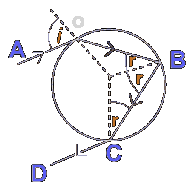
But sometimes the light bounces around twice inside each water droplet and exits at an angle of around 51 degrees. So you'll see a second rainbow above the main one with the colors reversed. It is fainter, but be kind. It is doing the best it can.
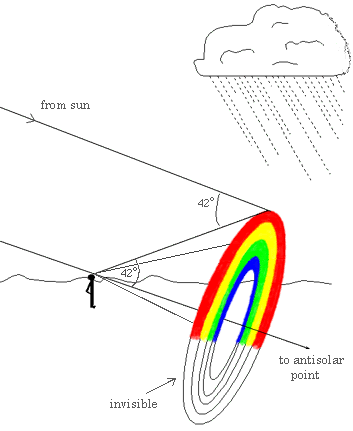
When we see rainbows we see them as arcs when in truth they are formed as circles. There is a point called the antisolar point that the rainbow seems to form around. From the picture we see the antisolar point formed as a line from the observers head by the sun shining from behind.
--We don't see the full circle of the rainbow because the horizon gets in the way. As the sun goes down we are able to see more of the rainbow, and the higher the sun is in the sky the smaller the arc seems.
--Sometimes people at high elevations, like in planes, see rainbows as full circles because they do not have the horizon to block their view.
Dear David:
Because rainbows occur at the intersection of a cloud of water droplets with your cone of vision. Kinda takes the poetry out of it, I guess, but inspect any thing of beauty up close and you're sure to see the panty lines.
We're used to thinking of rainbows as basically two-dimensional, but that's an illusion caused by a lack of distance cues. The cloud of water droplets that produces the rainbow is obviously spread out in three dimensions.
The geometry of reflection, however, is such that all the droplets that reflect the rainbow's light toward you lie in a cone with your eyes at the tip.
It takes an intuitive leap to see why this should be so, but let's give it a crack. Water droplets reflect sunlight (or any light) at an angle of between 40 and 42 degrees, depending on the wavelength.
(The difference due to wavelength is why rainbows separate into, well, the colors of the rainbow. But that's a story for another day.)
Because of the sharp angle, you only see rainbows when the sun is (1) behind you and (2) low in the sky. When the sun is high, the light reflecting off the droplets passes over your head and you see nothing.
Now for a little creative visualization. The sun is low and behind you. All the sunbeams head in, strike the cloud of water droplets ahead of you and bounce back at an angle of 40 degrees.
Naturally the beams can bounce 40 degrees any which way--up, down, and sideways. But the only ones you see are the one that lie on a cone with a side-to-axis angle of 40 degrees and your eyes at the tip.
Don't get it? OK, face a wall and extend your arm so it's at 40 degree angle thereto. Now rotate the arm in a full circle, keeping the 40 degree angle to the wall. Your arm describes a cone, right?
If you think about it, you should be able to convince yourself that the only parts of the wall that are at exactly a 40 degree angle to your shoulder lie on that cone. Same with rainbows. Mathematical concepts for the masses, my specialty.
Once we have these facts firmly seated in our minds we can easily understand several other amazing facts about rainbows.
Fact #1: Rainbows only have one side. You can easily demonstrate this using the little rainbow made by water from a garden hose. If the sun is behind you and the squirting water is in front, a rainbow may well visible to you.
But someone on the opposite side of the hose--that is, with both sun and hose in front of him--will see nothing.
Fact #2: everybody sees their own personal rainbow. Your cone of vision is different from that of the guy next to you, and it's your cone of vision intersecting the cloud of water droplets that creates your rainbow.
Fact #3: a rainbow always faces you squarely--that is, it never seems that one end is closer to you than the other. This is a consequence of the "flattening" of a three-dimensional phenomenon due to the lack of distance cues that I mentioned earlier.
For the same reason, a spherical burst of fireworks always appears to be a disc facing you, no matter where in the audience you sit.
The fact that you can never sneak around to the side of a rainbow is what gave rise to the expression "looking for the pot of gold at the end of the rainbow." Since the rainbow always faces you squarely, you can't get to the end of it.
And here you thought that pot of gold thing was just an arbitrary metaphor for the unattainable. It's no metaphor, friend, just fact.
FROM THE TEEMING MILLIONS
Dear Cecil:
The info on rainbows was interesting but not totally comprehensive. When I lived in Oregon, where it rains profusely, I often viewed double rainbows. I even have pictures to prove it. What is the scientific explanation of this phenomenon? --Tom Koshinz, Los Angeles
Dear Tom:
I said that water droplets reflect light at an angle of 40-42 degrees. Usually they do.
But sometimes the light bounces around twice inside each water droplet and exits at an angle of around 51 degrees. So you'll see a second rainbow above the main one with the colors reversed. It is fainter, but be kind. It is doing the best it can.
When we see rainbows we see them as arcs when in truth they are formed as circles. There is a point called the antisolar point that the rainbow seems to form around. From the picture we see the antisolar point formed as a line from the observers head by the sun shining from behind.
--We don't see the full circle of the rainbow because the horizon gets in the way. As the sun goes down we are able to see more of the rainbow, and the higher the sun is in the sky the smaller the arc seems.
--Sometimes people at high elevations, like in planes, see rainbows as full circles because they do not have the horizon to block their view.


Comment