Announcement

Collapse
No announcement yet.

Persian Art

Collapse
X
 
  • Filter
  • Time
  • Show
Clear All
new posts

  • #16
    THE ABBASSID PERIOD

    Once the initial shock of the Arab invasion was over, the Iranians got down to the job of assimilating their vanquishers. Artists and craftsmen put themselves at the disposal of the new rulers and the needs of the new religion, and Moslem buildings adopted the methods and materials of the Sassanian period.
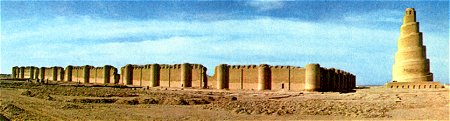


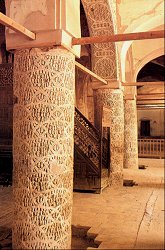
    The size of the buildings and the techniques of construction in the Abbassid period show a revival of the Mesopotamian architecture. Bricks were used for walls and pillars. These pillars then acted as isolated supports for the vaults that were used repeatedly throughout the Moslem world, due to the scarcity of roofing timber. The wide assortment of arches in Abbassid architecture leads one to believe that their varied shapes were for ornamental purposes rather than structural requirements.


    Of all the decorative arts, pottery made the most remarkable advances during the Abbassid period. In the 9th century new techniques were developed in which bold designs were painted with a strong cobalt blue pigment on a white background. Sometimes several tones of luster were combined on a white background, including red, green, gold or brown. Towards the end of the 9th century, animal and human silhouette designs became quite common, on a plain or densely covered background.
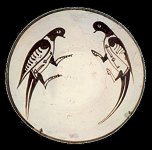
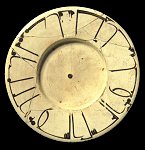


    The pottery of the late Abbassid period (12th to early 13th century) includes:

    Carved or molded lamps, incense burners, small floor tables and tiles with a turquoise-green glaze.
    Jars and bowls painted with floral patterns, chevrons, animals or human figures etc. under a green or clear glaze.
    Jars, bowls and tiles painted with a deep brown luster on a clear greenish glaze; the luster sometimes combined with blue and green lines.
    Paintings from the early Abbasid era are known to us from the fragments excavated at Samarra, outside western Iran (approximately 62 miles north of Baghdad, Iraq). These wall paintings were found in the reception rooms of bourgeois houses and in the non-public parts of palaces, especially the harem quarters, where no religious function took place. A favorite location of such decorations was the domes over square halls. A good deal of the images have Hellenistic elements, as shown by the drinkers, dancers and musicians, but the style is basically Sassanian in spirit and content. Many have been reconstructed using Sassanian monuments such as rock reliefs, seals etc.

    In the east of Iran, a painting of a woman's head, (late 8th or early 9th century) found in Nishapur has a strong resemblance to the art of Samarra; however, it is hardly touched by Hellenistic influences.

    The pictorial art (miniatures) in the final period before the destruction of the caliphate is found mainly in manuscripts illustrating either scientific or literary works and was mainly restricted to Iraq.
    Comment


    • #17
      THE SAMANIDS

      With the lessening of the caliphs' power in the 9th and 10th centuries, the feudal lords gradually returned to power, setting up independent principalities in eastern Iran; one of the most important was ruled by the Samanids. The Samanid rulers were great art patrons and they turned Bukhara and Samarkand in Transoxiana into famous cultural centres.
      The most complete documentation of Samanid art is to be found in its ceramics, and during the 9th century, the wares of Transoxiana were very popular throughout the eastern provinces of Persia. The best-known and most refined pottery of this Samarkand type is that bearing large inscriptions in Kufic (the earliest version of Arabic script used in the Koran, named after the city Kufa in Iraq) painted in black on a white background.
      Figure decoration never appeared on these Transoxiana wares and motifs were often copied from textiles such as rosettes, roundels, and peacock-tail "eyes". On the other hand, Khorasan pottery of the Samanid period, known primarily from material excavated at Nishapur, did not eliminate the human form, and there are examples of human figures against backgrounds abounding in animals, flowers and inscriptions.


      Slip-painted bowl from Nishapur, Iran, 10th century. A hunting scene with a distant echo of Sassanian majesty.

      Unfortunately, practically nothing remains of Samanid paintings or miniatures, apart from a few fragments of wall paintings found at Nishapur. One such fragment depicts a life-size image of a falconer on horseback, riding at a 'flying gallop' in keeping with modes derived from Sassanian tradition. The falconer is dressed in Iranian style with influences from the steppe, such as the high boots.


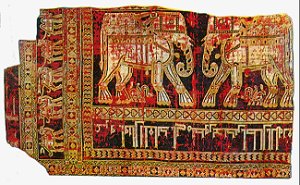
      As far as textiles are concerned, what have survived are several examples of tiraz (cloth strip used to decorate the sleeve) from Merv and Nishapur. Nothing remains of the vast production from the textile workshops of Transoxiana and Khorasan except the celebrated silk and cotton fragment known as the "Sudarium of St. Josse".

      Part of the St. Josse silk, Khorasan 10th century.
      The inscription wishes 'glory and prosperity to Abu Mansur Bukhtegin, may God prolong (His favours to him?)'.

      This piece is decorated with facing elephants set off by borders of Kufic characters and rows of Bactrian camels. It is inscribed to Abu Mansur Bukhtegin, a high official of the Samanid court who was put to death by Abd-al-Malik ibn-Nuh in 960. The fabric is almost certainly from the Khorasan workshop. Although the figures are rather stiff, Sassanian models have been closely adhered to, both in general composition and in the individual motifs.

      Comment


      • #18
        THE GHAZNAVIDS

        Ghaznavid art takes its name from the dynasty founded by the Turkish sultan Sabuktagin, whose rulers governed from Ghazni (in what is now Afghanistan). Craftsmen and artists were attracted from the conquered lands, primarily from the lands of the Islamic east, to beautify the capital.

        Unlike the Samanids, their predecessors the Ghaznavids did not go so far as to proclaim themselves the descendants of the Sassanians (the memory of their Turkish origin was too fresh), but they spoke Persian, celebrated pre-Islamic festivals, and promoted neo-Persian letters.

        The fact that elements foreign to Islam and Persia were also present at Ghazni poses the question of the extent of their influence on Ghaznavid art. Ghazni was the meeting ground between Moslem and Indian worlds. Indian monuments certainly left an impression on the conquerors, and there were numerous groups of Indian craftsmen at Ghazni; however, there is insufficient documentation to indicate an Indian contribution to Ghaznavid art.

        Ghaznavid architecture provided one of the best examples of how decoration was considered to be as important as the structure itself. As well as providing the structure, brickwork was used to provide geometric patterns. Marble was used extensively in Ghazni and virtually surpassed stucco. Sources say that it was used for the facings of the mosque "Bride of the Sky", whose splendour rivalled that of the mosque at Damascus.

        However, the Ghaznavid's use of sun-dried bricks combined with the severe climatic frosts resulted in the ruin of most of these buildings.


        In the palace of Mas'ud III, the design was greatly enriched by the insertion of molded terra-cotta tiles, as well as what appears to be ceramic plaques decorated in reliefs with figures of wild beasts, birds, and flowers, all glazed over in green, brown and yellow enamel. Today only fragments have been found in the ruins, and they are preserved in the Kabul museum.

        An innovation of great importance, because it was to become a classic formula in Persian architecture, is the so- called 'cruciform' mosque plan, a court with four iwans. This formula was widely adopted not only in mosques, but also in the construction of madrasas, the schools in which the Koran was taught.

        Like the Abbasids, sources suggest that the use of the human figure in wall paintings was widespread in Ghaznavid buildings.


        The only remaining frescoes, found in the palace at Lashkari Bazaar show a row of 44 personages (the ruins of two pillars suggest that the original total may have been 70) wearing tunics, of which only the neck is visible and a long cloak fastened at the left. The bodies are depicted frontally and the feet in profile. Similarities can be drawn to that of Persepolis or Susa where it was customary to provide pictures of the men who guarded the palace.

        Turkish elements had an influence on Ghaznavid painting; however, this influence is not limited to Ghaznavid art, but extends to all Persian Islamic painting. For example there are similarities between paintings (dated 1037) in Duvazdah Imam at Yazd in Iran and those paintings at Bezeklik and Toyuk.

        The bas reliefs found at Ghazni show scenes of court life (courtiers, dancers...), hunting scenes (horsemen battling a lion...) etc. The hunting scenes are similar to that of a Sassanian theme; however they are distinguished by their refinement of drawing and fluidity of movement.


        Ghazni, Rauza Antiquary, large decorative marble slab sculptured on both sides, 11th century.

        Ghaznavid art produced some of the most notable examples of calligraphy in Islamic art. The Kufic script was very popular, and achieved its most elegant form during the reign of Ibrahim (1059-99). This script with ornamental border remained the fashion for centuries in various Persian provinces.

        Little is known of Ghaznavid art to fully appraise this heritage, and its historical importance consists principally in the legacy that it transmitted to the Seljuks.

        Comment


        • #19
          THE SELJUKS

          The Seljuk period in the history of art and architecture extends for approximately two centuries from the Seljuk conquest in the second quarter of 11th century to the establishment of the Ilkhan dynasty in the second quarter of the 13th century. During this period, the centre of power within the Islamic world shifted from the Arab territories to Anatolia and Iran, with the traditional centres now residing in the Seljuk capitals - Merv, Nishapur, Rayy and Isfahan.

          In spite of the Turkish invaders, this era of Persian revival, beginning with the publication of Firdawsi's "Shah-namah", constitutes for Persia a period of intensively creative artistic development. The sheer productivity of these centuries in the visual arts, in comparison with the art from earlier centuries represents a quantum leap forward.

          The importance of Seljuk art is that it established a dominant position in Iran and determined the future development of art in the Iranian world for centuries. The stylistic innovations introduced by the Iranian architects of this period were, in fact to have vast repercussions, from India to Asia Minor. However, there is a strong overlap between Seljuk art and the stylistic groupings of the Buwayhids, Ghaznavids, etc.

          In many cases the artists of the Seljuk period consolidated, and indeed at times perfected, forms and ideas that had long been known. It must be remembered that the picture is not as clear as it should be, with the massive scale of illegal excavations in Iran over the past hundred years


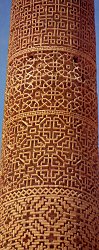
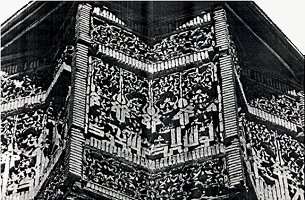
          Seljuk minaret of the mosque at Damghan, Iran. The decorative effect achieved by the use of recessed bricks, forming highly original rhythms and geometric patterns, is characteristic of this 11th century Persian art.

          The characteristic feature of the buildings of this period, is the decorative use of un-plastered bricks. The earlier use of stucco facings on the outer walls, as well as on the inside (to conceal the inferiority of the building material) was discontinued, although it reappeared later.

          With the establishment of the Seljuk Turks (1055-1256) a distinctive form of mosque was introduced. Its most striking feature is the vaulted niche or iwan which, had figured prominently in the Sassanian palaces and had been known even in the Parthian period. In this so-called 'cruciform' mosque plan, an iwan is introduced into each of the four enclosing walls of the court (See Ghaznavid Art). Such a plan was adopted for the rebuilding of the Great Mosque of Isfahan in 1121 and was widely used in Persia until recent times. A notable example is the Masjid-i-shah or Royal Mosque founded by Shah Abbas at Isfahan in 1612 and completed in 1630.

          Figure decoration appeared on Seljuk pottery from the mid 12th century onwards. At first the decoration was carved or moulded while the glaze was monochrome, though on the lakabi (painting) carved wares several colours were used. Sometimes decoration was applied onto the pot, painted in black slip under a clear or coloured glaze to create a silhouette effect. Large birds, animals and fabulous creatures form the bulk of the imagery, though on the silhouette ware human figures appear. The silhouette figures often stand-alone though it is usual for human and animal forms, whenever they occur, to be superimposed on a foliage background.

          The last quarter of the 12th century saw the creation of the splendid and elaborate minai(enamel) ceramics, produced by means of a double-firing technique to set the varnish over the enamel. This type of ware, which originated in Rayy, Kashan and perhaps Saveh displays ornamental detail similar to luster-painted ware of Kashan. Some compositions depict battle scenes or episodes drawn from the Shah-namah.

          Seljuk miniatures, of which few traces remain, because of the widespread destruction by the Mongol invasions, must also have been extremely ornate, like other art forms of the period, and certainly must have displayed features similar to pottery painting. The principle centre for book painting in the 12th and 13th centuries was Iraq, but this painting had a marked Iranian influence. Several fine examples of Seljuk Korans have survived, and they are notable for their magnificent painting on the cover often of pronounced geometric character, with the Kufic script taking the prime role.

          Comment


          • #20
            THE MONGOLS; ILKHANS

            The Mongol invasions in the 13th century changed life in Iran radically and permanently. Genghis Khan's invasion in the 1220s, destroyed lives and property in north-eastern Iran on a grand scale. In 1258 Hulagu Khan, Genghis Khan's grandson completed the conquest of Iran, and consolidated his control over Iraq, Iran and much of Anatolia. With his capital in Maragha in north-western Iran, he founded the Ilkhanid kingdom, nominally subject to the great Khan, Qubilai, ruler of China and Mongolia.

            The Ilkhan dynasty, lasting from 1251 to 1335, represents in Persian art (paintings, ceramics and metalwork) the period of greatest Far Eastern influence. The later Ilkhanids tried to repair some of the destruction caused by their devastating invasion in the early 13th century, by building new cities and employing native officials to administer the country.
            Ilkhanid architecture did not constitute a new style in its time, but continued the Seljuk plans and techniques. Seljuk double dome architecture was very popular under the Ilkhans and decorative brick displays while not completely abandoned, gave way to an ever-growing use of glazed ceramics. In Iran, large interior and exterior surfaces were first covered with great faience mosaics ('tile mosaic') of geometric, floral and calligraphic motifs in the 13th century.

            The technique was probably re-imported at the time from Asia Minor, where the Persian artists had fled before the Mongol invasion. One of the first Iranian monuments with large areas of faience mosaics is the Mausoleum of Oljeitu at Sultaniya.

            As far as ceramics are concerned, all activity at Rayy ceased following the Mongol destruction in 1220, but Kashan pottery recovered immediately from the hardships suffered in 1224. Tiles were widely used both in architectural decoration and in mihrab1, as in the Imamzada Yahya of Varamin, which has a mihrab dating back to c. 1265, bearing the signature of the famous Kashan potter Ali ibn-Muhammad ibn Ali Tahir. These were called kashi after their production centre in Kashan.


            Two cross tiles and two star tiles, Kashan, c. 1260-1270

            There are two types of pottery most associated with the Ilkhans, one is "Sultanabad" ware (whose name was taken from where the first pieces were discovered in the Sultanabad region) and the other "Lajvardina" (a simple successor to the minai technique). Gold over-painting set against a deep royal blue glaze makes Lajvardina ware one of the most spectacular ever produced in Persia.

            In contrast to this, Sultanabad ware is heavily potted and makes frequent use of grey slip with thick outlines, while another type displays black painting under a turquoise glaze. The drawing is of indifferent quality, but the ware as a whole has a special interest as a classic example of the way Chinese motifs invaded the Persian ceramic tradition.

            Comment


            • #21
              Persian miniature painting began in the Mongol period at the beginning of the 13th century, when Persian painters were exposed to Chinese art, and Chinese painters worked at the Ilkhan courts in Iran. It is not known whether Persian artists went to China before the 15th century; but it is certain that Chinese artists, imported by the Mongol rulers, went to Iran, like those whom Arghun used to paint the walls of Buddhist temples. Unfortunately, the works of these artists as well as the whole collection of secular mural paintings are lost.

              Miniature painting, of a high artistic level, was the only form of painting to survive from this period. In Ilkhanid miniatures, the human figure, which had previously been depicted in stocky and stereotyped fashion, was now shown more gracefully with truer proportions; drapery folds gave the impression of depth. Animals were observed more carefully than before and lost their decorative rigidity, mountains lost their smooth appearance and skies were enlivened by typically curly white clouds with twisted garland shapes. These influences progressively fused with Iranian paintings and were finally assimilated into new forms. The major centre of Ilkhan painting was Tabriz.

              Some of the effects of Chinese influence can be seen in the painting of Bahram Gur's Battle with the Dragon from the famous Demotte "Shah-namah" (The Book of Kings), illustrated in Tabriz in the second quarter of the 14th century. The mountains and landscape details are of Far Eastern origin as of course is the dragon with which the hero is locked in combat. By using the frame as a window and placing the hero with his back to the reader, the artist creates the impression that the event is actually taking place before our eyes.


              Bahram Gur's Battle with the Dragon. From the Shah-nama Ferdowsi, Tabriz. Second quarter of the 14th century.

              Less obvious, but more important, is the vague undefined relationship of immediate foreground to distant background, and the abrupt cutting off of the composition on all sides. Most of the miniatures of the Demotte Shah-namah are to be considered among the masterpieces of all times, and this manuscript is one of the oldest copies of Ferdowsi's immortal epic poem.

              The Shah-namah was frequently illustrated in the Ilkhanid period, probably because the Mongols developed a pronounced taste for the epic during the 13th and 14th centuries.

              Ilkhanid scribes and illuminators brought the art of the book to the foreground.

              The schools of Mosul and Baghdad rivalled the best Mamluke1 work and may indeed have laid the foundations for it. Characteristic of this school is the use of very large sheets (up to 75 x 50cm, 28" x 20") of Baghdad paper and correspondingly large-scale script, especially muhaqqaq2.

              Page from a Koran in muhaqqaq with Persian interlinear translation and prophetic traditions in Kufic characters around the pages. Late 13th to early 14th century.

              Metalworking, which had flourished in north-east Persia, Khurassan, and Transoxiana, also suffered terribly from the Mongol invasion; however, it did not die out completely. After a gap in production of almost a century, which can be paralleled closely in architecture and painting, the industry revived. The key centres were in Central Asia, Azerbaijan (the principle centre of Mongol culture) and Southern Iran.

              The combination of Persian style with Mesopotamian and Mamluke is characteristic of all the Ilkhanid metalwork. Mesopotamian metal inlay seems to have been inspired by Persian techniques, which it developed and perfected. Brass was substituted more and more for bronze, and gold inlay replaced red copper.

              There was also a tendency in Mesopotamian work to cover the complete surface by minute ornamental patterning and human and animal figures were always well defined. However, Persian works showed a preference for a technique of inlay and engraving which avoided rigid and precise contours. There was also a reluctance to cover the whole surface with ornaments.


              Pen box - brass inlaid with silver and gold, signed by Mahmud ibn Sunqur, dated 1281.

              Towards the end of the 13th century, the Far Eastern influence is evident in both the Persian and Mesopotamian styles in the more naturalistic treatment of the plant ornaments (among which appear the lotus flower...) and the typically elongated human form.

              Comment


              • #22
                THE TIMURIDS

                One hundred and fifty years after the Mongols first invaded Iran, Timur the Lame's ("Tamerlane", a conqueror scarcely less fearsome than his ancestor Genghis Khan) armies swept into Iran from the north-east. Craftsmen were spared from the massacres and transported to his capital, Samarkand, which they beautified with spectacular buildings, including now vanquished palaces with wall paintings depicting Timur's victories.

                In the time of Shah Rukh and Oleg Begh the art of miniature reached such a degree of perfection that it served as a model for all subsequent schools of painting in Persia. The most notable feature of the new Timurid style (although derived from the earlier Ilkhan period) is a new conception of space.

                In miniature painting, the horizon is placed high so that different planes are formed in which are arranged, almost in perspective, objects, figures, trees, flowers and architectural motifs. This enabled the artist to paint larger groups with greater variety and spacing, and without overcrowding.


                Khusraw at Shirin's palace, from a Khamsah by Nezami. Turkoman, Tabriz, late 15th century

                Everything is calculated; these are images that demand a great deal from the viewer, and they do not yield up their secrets lightly.

                Two of the most influential schools were in Shiraz, and Herat.

                Under the patronage of Sultan Ibrahim (1414 - 35) the school of Shiraz, basing itself upon the earlier Timurid style, created a highly stylised manner of painting in which bright and vigorous colours predominated. The compositions were simple and contained few figures.


                Hunting scene from Humay and Humayun of Khajoo Kermani. Timurid, Shiraz, 1427.

                The same city was later a major centre for the Turkoman style dubbed after the ruling dynasty of western and southern Iran. Characteristics of this style are the rich dramatic colours, and the elaborate design, which make all the elements in the painting become part of an almost decorative scheme. This style extended into the early Safavid period but seems to have faded out toward the middle of the 16th century. The most important works of the school are the 155 miniatures of the Khavar-nama by Ibn-Husam, which date back to 1480.


                Scene from Khavar-nama , Iran 1477. The work is a poem dealing with the exploits of Ali against the kings of the East.

                The first Herat miniatures were in form, a more perfect version of the early Timurid style, which had blossomed at the beginning of the century. Under the patronage of the last Timurid prince, Sultan Hussain ibn Mansur ibn Baiqara (1468 - 1506), Herat flourished as never before and many believe that it was here that Persian painting reached its climax.

                Their style is distinguished by sumptuous colours, an almost incredible precision of detail, perfect unity of composition, striking individual characterisation of the human figure, and an utmost sensibility in conveying atmosphere from the solemn to the playfulness of narrative painting. The great masterpieces of the Herat school that survive include two copies of the Kalila wa Dimna (a collection of animal fables with moral and political applications), the Golestan ('Rose Garden') by Sa'di (1426) and at least one Shah-nama (1429).


                Comment


                • #23
                  As in other periods of 'book art', painting was only one of the aspects in Islamic decoration. Calligraphy was always considered one of the highest forms of art in Islam, and was practised not only by professional calligraphers but also by Timurid princes and nobles themselves. The same artist often practised the arts of calligraphy, illumination and painting. Mirak Naqqash, for example, began as a calligrapher, went on to illuminate manuscripts, and finally became one of the greatest painters in the Herat court school.


                  Nastaliq calligraphy by Sultan 'Ali Mashadi taken from an anthology (the Makhzan al-Asrar, Tabriz, 1478 Executed in black ink on pale blue Chinese paper with drawings of architecture and landscapes in gold.

                  Persian calligraphers excelled in all styles of cursive writing; the elegant large muhaqqaq, the finer rihani, (both with sharp final endings), the dusk-like ghubar, and the heavy pliable thuluth script. In the late 14th century 'Umar Aqta' (with amputated hand), wrote a miniature Koran for Timur, which was so small that it could be fitted under the socket of a signet ring. When Timur disapproved of it because, according to a Prophetic tradition the Word of God should be written in big letters, the calligrapher produced another copy each of whose letters were a cubit1 in length.

                  This was also a time of great development in the decorative arts - textiles (in particular carpets), metalwork, ceramics etc.

                  Although no carpets have survived, miniatures afford ample documentation of the beautiful carpets made in the 15th century. In these, geometric motifs after the Turko-Asiatic fashion seemed to have been preferred.

                  Relatively little high quality metalwork has survived from the Timurid dynasty, though again miniatures of the period (whose obsessive detail makes them an excellent guide to contemporary objects) show that ewers with long curved spouts were developed at this time. A few spectacular but isolated objects give a clue to this largely vanished industry, which include a candlestick base formed by knotted dragon heads and a pair of massive bronze cauldrons.


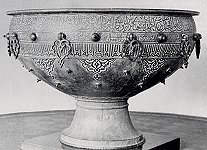
                  Bronze Cauldron
                  Made by 'Abd al-'Aziz ibn Sharaf al-Din Tabrizi in 1399 by order of Timur.
                  Bronze Jug
                  Inlaid with silver. Probably Heart, signed Habib Allah ibn 'Ali Baharjani, dated 1461.

                  Of gold and silver work apart from a very few pieces, nothing has survived from what must have been a superb output of articles and ornaments in precious metals. Miniatures show gold jewellery sometimes incrusted with stones. The use of precious and semiprecious stones for household objects was widespread under the direct influence of Chinese models. Jade in particular was employed for small bowls, jugs with dragon-shaped handles, and seal rings.

                  Recent research has demonstrated that the number of surviving Timurid ceramics is not nearly as small as it was once thought to be. In the early Timurid period no centre of ceramic production is known. However, it is certain that the Timurid capitals (Mashad and Herat in Khurassan, Bukhara and Samarkand in Central Asia) possessed large factories, where not only the magnificent tiles that decorated buildings of the period were produced, but also pottery.

                  Chinese blue and white porcelain (mainly bowls and large wide rim plates), introduced into Persia in the second half of the 14th century started a new fashion that dominated the production of ceramics throughout the 15th century. Against the white background, lotus flowers, ribbon shaped clouds, dragons, ducks on stylised waves etc. were drawn in various shades of cobalt blue. This style was to continue into the 16th century, when bolder motifs were developed with landscape and large animal figures.


                  Detail of a faience mosaic panel, which decorates the iwan on the south side of the Friday Mosque, at Isfahan. The subject is treated in Timurid style.
                  Timurid faience mosaic decoration, which adorns the façade of the principle iwan giving access to the Friday Mosque at Yazd.

                  From an architectural point of view, few innovations were made during the Timurid period with mosques constructed on an old Seljuk plan. The most important contribution of Timurid architecture; however, is in its decoration.

                  The introduction of faience mosaic ('tile mosaic') transformed the whole appearance of Timurid architecture and together with the use of patterned brickwork, became the most characteristic feature of architectural decoration. Huge surfaces were decorated with facings of carved arabesques and glazed tile work. The glaze was turquoise or deep blue, with white for the inscriptions.

                  Comment


                  • #24
                    THE SAFAVIDS

                    The Safavid dynasty, of Turkish origin, is generally considered to have lasted from 1502 to 1737, and under Shah Ismail's rule the Shi'ite doctrine was imposed as a state religion. The Safavids continued the attempts of the Ilkhanids to foster closer diplomatic ties with the European powers, in order to cement alliances against the Ottomans.

                    As a result of this closer relationship, the Safavids opened the door to European influence.

                    From the description of Western travellers it is known that there once existed wall paintings; with battle scenes in Shiraz showing the capture of Hormuz from the Portuguese, as well as erotic scenes in Julfa, and pastoral scenes at the Hazar Jarib palace in Isfahan.

                    Inside the Safavid palaces pictorial decoration was used alongside traditional decorations in Kashi or ceramics.


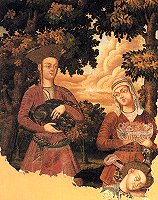
                    Safavid fresco (oil paint on plaster) "Attendants at an Outdoor feast". By Muhammad Zaman or his atelier, Isfahan, c. second half of 17th century

                    Early Safavid painting combined the traditions of Timurid Herat and Turkoman Tabriz to reach a peak in technical excellence and emotional expressiveness, which for many is the finest hour in Persian painting.

                    The masterpiece of the age is the Shahnama-yi Shahi (The King's Book of Kings, formally known as the Houghton Shah-nama) with its 258 paintings, which was the most lavishly illustrated Shah-nama recorded in all of Persian history.

                    Herat was the great Iranian miniature painting centre of the Timurid period, but in 1507, after its capture by the Safavids, the leading artists emigrated, some to India and some to the Safavid capital, Tabriz, or the Shaybanid capital, Bukhara.


                    Shah-nama of Shah Tahmasp, Tabriz, c. 1525. The scene depicts the death of King Mirdas.

                    One of the main innovations of the Bukhara miniaturists was the introduction of plant and animal motifs in the margins of their miniatures. It was in Tabriz, the other chief miniature centre of the period, that in 1522 Shah Ismail appointed the famous Behzad director of his library.

                    The Characteristic features of the Tabriz school can be seen in the illustrations for a manuscript of the Khamsa by Nezami; executed 1539 - 43 by Aqa Mirak of Isfahan, his pupil Sultan Muhammad, the Tabriz artists Mir Sayyid 'Ali, Mirza 'Ali, and Muzaffar 'Ali. Tabriz miniatures exploit the complete colour scale, and their compositions are complex and full of figures, which fill the space.


                    Khamsa by Nezami, miniature attributed to Sultan Muhammad. Safavid, Tabriz, c. 1539-43. The scene shows Sultan Sanjar and the old woman.

                    Shah Ismail's successor Shah Tahmasp, himself a painter, expanded the royal atelier. However, during the latter part of the 16th century, Shah Tahmasp became a religious extremist, lost interest in painting and stopped his patronage. This was the beginning of the end for the luxury book.

                    Many of the best artists left the court some going to Bukhara, others to India where they were instrumental in the formation of a new style of painting, the Mughal School. Those artists who remained turned from the production of lavishly illustrated manuscripts to separate drawings and miniatures for less wealthy patrons.

                    Some time around the end of the 16th century, with the transfer of the capital to Shiraz (1597), an official deregulation of the traditional code of book painting took place. Some painters turned to other media, experimenting with book covers in lacquer work or with full-length oil paintings.

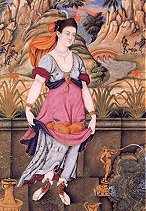
                    If earlier paintings had been about man in his natural environment, the late 16th and early 17th century is about man himself. The work of this period is dominated by large scale representation of seedy dervishes, Sufi shaikhs, beggers, merchants.... with satire as the driving force behind most of these pictures. Some of the same artists leant their talents to an altogether different genre of painting - the sensuous and erotic - with scenes of lovers, voluptuous women, etc. These were extremely popular and were produced mechanically with the minimum of effort.


                    Painting by Riza 'Abbasi, Isfahan, 1630. From the end of the 16th century, the human figure becomes more important in paintings and the subjects and treatment are sensuous. Drawings and paintings have a calligraphic quality.

                    Two main factors influenced artists between 1630 and 1722; the works of Riza, and European Art. In the drawings by Riza, the outline of basic shapes is accompanied by an obsession with pleats and folds, which normally serve to emphasise the sensuous curvature of bodily form, but on many occasions, reach the point of complete abstraction. In a country with a powerful calligraphic tradition, writing and drawing are always interconnected, but at this time the link seems to have been particularly strong so that drawing takes on the physical appearance of Shikastah or Nasta'liq1 calligraphy.


                    Woman by a fountain. By 'Ali Quli Bayg Jabbadar, Isfahan, c. 1650-60. The subject and style of painting here are clearly influenced by European art.
                    A youth and an old man. Two drawings mounted on the same album leaf. Both by Riza 'Abbasi. Isfahan c. 1620-5

                    By the second half of the 17th century, when Shah Abbas II sent the painter Muhammad Zaman to study in Rome, there was awakened a need in artists to find new ways of expression. Muhammad Zaman himself returned to Persia completely under the influence of Italian painting techniques. However, this did not lead to a great move forward in his style of painting; indeed his miniatures for the Shah-nama are in general banal and lack a sense of balance.


                    Comment


                    • #25
                      ZAND & QAJAR PERIODS;

                      The Qajar dynasty, which ruled Persia from 1794 to 1925, was not a direct continuation of the Safavid period. The invasion of the Ghilzai Afghan tribes with the occupation in 1722 of the Safavid capital Isfahan, and the eventual collapse of the Safavid Empire in the following decade plunged Iran into a period of political chaos. With the exception of the Zand interval (1750-79), the history of 18th century Iran was marred by tribal violence. This ended with the coronation of Aqa Muhammad Khan Qajar in 1796, which ushered in a period of political stability that was characterised by a revival of cultural and artistic life.

                      The Zand and Qajar periods saw a continuation of oil painting introduced in the 17th century, and the decoration of lacquer boxes and book-bindings. Illustrated historical manuscripts and single page portraits were also produced for a range of patrons, in a style consistent with that of Muhammad Ali (son of Muhammad Zaman) and his contemporaries. While the excessive use of shading sometimes endows these works with a dusky quality, they do display an improved understanding of the play of light (coming from a single source) on three-dimensional forms.

                      The evolution of Persian art in the 18th and 19th centuries can be divided into distinct phases, beginning with the reign of Karim Khan Zand (1750-79), Fath Ali Shah (1797-1834) and Nasir ad-Din Shah(1848-96).

                      During the Zand period, Shiraz became not only the capital but also the centre of artistic excellence in Iran, and Karim Khan's building program in the city attempted to emulate Shah Abbas' Isfahan. Shiraz was endowed with fortifications, palaces, mosques and other civil amenities.


                      Karim Khan was also a noted patron to painting, and the Safavid-European tradition of monumental figure painting was revived under the Zand dynasty, as part of an overall revival of the arts.

                      Zand artists were as versatile as their predecessors. As well as developing life-sized paintings (murals and oils on canvas), manuscripts, illustrations, watercolours, lacquer work, and enamels from the Saffavid dynasty, they added a new medium that of wash drawing. However, in their paintings, the results often appeared to be rigid, since the Zand artists in order to correct what they considered an excessive emphasis on three-dimensionality, attempted to lighten the composition by the introduction of decorative elements. Sometimes pearls and various jewels were painted on the headgear and clothing of the subjects.


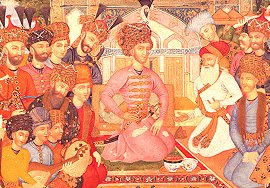
                      Shah Abbas II receiving a Mughal ambassador. Historical painting by 18th century Zand artist Abu'l Hasan Ghaffari Mustawfi Kashani. Notice the use of decorative elements in this painting.


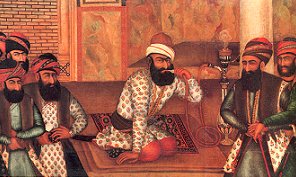
                      Karim Khan, who preferred the title Regent (Vakil) to that of Shah, did not demand that his painters prettify his appearance; he was happy to be shown at an informal and unpretentious gathering in a modest architectural setting.

                      The tone of these Zand paintings contrast sharply with the later images of Fath Ali Shah (the second of the seven rulers of the Qajar dynasty) and his court.

                      Karim Khan Zand and his kinsmen, by Muhammed Sadiq, Shiraz, c. 1779

                      There is an unquestionable Zand inheritance in early Qajar art. It is known that the founder of the Qajar dynasty, Aqa Muhammad Khan, decorated his Tehran audience hall with paintings looted from the Zand palace and Mirza Baba (one of Karim Khan's court artists) went on to become Fath 'Ali Shah's first painter-laureate.

                      Comment


                      • #26
                        Fath Ali Shah was particularly receptive to ancient Iranian influences, and numerous rock reliefs were carved in neo-Sassanian style, depicting the Qajar sovereign in the guise of Khosroe.

                        The best known reliefs are at Chashma-i-Ali, at Taq-i-Bustan, and in the vicinity of the Koran Gate in Shiraz.


                        Neo-Sassanian relief on a mountain side at Rayy, near Tehran, depicting Fath Ali Shah killing a lion. First half of 19th century.

                        Under Fath Ali Shah there was a clear return to tradition; however, at the same time late 18th century European court style appeared in the palaces in Tehran. European influences also mingle with Sassanian and neo-Achaemenid themes in the carved figural stucco of this period (as can be seen in many houses in Kashan).

                        Fath Ali Shah also used large-scale frescoes and canvasses to create an imperial personal image. Portraits of princes and historical scenes were used to adorn his new palaces and they were often shaped like an arch in order to fit into a space in the same shape on a wall. Fath Ali Shah also distributed several paintings to foreign powers such as Russia, Britain, France and the Austro-Hungarian Empire.


                        The interaction of popular style and European influence is even more evident in painting, with Flemish and Florentine elements appearing in the painting of the dancer "Mazda" by Madhi Shirazi (1819-20).

                        With the introduction of printing and large scale painting some of the finest Qajar miniature artists turned their hand to lacquer work such as book bindings, caskets, and pen boxes (qalamdan). The style is in particular cosmopolitan and characteristic of a court that attempted to combine the styles of Persepolis, Isfahan and Versailles.

                        Comment


                        • #27
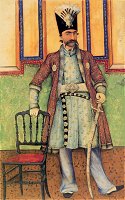
                          In the second half of the 19th century Nasir al Din Shah, as well as collecting European artworks supported a local school of portraiture which abandoned the style of Fath Ali Shah in favour of a European-influenced academic style. The works of these local artists ranged from state oil portraits to watercolours of unprecedented naturalism.

                          Photography now began to have a profound impact on the development of Persian paintings. Soon after it was introduced into Iran in the 1840s, Iranians promptly adopted the technology. Nasir-al Din Shah's Minister of Publication, I'timad al-Saltaneh, claimed that photography had greatly served the art of portraiture and landscape by reinforcing the use of light and shade, accurate proportions and perspective.


                          In 1896 Nasir al-Din Shah was assassinated and within ten years Iran had its first constitutional parliament. This period of political and social change saw artists exploring new concepts, both within and beyond the confines of imperial portraiture.

                          In the double portraiture of Muzaffar al-Din Shah the prematurely aged ruler is shown resting one arm on a cane, the other on the supporting arm of his Premier. The artist here conveys both the frail health of the Monarch and the Monarchy.


                          Portrait of Muzaffar al-Din Shah and Premier 'Abd al-Majid Mirza, 'Ayn al-Dawleh', by 'Abd al-Husayn (Sani' Humayun). Tehran, early 20th century

                          The most important artist of the late Qajar period was Muhammad Ghaffari, known as Kamal al-Mulk (1852-1940) who championed a new naturalistic style.


                          Comment


                          • #28
                            Qajar tile-work is usually unmistakable. The repertory of the so-called cuerda seca tiles shows a completely new departure from that of the Safavid period. For the first time representations of people and animals form the main subject matter; there are hunting scenes, illustrations from the battles of Rostam (the hero of the national epic, Shah-nama) soldiers, officials, scenes of contemporary life and even copies of European illustrations and photographs.


                            The Qajar technique par excellence - again triggered by European influence, in this case Venetian glass- was mirror-work. Mugarnes cells faced with mirrors yielded an original and spectacular effect, as can be seen in the Golestan palace in Tehran or the Hall of Mirrors in Mashad's Holy Shrine.


                            In the field of applied arts, only weaving continued to have an importance that extended beyond the borders of Iran, and during the Qajar period, the carpet industry gradually revived on a larger scale.

                            Although many traditional designs were retained, they were expressed in different ways, often smaller in scale than their Safavid prototypes, with the use of a brighter range of colours.

                            Comment


                            • #29
                              Ali Asghar Tajvidi was born in 1327 (Shamsi) in Fassa. He finished his elmentery educations there and went to Tehran to continue his studies.


                              In 1352m he began to study visual Arts in University of fine Arts in Tehran. In 1356 he graduated, attaining the first rate in position.

                              From his very childhood, he loved arts. His source of creativity at first was the beautiful nature. He, at first, began on drawing.

                              After getting experience in the field of painting, he faced Miniature, Iranian authentic painting and did his best in mastering this field. During his studies, he benefited the presence of the great artisian of the time, Mahmoud Farshchian.


                              Beside this, Tajvidi got experience in other fields such as oil painting and music. His aquanntance with the history of arts has had alive effect in his vast vision to standardize his system, and caused his to employ his skills for the Iranian favorit painting-Miniature.

                              Tajvidi works have been derived from Iranian traditional culture, history and literature.

                              Besides selecting literal and historical motifs, he has benefited from relgious subject matters, as well and has attempted some of his work.

                              While he has paid attention to pure traditional meaning of his art; by promoting normal moulds and creating new systems, he has employed expansibility of Iranian painting to express artistic thoughts anb goals.


                              Tajvidi has already taken part in several personal anb public exibitions such as public exibition of contemporary museum of arts and Niavaran culture gallery in Tehran and University of Shiraz exibition and Vessal Art Gallery in Shiraz and has been succesfull in all of them.

                              Comment


                              • #30
                                Persian carpets have been praised by the Thai Minister of Commerce Kroekrai Chiraphaet as a symbol of Iran's unique craftsmanship.

                                "The carpets on display here illustrate Iran's unique sense of taste for art; Iranian carpet weavers have no rivals in the world," the Thai official said at the opening of the 1st Persian carpet exhibit in Bangkok.

                                He also pointed to the strong ties between the two Asian countries, saying that Iran is a strategic partner of Thailand.

                                The exquisite hand-woven carpets exhibit, which opened on Friday at Bangkok's Intercontinental Hotel, is named 'Carpets, Iranian Cultural Heritage'. It is currently showcasing over 100 different carpets and will run until October 21.

                                Iran's ambassador to Thailand, Mohsen Pakaein, who had also attended the inaugural ceremony of the exhibition, said, "Persian carpets demonstrate Iranian identity, art, history and industry."

                                "Iranian carpets are the country's top non-oil export. Over 5 million people work in the industry throughout the nation," he added.

                                Comment

                                Working...
                                X