Announcement

Collapse
No announcement yet.

The 25 Greatest PCs of All Time

Collapse
X
 
  • Filter
  • Time
  • Show
Clear All
new posts

  • #16
    11. Sony VAIO 505GX (1998
    In late 1997 Sony introduced the VAIO PCG-505 in Japan, proving not only that thin was in, but that being thin no longer meant compromising on computing power. The PCG-505 measured just 0.94 inches thick--amazingly slim for the time--and weighed a mere 3 pounds (the chassis was made of magnesium alloy). And when this notebook first hit the United States in the latter half of 1998 as the Sony VAIO 505GX, it spurred an ultraportable revolution.

    At $2699, the 505GX didn't come cheap. But it packed in a fair amount of functionality for a compact notebook PC, including a roomy, comfy 10-inch-wide keyboard (1 inch wider than the keyboards of competing subnotebooks of its time). The 505GX improved on the Japan-only version with specs that included a Pentium MMX-266 CPU and a 56-kbps modem. In PC World's tests at the time, the notebook's lithium ion battery lasted 4.7 hours, which we deemed "an adequate figure but hardly stellar."

    Sony continued the 505 line with later iterations such as the X505; its current ultraportables, such as the TX line, retain some of the 505's design flair.
    Comment


    • #17
      10. Apple PowerBook 100 (1991)
      If your first portable computer doesn't succeed, try, try again. That's the lesson of the PowerBook 100, Apple's splendid successor to the famously awful Mac Portable, a machine we named to our list of the 25 worst tech products of all time.

      Along with the higher-end PowerBook 140 and 170, the $2500 100 sported two features that the rest of the industry quickly cribbed. First, the company pushed the keyboard back toward the screen hinge, freeing up space for a wrist-rest area that made typing more comfortable. And in the center of that wrist rest sat a nice, large trackball, the best mobile pointing device of its era. (At the time, folks who ran Windows on portable computers were still futzing with unwieldy clip-on trackballs.) Those were just two of the more striking innovations in a slick laptop design that, according to Jim Carlton's book Apple, took the company from last place to first in laptop sales.

      The PowerBook 100--which was, by the way, manufactured by Sony--was discontinued in 1992. But the PowerBook line went on and on, coming to an end just this year, when the final 12-inch PowerBook was replaced by the MacBook.

      Comment


      • #18
        9. Columbia Data Products MPC 1600-1 (1982)
        When IBM created its first PC, it used an Intel 8088 CPU, off-the-shelf parts, and Microsoft's DOS--which meant that other manufacturers could build machines that were at least reasonably compatible with it. They did, and the very first to ship one was Columbia Data Systems.

        The $2995 MPC, whose name was short for "Multi Personal Computer," had double the typical IBM PC's RAM, more expansion slots and ports, and two floppy drives rather than one. At the time, Columbia's Fred Conte told InfoWorld that he didn't see the system going head-to-head with Big Blue. "It is a multibillion dollar marketplace, and if we can pick up a small percentage--say, 2 to 3 percent--it will be a luxury," he said.

        Columbia's PC soon had lots of company. At the COMDEX show in November 1982, a flurry of what were then called "IBM look-alikes" were announced--so many that the show also saw the announcement of the first magazine specifically "For Second-Generation IBM PCs and Compatibles." Its name? PC World.

        By the mid-1980s, Columbia foundered, and though the company still exists, it hasn't built a PC in a long time. But by producing the clone that other clones cloned, the company helped to define the Intel-and-Microsoft platform that dominates to this day.

        Comment


        • #19
          8. Tandy TRS-80 Model 100 (1983)
          Though not quite the first notebook computer--Epson's forgotten HX-20 preceded it--Tandy's Model 100 was the first that caught on. (One thing that didn't catch on: Tandy's desire that the machine be known as a MEWS, for Micro Executive Work Station.)

          In a day when most "portable computers" were 25-pound behemoths, the 3.4-pound Model 100 was indeed the size of a notebook, which meant it could go places that computers had never gone before. Yet it packed a 2-by-7.5-inch screen that could display 40 characters across and eight lines of text; a full-size keyboard that's still impressive today; built-in software such as a word processor and spreadsheet; and a 300-bps modem that let you connect to services such as CompuServe.

          Variants of the Model 100 included 1984's Model 200, which introduced the clamshell case that almost every portable computer would eventually adopt. Well into the 1990s, some journalists were still toting these Radio Shack systems--and sites such as Club 100 continue to help people use them.

          Comment


          • #20
            7. Commodore Amiga 1000 (1985)
            The Commodore 64 may have been the best-selling computer of its time, but its follow-up, developed by a Silicon Valley startup that Commodore acquired, was a vastly better computer. Years ahead of its time, the Amiga was the world's first multimedia, multitasking personal computer (see an early commercial for it on YouTube).

            The $1500 (sans monitor) Amiga came with the same Motorola 68000 CPU used in the Apple Macintosh. But the most innovative thing about its architecture was its three coprocessors--they helped provide the Amiga's graphics and sound, which were stunning for the time. Its main video processor (dubbed Denise) helped Amigas accomplish feats like 3D animation, full-motion video, and fancy TV processing years before other computers. And the four-voice stereo sound chip (Paula) provided speech synthesis, produced more realistic audio than the Commodore 64's famous SID chip, and helped inspire Soundtracker, the first "tracker-style" music sequencing program.

            The original Amiga was rechristened the Amiga 1000 when it was replaced by the Amiga 500 and 2000 in 1987; later Amiga-based products included the Amiga 4000T tower and the CD32, a gaming console. Commodore declared bankruptcy in 1994, and the Amiga name and technologies bounced from owner to owner in subsequent years. Modern iterations of NewTek's Video Toaster and LightWave 3D software continue to be used for major TV and movie productions to this day.

            Comment


            • #21
              6. IBM Personal Computer, Model 5150 (1981)
              Many key moments in PC history weren't identifiable as such when they happened. (Was there any reason to pay much attention when a couple of young guys named Steve decided to start a microcomputer company and name it after a type of fruit?) But when the company that was synonymous with computers announced its first PC on August 12, 1981, everyone knew it was a great milestone in the history of a very young industry.

              Technology-wise, the most interesting thing about IBM's Personal Computer, Model 5150, was its CPU: Intel's 8088, a powerful 16-bit processor in an era when most popular models still used basic 8-bit CPUs. IBM offered the system with several operating systems, including the then-popular CP/M, something called P-System, and a new OS that IBM named PC-DOS but that most people would remember as MS-DOS for versions marketed by publisher Microsoft. (Legendarily, Microsoft's OS was based on QDOS, or "Quick and Dirty Operating System," which it picked up for a song from a small Seattle company.)

              Within 18 months IBM's machine sat at the center of a booming PC ecology, with a bevy of hardware add-ons, third-party software, clones, books, and magazines. Some of IBM's later machines were hits and some were flops, but all of them, like the vast majority of computers on the planet today, were direct descendants of the IBM Personal Computer. (Read IBM's take on its own archives.)

              Comment


              • #22
                5. IBM ThinkPad 700C (1992)
                Unveiled at Comdex in 1992, IBM's ThinkPad 700C ushered in a new era for laptop computers: Now, the laptop could be both useful and stylish. The first ThinkPad's distinctive black case and its red TrackPoint pointing device in the middle of the keyboard were striking departures from other notebooks, which tended to be practically interchangeable, chunky, dull gray or beige boxes with trackballs that hung off to the side or sat like a lump below the keyboard.

                One of three ThinkPad models at launch, along with the 300 and 500 (the numbering scheme was reportedly inspired by BMW's car lines) the $4350 ThinkPad 700C was IBM's top-of-the-line system. It came with an eye-catching 256-color, 10.4-inch TFT VGA color screen (large by 1992 standards), a removable 120MB hard drive, a 25-MHz 486SLC processor, and a comfortable touch-typist-friendly keyboard. Current ThinkPads--now manufactured by Lenovo--may be radically more powerful than the 700C, but they retain the black case, TrackPoint, and fine keyboard as major selling points. (See the ThinkPad's evolution at Lenovo's archive.)

                PC World recognized the ThinkPad's significance right away: The product won a World Class award in 1993. In 2004 it became the first--and to date, only--product inducted into the World Class Hall of Fame.

                Comment


                • #23
                  4. Apple Macintosh Plus (1986)
                  In 1984 Apple released the original Macintosh, which, while heavily influenced by the Xerox Star, was a breakthrough personal computer. But its 128KB of memory was so skimpy that the machine was virtually unusable. The company really hit the ball out of the park in 1986 with the Macintosh Plus (see the specs of this Apple model and others at Apple-History.com).

                  The $2599 Mac Plus had the same Motorola 68000 processor as the original Mac, but it came with a roomy 1MB of RAM and was upgradeable to 4MB of RAM. It supported the brand-new 800KB double-sided floppy-disk format, and was the first Mac with a SCSI port for fast data transfer to and from an external hard drive. Like earlier Macs, its cute beige all-in-one case housed a monochrome 512-by-342-pixel display and the 3.5-inch floppy drive. It also came with matching beige input devices: a sturdy keyboard with a numeric keypad connected by a coiled cord, and a boxy, rectangular mouse.

                  Apple sold the Mac Plus until 1990, making it the longest-selling Mac model ever. By then it had received cult notoriety via a cameo in the movie Star Trek IV: The Voyage Home. Today, working Mac Plus models sell on eBay for about $25. Nonworking models have found an entirely different afterlife: They've been reincarnated as fish tanks.

                  Comment


                  • #24
                    3. Xerox 8010 Information System (1981)
                    As Winston Churchill might have put it, rarely have so many computers owed so much to such a flop. The flop in question is Xerox's 8010 Information System (better known as the Star), the computer that commercialized many of the breakthroughs invented in the company's legendary PARC research labs and first seen in the Alto computer (which was never sold as a commercial product).

                    Announced in 1981 and shipped in 1982, the Star had a graphical user interface with what-you-see-is-what-you-get graphics and a desktop metaphor (which, as documented at the DigiBarn computing museum, still look impressive today). It used a mouse, a device that was so unfamiliar that Xerox's documentation also called it a "hand-held pointer." It had built-in ethernet networking, and could work with "a 12-ppm laser printer that was three-fourths the size of a washing machine," says Dave Curbow, who joined the Star team as a software engineer in 1983. "There were way too many firsts to enumerate."

                    It also had a hefty price tag--$16,500 per unit--that was just the beginning, since the whole idea was that a business would outfit itself with multiple networked workstations, servers, and peripherals. "You couldn't buy one machine and do anything," Curbow explains.

                    Given that the notion of buying even a single small computer was so new at the time, it's not startling that Xerox had trouble selling companies on the Star. A couple of years later, Apple's far cheaper, Xerox-influenced $2495 Macintosh found more success. And over time, virtually every one of Xerox's out-there ideas became a core part of the everyday computing experience.

                    Comment


                    • #25
                      2. Compaq Deskpro 386 (1986)
                      For the first few years of the IBM PC-compatible era, the industry had one undisputed leader--Big Blue itself. Then an odd thing happened: Intel introduced the powerful 80386 CPU, its first 32-bit processor, and it was Compaq, not IBM, that brought a 386 PC to market before anyone else.

                      The Deskpro 386's $6499 starting price wasn't as sky-high as it sounds today considering that decent configurations of IBM's AT cost at least $5000 and its high-end RT usually topped $16,000. With a 32-bit bus and 16-MHz clock speed, "on CPU performance alone the Deskpro 386 inhabits another league," PC World wrote at the time.

                      In 1986 it wasn't a given that a next-generation PC would run previous-generation software out of the box; the IBM RT, which used a RISC CPU, didn't. And so the fact that the Deskpro ran DOS, Windows, Lotus 1-2-3, and other major applications perfectly was as much of a selling point as the fact it did so with blazing speed.

                      The Deskpro 386 wasn't just one of the most powerful, most popular PCs of its time--it was also compelling proof that the PC platform was far bigger than any one company.

                      Comment


                      • #26
                        Greatest PCs: Number 1
                        1. Apple II (1977)

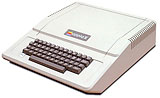
                        The Apple II wasn't the first personal computer, or the most advanced one, or even the best-selling model of its age. But in many ways it was The Machine That Changed Everything. On all four of our criteria--Innovation, Impact, Industrial Design, and Intangibles--it was such a huge winner that it ended up as our Greatest PC of All Time.

                        The 8-bit system came with 4KB of memory, expandable to 48KB. It used a cassette rather than a disk for storage. It cost $1200, about twice the base price of its two biggest competitors, the Tandy TRS-80 Model I and the Commodore PET 2001. It couldn't even display lowercase letters (in the first several years of its existence, anyway). Yet it packed more pure innovation than any other early computer, and was the first PC that deserved to be called a consumer electronics device.

                        Born out of the Home Brew Computer Club by Steve Wozniak and Steve Jobs's tiny Apple Computer in 1977, the Apple II was the company's second PC, but it boasted more than its share of firsts: It was the first color PC (you could even use it with a television), the first to be easily expandable by users, and the first to run the VisiCalc spreadsheet--proving that these new boxes had a place in business.

                        Perhaps its greatest innovation was its design. Jobs wanted the machine to look at home on people's desktops, so he insisted that the Apple II have a sleek look, as opposed to the sheet-metal-and-exposed-wire appearance of most other early PCs. The machine's coolness factor--an Apple trademark to this day--was as important to its long-term success as Wozniak's inventive engineering was.

                        And we do mean long-term: From the original Apple II model that debuted at the first West Coast Computer Faire in April 1977 to the discontinuation of the final iteration of the IIe in December 1993 (outlasting the 16-bit IIGS model that was introduced years after it), more than 2 million Apple II-family PCs had been produced. The Apple II line, well documented at Steven Weyhrich's Apple II History site, kept the company going through the Apple Lisa debacle and other turbulent events of the 1980s. By the middle of that decade, though, Apple had turned its attention to that other world-beater, the Macintosh Plus (number 4 on our list). But it was the Apple II that put the personal in the nascent personal computer industry. The rest is history.

                        Comment


                        • #27
                          I love RED ALERT, CIVILIZATION, ROME, EMPIRE EARTH
                          نه غزه نه لبنان جانم فدای ایران


                          صادق هدايت؛ بوف کور

                          Comment

                          Working...
                          X