
Backgammon, or Takhteh Nard (Battle on Wood) in Persian, is not just a game; it’s a culture, a history, and part of the Iranian identity. People all across Asia claim the game as their own and Iranians are no exception. The game has evolved throughout time and many believe that it is the oldest recorded game in history - even more ancient than chess - and despite all the churches and mosques banning it at various points throughout history, the game has survived and is more widespread now than ever before
The game is a growing phenomenon played by Iranians, Greeks, Arabs, Turks, Chinese, Russians and many more in cafes, hooka bars, and homes all across the world. I even visited a backgammon bar while I was in Greece a couple years ago where dozens of Greek youth were playing while having a drink. The game means different things to different people, but for me, as a child growing up in northern Orange County, I learned to play many games, but I grew to love backgammon for three reasons.
The First Reason: Unlike chess, backgammon has a strategy component as well as a luck component through two pieces of dice you roll each time it’s your turn and for that reason some people find the game unsatisfying relative to chess, a game based purely on strategy and no luck. Chess players hold their game in higher regard because they believe that chess is more realistic as they feel it can better parallel the world, especially when viewing the history of the Great Game between Britain and Russia during the 19th century when they competed for territory in Asia.
More recently, chess and its strategy of positioning pieces can be seen through the lens of the Cold War when America and the Soviet Union positioned themselves against each other in various countries. What most chess fans fail to consider, however, is that luck plays an important role in the world arena, even in world politics, which is why I feel that backgammon is more relative as it employs luck as well as strategy to its game.
The Second Reason: My grandfather taught me how to play. There was a language barrier between us. Where I spoke broken Persian as a child, he spoke broken English, but while playing backgammon, we spoke the same language. We bonded and through that bond, I was a bit closer to my Iranian identity. Like I said before, growing up Iranian or Middle Eastern in America is no easy task, whether it is after the Hostage Crisis or after September 11th. In our struggle for a sense of self, many of us immigrants connect to our homeland via different concepts.
Some Iranians growing up in America are able to identify with being Iranian for a number of reasons such as their love for the Persian language, poetry from Sa’adi, Hafez, or Rumi, Iranian history, Persian dance, Iranian cuisines, their relationship with their parents or grandparents, etc. For me as well as many others, it was a combination of the aforementioned concepts.
Backgammon, however, helped pave the way for me to connect to my grandfather and through my grandfather, Iran. We spent and still spend countless hours playing and while competing in the historic game, he’ll tell me about his life in pre-developed Iran and onwards and his life isn’t just a personal story, it is the story of a nation from a man’s perspective who witnessed great events as well as personal experiences that will not be found in any history book on Iran.
The Third Reason: Anyone who considers himself an avid contender will know that backgammon is nothing, no fun at all, without the trash talk or kor kori khoondan. As a child playing my grandfather I didn’t talk any kor kori mostly because I was a novice and as such, I was rarely winning to be able to talk trash, but I certainly listened to a lot of it, and it was quite witty I might add. For instance, my grandfather would be ahead 3-0 and he’d ask me what the score was, even though he knew, so I’d be reduced to telling him that I was zero and him three and he’d always jokingly follow with: “kay heech shodi,” or “when did you become zero?”
In any case, when UC Berkeley’s Iranian Student Alliance in America held a backgammon tournament, I knew I had to compete not just to win, but to make my backgammon mentor proud. And although I lost in the final round and won second place, I came back with a full heart in the next two tournaments and won first place both times around. He never said so, but I knew he was proud to know his apprentice was representing not just him, but his homeland. Like I said before, backgammon is not just a game, it’s a culture, a history, and part of my Iranian identity.
Some recommendations to consider:
Never play on Yahoo because Yahoo backgammon rules do not conform to Iranian backgammon rules.
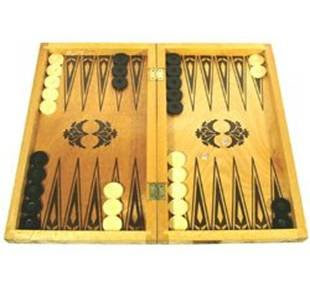
When given a choice of playing on a wooden board or a cardboard table, always choose the wooden board, as the sound of the dice rolling on the board is key to any game experience.
Never play with dice that have rounded corners because the dice will spin after you roll them, where perfectly square dice with flat edges land perfectly without any spin.
The game is a growing phenomenon played by Iranians, Greeks, Arabs, Turks, Chinese, Russians and many more in cafes, hooka bars, and homes all across the world. I even visited a backgammon bar while I was in Greece a couple years ago where dozens of Greek youth were playing while having a drink. The game means different things to different people, but for me, as a child growing up in northern Orange County, I learned to play many games, but I grew to love backgammon for three reasons.
The First Reason: Unlike chess, backgammon has a strategy component as well as a luck component through two pieces of dice you roll each time it’s your turn and for that reason some people find the game unsatisfying relative to chess, a game based purely on strategy and no luck. Chess players hold their game in higher regard because they believe that chess is more realistic as they feel it can better parallel the world, especially when viewing the history of the Great Game between Britain and Russia during the 19th century when they competed for territory in Asia.
More recently, chess and its strategy of positioning pieces can be seen through the lens of the Cold War when America and the Soviet Union positioned themselves against each other in various countries. What most chess fans fail to consider, however, is that luck plays an important role in the world arena, even in world politics, which is why I feel that backgammon is more relative as it employs luck as well as strategy to its game.
The Second Reason: My grandfather taught me how to play. There was a language barrier between us. Where I spoke broken Persian as a child, he spoke broken English, but while playing backgammon, we spoke the same language. We bonded and through that bond, I was a bit closer to my Iranian identity. Like I said before, growing up Iranian or Middle Eastern in America is no easy task, whether it is after the Hostage Crisis or after September 11th. In our struggle for a sense of self, many of us immigrants connect to our homeland via different concepts.
Some Iranians growing up in America are able to identify with being Iranian for a number of reasons such as their love for the Persian language, poetry from Sa’adi, Hafez, or Rumi, Iranian history, Persian dance, Iranian cuisines, their relationship with their parents or grandparents, etc. For me as well as many others, it was a combination of the aforementioned concepts.
Backgammon, however, helped pave the way for me to connect to my grandfather and through my grandfather, Iran. We spent and still spend countless hours playing and while competing in the historic game, he’ll tell me about his life in pre-developed Iran and onwards and his life isn’t just a personal story, it is the story of a nation from a man’s perspective who witnessed great events as well as personal experiences that will not be found in any history book on Iran.
The Third Reason: Anyone who considers himself an avid contender will know that backgammon is nothing, no fun at all, without the trash talk or kor kori khoondan. As a child playing my grandfather I didn’t talk any kor kori mostly because I was a novice and as such, I was rarely winning to be able to talk trash, but I certainly listened to a lot of it, and it was quite witty I might add. For instance, my grandfather would be ahead 3-0 and he’d ask me what the score was, even though he knew, so I’d be reduced to telling him that I was zero and him three and he’d always jokingly follow with: “kay heech shodi,” or “when did you become zero?”
In any case, when UC Berkeley’s Iranian Student Alliance in America held a backgammon tournament, I knew I had to compete not just to win, but to make my backgammon mentor proud. And although I lost in the final round and won second place, I came back with a full heart in the next two tournaments and won first place both times around. He never said so, but I knew he was proud to know his apprentice was representing not just him, but his homeland. Like I said before, backgammon is not just a game, it’s a culture, a history, and part of my Iranian identity.
Some recommendations to consider:
Never play on Yahoo because Yahoo backgammon rules do not conform to Iranian backgammon rules.
When given a choice of playing on a wooden board or a cardboard table, always choose the wooden board, as the sound of the dice rolling on the board is key to any game experience.
Never play with dice that have rounded corners because the dice will spin after you roll them, where perfectly square dice with flat edges land perfectly without any spin.




Comment