
BLOODS
The Bloods were formed when several members of the Pirus called on a meeting with other smaller gangs in Los Angeles, to form an alliance called the Bloods. Knowing that the Crips used the color blue to identify each other, the Bloods decided to use an opposing color, red, to identify each other.There has also been a set by the name of the Lime Street Pirus who wear the color green.
During the 1990s, there have been many alleged Bloods gang members in New York City. It has been said that they were formed on Rikers Island, New York City's largest jail facility. While in New York, they have become infamous for various slashings [1].
Following several months of gang violence that killed 40 people, the Tookie Protocol For Peace was negotiated between the Bloods and the Crips in May of 2004. Former Crips member and founder, the late Stanley Tookie Williams helped negotiate the "perpetual peace treaty"
A number of popular West Coast rappers are affiliated with Bloods gangs. Ex-G-Unit rapper The Game is a member of the Cedar Block Piru Bloods in Compton, and rapper/producer DJ Quik, also a Compton native, is a known member of the Tree Top Piru Bloods. The Boo-Yaa TRIBE are members of a Samoan Bloods gang in Carson City [3], and Westside Connection rapper Mack 10 is from the Queen Street Bloods in Inglewood. In 1995, Los Angeles producer Ron "Ronnie Ron" Phillips produced the self-titled debut album of the Damu Ridaz, a rap group consisting of gang members from the Denver Lane Bloods.
Entertainers with Blood affiliations
* Suge Knight ( Mob Piru Bloods )
* The Game ( Cedar Block Piru Bloods )
* DJ Quik ( Tree Top Piru Bloods )
* Mack 10 ( Queen Street Inglewood Bloods )
* Tha Realest ( Compton Piru Bloods )
* Top Dogg ( Compton Piru Bloods )
* G.P. ( Compton Piru Bloods )
* Boo-Yaa Tribe ( West Side Piru Bloods, Carson Samoan Warriors )
* B-Real ( of Cypress Hill ) (89th Street Family Swan Bloods )
* Sinister ( 89th Street Family Swan Bloods )
* Treach ( of Naughty by Nature ) ( Lime Street Piru Bloods )
* Damu Ridaz ( Denver Lane Bloods )
* Lee Clarke ( Craigyhill Piru Bloods )
* Dipset/Diplomats (145th, Harlem Bloods)
[edit]
Trivia
* According to a Los Angeles Weekly profile, the Bloods generally refuse to use the letter C in names, especially when names start with a C, replacing it with the letter K. Or use lower case c and upper case K, ie: cKrab, cKompton.
* The Bloods refer to crips in disrespect as "krabs".
Clothing
Many gangs identify with a particular color and display that color by flashing it. This is commonly done by wearing or displaying a colored T-shirt, bandanna, hat, or belt. Some colors commonly associated with major gangs are blue with the Crips and Sureños, and red with Bloods and Norteños. In recent times, due to increased vigilance by community members and law enforcement officers, more subtle patterns have been adopted, such as wearing a colored t-shirt under a white or black one, wearing clothing with colored details or insignias, or flashing using shoelaces.
In addition, some gangs associate the manner in which an article is worn to designate membership, such as a hat tilted to the left or to the right, or a bandanna of any color hanging from the left or right side of the rear pants pocket.
Tattoos
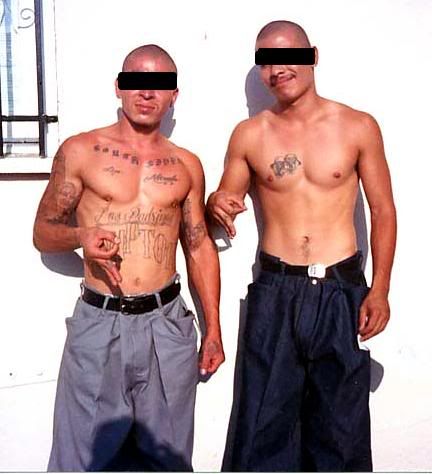
Tattoos have long been associated with gang membership, and connote the toughness desired by gang members as well as the permanence of gang affiliation. The designs used are frequently very symbolic and often occur again and again in the symbology of a particular gang, with some variation from area to area or to represent particular deeds (murder being one example).
The gang symbols used in tattoos and graffiti (below) are sometimes fairly involved, and often refer to the mythology and meaning that a gang may invent for itself. For example, the Star of David represents the Folk Nation once led by a man known as King David. In addition, each point of the star represents a "value" of the "nation." Norteños, commonly associated with Nuestra Familia, use the numbers 14 and 4 to refer to themselves, referencing the fact that N is the 14th letter of the alphabet.
Graffiti
Graffiti has also long been seen as a gang activity, and is most related to the fact that many gangs have particular areas that they try to control. As above, the graffiti is often very symbolic and may contain more information, such as what activities the gang participates in and with whom they are at war. However, while gangs may bring graffiti, often graffiti is not the result or an indicator of significant gang activity.
Hand signs
"Throwing up" a gang sign with the hands is one of the most known and obvious forms of "claiming." It is used in many situations where other identifiers may not be possible or appropriate, and can also show that a gang member is in the area to "do business" as opposed to just passing through. Usually these signs are made by formation of the fingers on one or both hands to make some sort of symbol or letter. It can also serve to relay more specific information, such as what set they represent within a larger gang or in which activities they are currently taking part. These signs, because they are displayed only when wanted (as opposed to the types of identifiers above) are usually the most consistent across various areas. Many of these hand signals are quite close to other common hand signs, and this can cause confusion amongst gang members, non-gang members, and anti-gang authorities.
Another identifier that can be displayed only when desired is a gang handshake, also called "gripping up", usually including some component of the gang hand sign and/or other symbols.
Legal ramifications
Gang signs have been considered illegal in many situations, including schools, workplaces, and domestic settings. In addition, it is dangerous in many areas to display gang signs, knowingly or otherwise.





The Bloods were formed when several members of the Pirus called on a meeting with other smaller gangs in Los Angeles, to form an alliance called the Bloods. Knowing that the Crips used the color blue to identify each other, the Bloods decided to use an opposing color, red, to identify each other.There has also been a set by the name of the Lime Street Pirus who wear the color green.
During the 1990s, there have been many alleged Bloods gang members in New York City. It has been said that they were formed on Rikers Island, New York City's largest jail facility. While in New York, they have become infamous for various slashings [1].
Following several months of gang violence that killed 40 people, the Tookie Protocol For Peace was negotiated between the Bloods and the Crips in May of 2004. Former Crips member and founder, the late Stanley Tookie Williams helped negotiate the "perpetual peace treaty"
A number of popular West Coast rappers are affiliated with Bloods gangs. Ex-G-Unit rapper The Game is a member of the Cedar Block Piru Bloods in Compton, and rapper/producer DJ Quik, also a Compton native, is a known member of the Tree Top Piru Bloods. The Boo-Yaa TRIBE are members of a Samoan Bloods gang in Carson City [3], and Westside Connection rapper Mack 10 is from the Queen Street Bloods in Inglewood. In 1995, Los Angeles producer Ron "Ronnie Ron" Phillips produced the self-titled debut album of the Damu Ridaz, a rap group consisting of gang members from the Denver Lane Bloods.
Entertainers with Blood affiliations
* Suge Knight ( Mob Piru Bloods )
* The Game ( Cedar Block Piru Bloods )
* DJ Quik ( Tree Top Piru Bloods )
* Mack 10 ( Queen Street Inglewood Bloods )
* Tha Realest ( Compton Piru Bloods )
* Top Dogg ( Compton Piru Bloods )
* G.P. ( Compton Piru Bloods )
* Boo-Yaa Tribe ( West Side Piru Bloods, Carson Samoan Warriors )
* B-Real ( of Cypress Hill ) (89th Street Family Swan Bloods )
* Sinister ( 89th Street Family Swan Bloods )
* Treach ( of Naughty by Nature ) ( Lime Street Piru Bloods )
* Damu Ridaz ( Denver Lane Bloods )
* Lee Clarke ( Craigyhill Piru Bloods )
* Dipset/Diplomats (145th, Harlem Bloods)
[edit]
Trivia
* According to a Los Angeles Weekly profile, the Bloods generally refuse to use the letter C in names, especially when names start with a C, replacing it with the letter K. Or use lower case c and upper case K, ie: cKrab, cKompton.
* The Bloods refer to crips in disrespect as "krabs".
Clothing
Many gangs identify with a particular color and display that color by flashing it. This is commonly done by wearing or displaying a colored T-shirt, bandanna, hat, or belt. Some colors commonly associated with major gangs are blue with the Crips and Sureños, and red with Bloods and Norteños. In recent times, due to increased vigilance by community members and law enforcement officers, more subtle patterns have been adopted, such as wearing a colored t-shirt under a white or black one, wearing clothing with colored details or insignias, or flashing using shoelaces.
In addition, some gangs associate the manner in which an article is worn to designate membership, such as a hat tilted to the left or to the right, or a bandanna of any color hanging from the left or right side of the rear pants pocket.
Tattoos
Tattoos have long been associated with gang membership, and connote the toughness desired by gang members as well as the permanence of gang affiliation. The designs used are frequently very symbolic and often occur again and again in the symbology of a particular gang, with some variation from area to area or to represent particular deeds (murder being one example).
The gang symbols used in tattoos and graffiti (below) are sometimes fairly involved, and often refer to the mythology and meaning that a gang may invent for itself. For example, the Star of David represents the Folk Nation once led by a man known as King David. In addition, each point of the star represents a "value" of the "nation." Norteños, commonly associated with Nuestra Familia, use the numbers 14 and 4 to refer to themselves, referencing the fact that N is the 14th letter of the alphabet.
Graffiti
Graffiti has also long been seen as a gang activity, and is most related to the fact that many gangs have particular areas that they try to control. As above, the graffiti is often very symbolic and may contain more information, such as what activities the gang participates in and with whom they are at war. However, while gangs may bring graffiti, often graffiti is not the result or an indicator of significant gang activity.
Hand signs
"Throwing up" a gang sign with the hands is one of the most known and obvious forms of "claiming." It is used in many situations where other identifiers may not be possible or appropriate, and can also show that a gang member is in the area to "do business" as opposed to just passing through. Usually these signs are made by formation of the fingers on one or both hands to make some sort of symbol or letter. It can also serve to relay more specific information, such as what set they represent within a larger gang or in which activities they are currently taking part. These signs, because they are displayed only when wanted (as opposed to the types of identifiers above) are usually the most consistent across various areas. Many of these hand signals are quite close to other common hand signs, and this can cause confusion amongst gang members, non-gang members, and anti-gang authorities.
Another identifier that can be displayed only when desired is a gang handshake, also called "gripping up", usually including some component of the gang hand sign and/or other symbols.
Legal ramifications
Gang signs have been considered illegal in many situations, including schools, workplaces, and domestic settings. In addition, it is dangerous in many areas to display gang signs, knowingly or otherwise.


Comment