
 Noah
Noah or Noach (Hebrew: נוֹחַ or נֹחַ, Standard Nóaḥ Tiberian Nōªḥ; Arabic: نوح, Nūḥ; "Rest") was the tenth and last of the antediluvian Patriarchs, best known for the Deluge which came in his time. His story is contained in the Hebrew Bible's book of Genesis, chapters 5-9.
While the Deluge and Noah's Ark are the best-known element of the story of Noah, he is also mentioned as the "first husbandman" and the inventor of wine, as well as in connection with the somewhat mysterious episode of his drunkenness and the subsequent Curse of Ham. Some analyses of the text of the story have suggested that its present form combines two originally separate sources, possibly relating to two separate stories, and that it contains elements of earlier Mesopotamian mythology, although both of these points are disputed and controversial.
The story of Noah was the subject of much elaboration in the later Abrahamic traditions, and was immensely influential in Western culture.
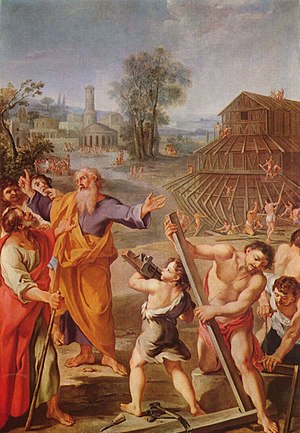
This is the story of Noah according to chapters 5–9 of the book of Genesis.
Noah was the son of Lamech, and the tenth generation after Adam. "And [Lamech] called his name Noah, saying, "Out of the ground which the Lord has cursed this one shall bring us relief from our work and from the toil of our hands." From Noah's sons, Shem, Japheth and Ham, all the peoples of the world would be descended.
When Noah was six hundred years old, God decided to send a great flood to destroy all life, for He was angered at the wickedness of man. But He saw that Noah was a righteous man, and warned him to build a vessel for himself and his family, "and of every living thing of all flesh ... so that life might yet be saved.And so the Flood came, and all life was extinguished, except for those who were with Noah, "and the waters prevailed upon the earth a hundred and fifty days. "But God remembered Noah," the waters receded, and the Ark came to rest on the mountains of Ararat.
There Noah built an altar to God (the first altar mentioned in the Bible) and made an offering. "And when the Lord smelled the pleasing odour, the Lord said in his heart, 'I will never again curse the ground because of man, for the imagination of man's heart is evil from his youth; neither will I ever again destroy every living creature as I have done. While the earth remains, seedtime and harvest, cold and heat, summer and winter, day and night, shall not cease'.
Then God made a covenant: Noah and his descendants would henceforth be free to eat meat ("every moving thing that lives shall be food for you, and as I gave you the green plants, I give you everything"), and the animals would fear man; and in return, man would be forbidden to eat "flesh with its life, that is, its blood." And God forbade murder, and gave a commandment: "Be fruitful and multiply, bring forth abundantly on the earth and multiply in it." And as a sign of His covenant, He set the rainbow in the sky, "the sign of the covenant which I have established between me and all flesh that is upon the earth."
The story of Noah concludes: "Noah was the first tiller of the soil. He planted a vineyard; and he drank of the wine, and became drunk, and lay uncovered in his tent." Noah's son Ham saw his father naked and informed his brothers, who covered Noah while averting their eyes. Noah awoke and cursed Ham's son Canaan with eternal slavery, while giving his blessing to Shem and Japheth: "Blessed by the Lord my God be Shem; and let Canaan be his slave. God enlarge Japheth, and let him dwell in the tents of Shem; and let Canaan be his slave."
Noah died 350 years after the Flood, at the age of 950,the last of the immensely long-lived antediluvian Patriarchs. The longevities of humans rapidly diminishes from generation to generation after this flood. Longevities before the flood are often as much as 900 years. Longevities afterwards approach the about 100 years within just a few generations.

While the Deluge and Noah's Ark are the best-known element of the story of Noah, he is also mentioned as the "first husbandman" and the inventor of wine, as well as in connection with the somewhat mysterious episode of his drunkenness and the subsequent Curse of Ham. Some analyses of the text of the story have suggested that its present form combines two originally separate sources, possibly relating to two separate stories, and that it contains elements of earlier Mesopotamian mythology, although both of these points are disputed and controversial.
The story of Noah was the subject of much elaboration in the later Abrahamic traditions, and was immensely influential in Western culture.
This is the story of Noah according to chapters 5–9 of the book of Genesis.
Noah was the son of Lamech, and the tenth generation after Adam. "And [Lamech] called his name Noah, saying, "Out of the ground which the Lord has cursed this one shall bring us relief from our work and from the toil of our hands." From Noah's sons, Shem, Japheth and Ham, all the peoples of the world would be descended.
When Noah was six hundred years old, God decided to send a great flood to destroy all life, for He was angered at the wickedness of man. But He saw that Noah was a righteous man, and warned him to build a vessel for himself and his family, "and of every living thing of all flesh ... so that life might yet be saved.And so the Flood came, and all life was extinguished, except for those who were with Noah, "and the waters prevailed upon the earth a hundred and fifty days. "But God remembered Noah," the waters receded, and the Ark came to rest on the mountains of Ararat.
There Noah built an altar to God (the first altar mentioned in the Bible) and made an offering. "And when the Lord smelled the pleasing odour, the Lord said in his heart, 'I will never again curse the ground because of man, for the imagination of man's heart is evil from his youth; neither will I ever again destroy every living creature as I have done. While the earth remains, seedtime and harvest, cold and heat, summer and winter, day and night, shall not cease'.
Then God made a covenant: Noah and his descendants would henceforth be free to eat meat ("every moving thing that lives shall be food for you, and as I gave you the green plants, I give you everything"), and the animals would fear man; and in return, man would be forbidden to eat "flesh with its life, that is, its blood." And God forbade murder, and gave a commandment: "Be fruitful and multiply, bring forth abundantly on the earth and multiply in it." And as a sign of His covenant, He set the rainbow in the sky, "the sign of the covenant which I have established between me and all flesh that is upon the earth."
The story of Noah concludes: "Noah was the first tiller of the soil. He planted a vineyard; and he drank of the wine, and became drunk, and lay uncovered in his tent." Noah's son Ham saw his father naked and informed his brothers, who covered Noah while averting their eyes. Noah awoke and cursed Ham's son Canaan with eternal slavery, while giving his blessing to Shem and Japheth: "Blessed by the Lord my God be Shem; and let Canaan be his slave. God enlarge Japheth, and let him dwell in the tents of Shem; and let Canaan be his slave."
Noah died 350 years after the Flood, at the age of 950,the last of the immensely long-lived antediluvian Patriarchs. The longevities of humans rapidly diminishes from generation to generation after this flood. Longevities before the flood are often as much as 900 years. Longevities afterwards approach the about 100 years within just a few generations.



Comment