Cars & Motors News

Collapse
This is a sticky topic.
X
X
 
  • Time
  • Show
Clear All
new posts
  • Rasputin
    Senior Member
    • Jan 2005
    • 63906

    #781
    2005 GMC Envoy Denali

    Anyone who has taken a family car trip knows, probably painfully well, how important roominess is in such a vehicle. It's downright vital for the mental and physical well-being of all concerned. Well, all of the concerned members of this writers family were most impressed and pleased with the spaciousness of the 2005 GMC Envoy XL Denali. There's lots of room for five adult passengers and when you need to move your George Carlon-esque"stuff" the 60/40-split rear seats fold up for a maximum capacity of 80 cubic feet.
    The big hit with the youngest family members is - surprise, surprise - the DVD entertainment system and I must admit I too would much rather watch Finding Nemo as opposed to an endless stream of highway commuters. The older kids and adults are impressed with satellite radio, who thankfully have stopped advertising themselves are commercial-free when we all know that promotional spots are equally annoying. The Denali version also includes heated front seats, Bose stereo, and a leather and wood steering wheel.
    In terms of performance the Denali has a 5.3-liter V8 powerplant that creates 300 horsepower, and can tow up to 6,700 pounds. If you're going to do a lot of towing, consider the option of an electronically controlled rear air suspension to help keep everything nice a level when hauling heavy loads. Loaded or not, the ride is very comfortable with only the very worst of bumps getting past the cushioning suspension.
    At the end of the trip, I turned around to a sea of happy faces. Ah, happy passengers. That makes for a happy driver, and a communal thumbs-up for the Denali version of GMC's Envoy.


    iran

    Comment

    • Rasputin
      Senior Member
      • Jan 2005
      • 63906

      #782
      2005 Bentley Continental GT Review

      The policeman in his regulation Ford Crown Victoria could not have been more pleasant. Before I could say anything beyond “excuse me officer’ he very gently interrupted by saying “you are looking for the Ritz Carlton which is half a mile back. Turn left at the first set of traffic lights and you’ll be there in no time.”
      He was right of course. Tea at the Ritz Carlton in Half Moon Bay sounded like a very nice way to start a road test, especially if the car happened to be a 160 thousand dollar 195 miles per hour Bentley Continental. If I had any doubts about its presence these were soon dispelled by John, the man in charge of all the valets. There was a long line of cars waiting to unload their passengers and luggage but a bit like the Red Sea, the road majestically opened as I was waved very firmly into pole position. “Welcome to the Ritz Carlton Sir , just leave the keys with us, we’ll take care of the car.” And they did just that. There is a huge car park about 100 yards down the road full of BMWs, Jaguars and other “lesser” makes but when we returned after a very nice cup of Earl Grey tea the Bentley was right there, by the door waiting to whisk us to Monterey a mere 95 miles down the road. When I say waiting it wasn’t a matter of telling someone to get the car, the Bentley was parked just yards from where we left it and in a way this sums it all up. “We know our cars” added one of the valets as he handed over the keys, “believe me, we’ve seen everything from Maybachs to Mazdas, but this one is special”.
      After 300 miles in the-very comfortable driving seat- I realized what he was talking about. The Bentley is not just about money, it is also about taste. While it has presence it cannot, by any stretch of the imagination be called ostentatious. Imposing yes, I am rich, get out of my way aggressive it most certainly is not.
      This is what W.O. Bentley had to say 83 years ago: “while it would offer great comfort and unquestioned luxury as it went about its daily business, so also it would possess a thinly veiled ability to turn into something special at any moment”. Precisely. The 552-bhp 6.0 liter W-12 engine does just that. Highway 1 along the Pacific Ocean is mostly double yellow lines with just the odd passing lane here and there. In the Bentley’s case that was all I needed. Without revving the living daylight out of the engine I simply pressed gently on the loud pedal and in contrast to the message often typed into wing mirrors about other cars maybe be nearer than they appear the opposite was true. Within seconds these were just little specs on the horizon. The car may weigh 5353 pounds but with a 0-60 figure in under 5 seconds passing was no more than a mere formality. Did I get anywhere near its top speed of just under 200 miles per hour? Certainly not. I did, however, get up to 120 miles per hour on a disused airfield. Even at that speed the Bentley was solid as a rock.
      The engine, a rather special one is a W12 made up of two 15 degree V6s joined by a common crankshaft. So far it is similar to VW-Audi’s Phaeton and A8 but Bentley adds its own cylinder heads with a specific combustion-chamber shape, adds twin turbos and intercoolers plus lots of ECU software. How they manage to squeeze all this into the Bentley’s relatively short nose I’ll never know and to be fair I would not volunteer to fix anything should it go wrong.
      For many, many years Rolls-Royce and Bentley were made on the same production lines in Crewe, England. At times the cars were almost identical with slightly sportier suspensions on the Bentley. A few years ago (1988 to be precise) Volkswagen bought the group or so it thought. Apparently the name Rolls-Royce was owned by BMW of all people and as the two could not agree on a joint venture Bentley stayed in Crewe while BMW built an absolutely beautiful, state of the art plant for the new Rolls in Goodwood, near the famous race track where Stirling Moss nearly lost his life back in the 60s. I’ve driven the new Rolls and while it is very nice it just isn’t me whereas the Bentley most definitely would be I had 160 or so thousand dollars to spare. On the road the car just glides thanks to its immense power and while Rolls used to advertise their cars with the slogan “at 60 miles per hour the loudest noise is the ticking of the clock” in the Bentley the Breitling clock is silent so at 60 the loudest sound is Beethoven’s violin concerto. The clarity was uncanny, probably the best I’ve ever come across in a car.


      iran

      Comment

      • Rasputin
        Senior Member
        • Jan 2005
        • 63906

        #783
        2007 Mazda5 Touring

        As a long time Mazda RX-7 convertible owner (1990) I have a soft spot in my heart and in my head for almost any new model from the Hiroshima based Mother Company.
        Over the years I have driven some great new cars from Mazda…the RX-Great (, Mazda 3, MPV, MX-5 (Miata) and the Mazda6 Sport Wagon...so when planning another trek up to New York City for a family visit I was offered the opportunity to test the 2007 Mazda5 Touring, I jumped at the chance.
        And boy was I happy I did. The Mazda5 is like a mini minivan or a short puffy wagon, no mater what its nomenclature it was a great car for me.
        Over the years of test driving new cars in the New York area I have never received an admiring second look, but this time I received many compliments and questions about the car I was driving … the phantom blue 2007 Mazda5 Touring.
        This car turned heads and softened hearts of New Yawkers…the parking lot attendant who sees and drive thousands of cars each week and has no time for nuttin’ took time to compliment the car and actually spent his valuable minutes taking a stem to stern look at my attractive car...the engine compartment, the interior and then even opening the rear gate and examining the very rear seats…(this model driving has a third row of seats for kiddies, pets or short agile relatives, giving the Mazda5 a stated 6 passenger seating capacity.
        Even the doorman of my Aunt’s building who wouldn’t notice Godzilla and Mothra facing off in the driveway took time from perusing his New York Post to ask about and compliment my car.
        A very special benefit of the Mazda5 is it's well designed and just-the-right-hieght seats, which allowed my wonderful Aunt Florence (who recently had a knee replaced) to easily and gracefully get in and out of the car. She just had to turn, step and ease across into the front passenger seat…which has obviously been designed and engineered so a not-so-agile person can easily get in an out of.
        I am sure that this rare and attractive attribute/benefit is missed by virtually all potential buyers out there who upon seeing a commercial or an ad for this car write it off as too high to allow an easy egress and exit for their own Aunt Florence.
        The car I tested was equipped with the optional Navigation and TPMS system which at $2000 bucks was WORTH EVERY PENNY… its helpfullness, intuitivness and ease of use and programming really surprised me.
        Over the years I have gigged many new cars for having non-intuitive nav systems, some that a PhD in electrical engineering and rocket science could never quickly figure out how to use…I guess when I drove those I should have taken one of my genius children along to operate and program the radio and nav.
        But happily the Mazda5 system was easy enough for me to figure out how to use after just a few minutes of clicking, punching and prodding…oh you ask why I didn’t just look at the owners manual…you surely jest…
        After a few minutes the sweet voice of our navigation system "SHE" became our friend and helper; “I wonder how "SHE" will route us", "what was that "SHE" said?"..."SHE" became a welcomed knowledgeable and helpful participant in our daily travels…
        The Mazda5 handled nimbley yet felt big and solid and more than safe enough to traverse the L.I.E., the Garden State, and did really well on the East and West Side…and all around the town, it's big enough to carry 6 passengers yet small enough to easily parallel park.
        With an MSRP of about $23 grand fully loaded this Mazda5 is a model that I have already recommended many times to friends and acquaintances.
        So ask your Aunt Florence to go on a test drive with you and you’ll see why I think that the Mazda5 deserves a closer look and consideration before you make a final decision as to which will be your next car.
        The link below will take you directly to our New Car Buyers Guide's 4 Car Compar-a-Graph, an exclusive research tool that will help you compare all of the specs, capacities and dimensions of this and every other new model...a tool that will help you get smart not screwed.
        But as we say here at The Auto Channel...data is just a small element of the decision making process...you gotta test drive, you just gotta!
        So please remember to say hello to your Aunt for me...I know she will be smiling as she effortlessly glides in and out of your new car.


        iran

        Comment

        • Rasputin
          Senior Member
          • Jan 2005
          • 63906

          #784
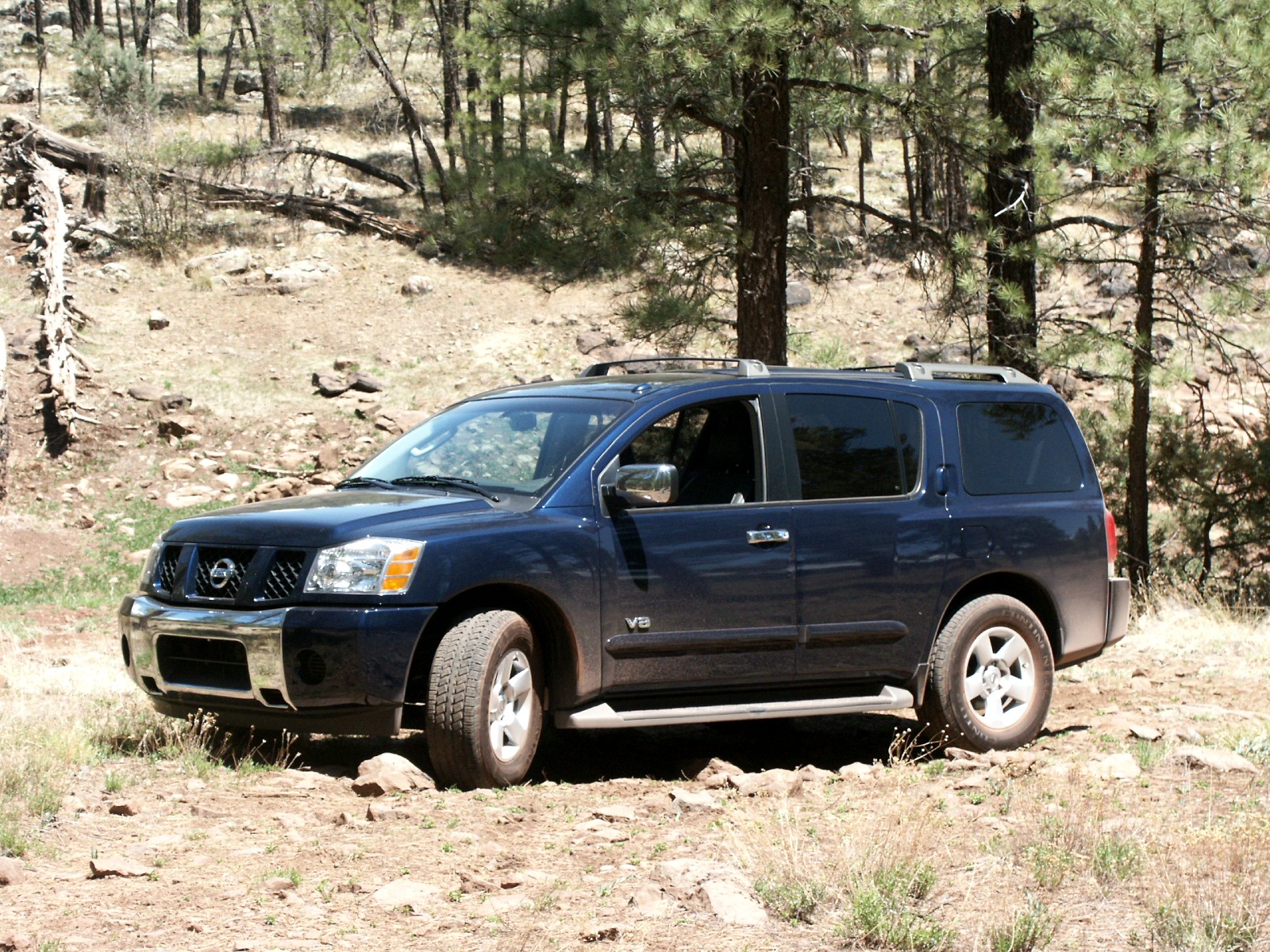
          2006 Nissan Armada

          We must give Nissan’s press fleet contractors (A&M and Smart Park) credit. They bused us expeditiously from the Phoenix airport to the Smart Park lot where our Majestic Blue (a new color this year) Armada was waiting. The power tailgate was wide open awaiting our luggage, the motor was running with AC on full and soft jazz was tuned in on the 10-speaker Bose sound system. You won’t get that kind of service at Avis.
          Parallel parking the large Armada was remarkably easy with its big mirrors and long wheel base with very little overhang front or rear. We pulled up for lunch at First Watch, our favorite trendy café in downtown Phoenix. A Cajun omelet for me and fruit-garnished chicken salad for my pretty blonde got us off to a good start.
          Traffic ran briskly up I-17 once we cleared the coagulated glom of vehicles where the freeway narrows to two lanes just beyond the northern edge of Phoenix. For a full-size sport-ute the Armada doesn’t feel too cumbersome or truck-like, although from behind the wheel there’s no question we’re in something big. We’re sitting comfortably high with good visibility all around. Controls and gauges are easy to manage and easy to read as we get acclimated. Power mirror, window and lock controls are mounted on the horizontal surface of the window sill where my arm and hand naturally rests.
          We had forgotten just how dramatic the Arizona vistas are as the freeway climbs to over 4500 feet then back down and up again before our exit at Highway 178. Traffic bested the 75 mph speed limit most of the way and began to thin the farther north we went. The Armada’s 5.6-liter, 90-degree, 305-hp V8 was enough to keep up easily although I found myself shifting the 5-speed automatic down manually on some of the steeper grades. Stately saguaro cactus punctuate the creosote and other low scrub as elevation increases. As we approach Sedona the twisted old cedars begin to dominate and the silvery prickly pear cactus sparkle in the mid afternoon sun. The famous red rocks suddenly come into view beginning with Bell Rock and Courthouse Butte. Another five miles of slow traffic and we’re literally surrounded by red rock formations.
          The last Saturday in April appears to be the beginning of a tourist surge in Sedona, this most spiritual of tourist places. These beautiful red rock formations have inspired folks to identify recognizable shapes and forms, much like finding shapes in clouds. Along Schnebly Hill Road are formations called Cow Pies, Talking Heads and Aunt Jemima. Directly above downtown Sedona is a formation everyone sees as an image of Snoopy reclining on his dog house with little Woodstock the bird perched on his nose. It would be hard to mistake Snoopy.
          We pulled up at a coffee shop downtown with views of Snoopy, Oak Creek about 300 feet below and Schebley Hill about 1500 feet above. Browsing the Mulroni (window sticker) we find that we’re driving the 2-wheel drive SE version of the ’06 Armada. Base price is $34,500. We have the $4,100 Sunroof package that includes the sunroof, power lift tailgate, Sirius radio, leather seats, side airbags and Bose audio system. Floor/cargo mats cost another $210 for a total of $39,480.


          iran

          Comment

          • Rasputin
            Senior Member
            • Jan 2005
            • 63906

            #785
            2005 Honda Accord Hybrid Sedan Tutorial

            Since the Accord's launch as a compact hatchback car in 1976, it has earned widespread acclaim as a leader in smart design, superb quality and world-class efficiency. In its 28-year history, the Accord has constantly re-invented itself, going from that original compact hatchback to today's premium mid-sized sedan and coupe. The seventh-generation Accord V-6, released in 2003, once again raised the bar for performance, safety and value in the mid-sized segment with a highly efficient and powerful 3.0-liter, 240-horsepower, SOHC VTEC V-6 engine, 4-wheel disc brakes and a standard anti-lock braking system (ABS) on all models, along with standard features such as air conditioning, power windows, mirrors and door locks, and an AM/FM/CD stereo system. In addition, the 7th-generation Accord was one of the first mid-sized sedans to bring luxury features such as a voice-activated navigation system, XM satellite radio and side curtain airbags to the premium mid-size segment.
            In 2005, the Accord further establishes its role as a technology, performance and efficiency leader with the introduction of the Accord Hybrid, the world's first V-6-powered gasoline-electric hybrid vehicle. Boasting the highest fuel efficiency for a V-6-powered automobile, Accord Hybrid utilizes the third generation of Honda's exclusive Integrated Motor Assist (IMA) hybrid system featuring new Variable Cylinder Management (VCM) technology. By combining a high-output V-6 engine and IMA with VCM, the Accord Hybrid Sedan provides even more power - 255 hp versus 240hp in the regular Accord V-6 Sedan - while improving fuel efficiency to an estimated 30 mpg city / 37 highway - better than virtually all 4-cylinder mid-sized sedans and similar to that of the compact class Civic Sedan, already a benchmark for fuel efficiency in the compact car class.


            iran

            Comment

            • Rasputin
              Senior Member
              • Jan 2005
              • 63906

              #786
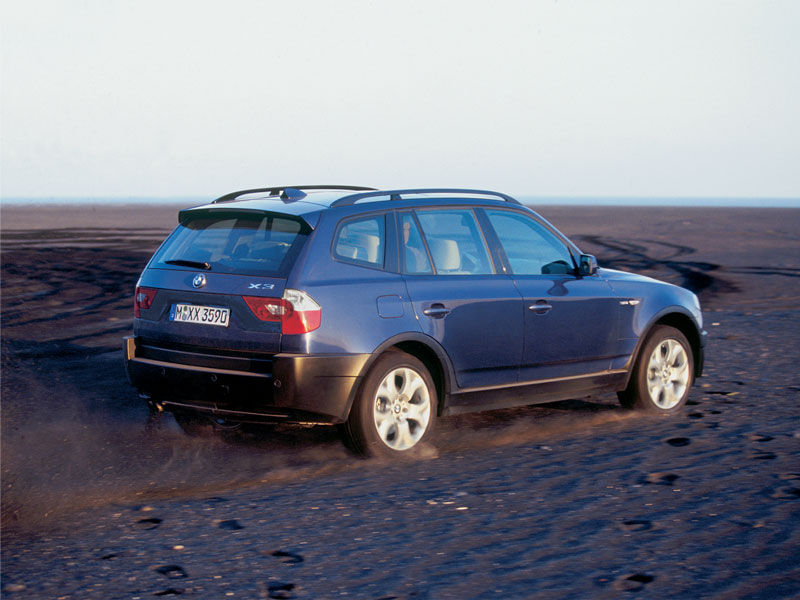
              2004 New Car Review: BMW X3 3.0i Automatic

              SPECIFICATIONS
              2004 BMW X3 3.0i Automatic

              Base Price $ 36,300
              Price As Tested $ 43,445
              Engine Type dual overhead cam 24-valve aluminum alloy inline 6
              Engine Size 3.0 liters / 182 cu. in.
              Horsepower 225 @ 5900 rpm
              Torque (lb-ft) 214 @ 3500 rpm
              Transmission 5-speed automatic
              Wheelbase / Length 110.1 in. / 179.7 in.
              Curb Weight 4067 lbs.
              Pounds Per Horsepower 18.1
              Fuel Capacity 17.7 gal.
              Fuel Requirement 91 octane unleaded premium gasoline
              Tires P235/55 HR17 Pirelli Scorpion
              Brakes, front/rear vented disc / vented disc,
              Suspension, front/rear independent double-pivot strut / independent multilink
              Ground clearance 8.0 inches
              Drivetrain front engine, all-wheel drive


              PERFORMANCE
              EPA Fuel Economy - miles per gallon city / highway / observed 16 / 23 / 19
              0 to 60 mph 7.9 sec
              Towing capacity 3500 lbs.


              OPTIONS AND CHARGES
              Titanium silver metallic paint $ 475
              Premium package - includes: panorama glass moonroof, auto-dimming rearview mirror, leather upholstery, lumbar support $ 2,550
              Navigation system $ 1,800
              Privacy glass $ 350
              Destination charge $ 695


              iran

              Comment

              • Rasputin
                Senior Member
                • Jan 2005
                • 63906

                #787
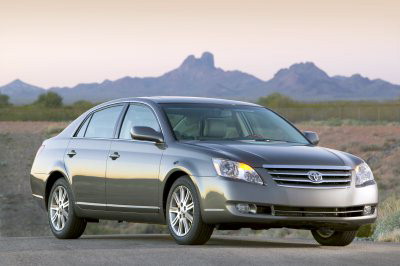
                2005 Toyota Avalon XLS

                SPECIFICATIONS
                MODEL: Toyota Avalon XLS
                ENGINE: 3.5-liter DOHC V6
                HORSEPOWER/TORQUE: 280 hp @ 6,200 rpm/260 lb.-ft. @ 4,700 rpm
                TRANSMISSION: 5-speed automatic with sequential shift
                WHEELBASE: 111.0 in.
                LENGTH x WIDTH x HEIGHT: 197.2 x 72.8 x 58.5 in.
                TIRES: P215/55 R17
                CARGO: 14.4 cu. ft.
                ECONOMY: 22 mpg city/31 mpg highway/21.8 mpg test
                PRICE: $35,169 (includes $540 delivery, processing and handling fee)
                People in my neighborhood know what I do for a living, so after 21 years, there are rarely comments about the vehicles they see parked in my driveway. However, when I looked out the window and saw the Toyota Avalon sitting there, I knew this was about to change.
                The Avalon, besides being a stunningly good-looking car, was dressed in a striking lime-green dress that accentuated every curve. This pale green (Silver Pine Mica to Toyota), I was told by my fashion-conscious daughters and wife, is the "in" color right now. And everyone who saw it felt they had to comment on the car. Surprisingly, few mentioned the sleek body under the dress, or asked about power, etc., but the majority of the comments were on the paint.
                The body is excellent, too. Being a professional, I couldn't simply admire the outside, of course. There's a strong family resemblance to the Lexus ES330, but the Avalon is four inches longer in wheelbase and six inches longer overall, pushing it into the "large car" category, while the Lexus is simply a "premium midsize."
                As a large car, the Avalon offers a ton of interior room inside. Here's an Oprah lurking under the dress. Front leg, shoulder and head room is excellent. In the rear, the leg room invites stretching, even with the front seat all the way back on the stops. And the rear seats recline. Okay, the recline is more like an airline seat recline, but rear passengers can use the feature, plus the legroom that you don't get in a plane, to fine chaise lounge-like comfort. My daughter found the rear seat to her liking during seven hours of driving one day, and she's usually the first to let me know if I've cramped her too much back there.
                Under the hood of this beauty is a 3.5-liter double overhead cam V6 with Toyota's VVT-i technology that varies cam timing depending on how much power is asked for. The engine's rated at 280 horsepower, which is more than enough for this car. Hooked to a 5-speed automatic with a sequential manual shift, you can do almost anything you want.
                Acceleration is excellent, as is the critical 40-60 mph acceleration mode that you wind up using to pass in short spaces or get by slower traffic on Interstates. We averaged nearly 25 mpg on our longer runs and 21.8 mpg overall.
                When it's challenged, there's a slight roar from under the hood, but in general the Avalon is a quiet car. We noticed some tire noise that was road-surface dependant, and a hint of wind noise, but otherwise the Avalon was Lexus-quiet.
                As befits a near-luxury car, the Avalon was equipped with all the necessary power options, including windows, door locks, seats (with lumbar support), the power rear recliner, tilt and telescoping steering wheel with audio and climate controls, and a power moon roof. Our tester had a voice-activated DVD navigation system with a 6-disc CD changer and AM/FM radio ($2,450). The nav system helped us find where we were headed, although the directions provided worked, too.


                iran

                Comment

                • Rasputin
                  Senior Member
                  • Jan 2005
                  • 63906

                  #788
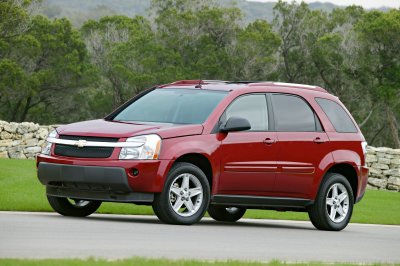
                  2005 Chevrolet Equinox

                  Chevrolet’s latest advertising tag line is “An American Revolution.” But in the case of the new Chevy Equinox, it’s more like an American/Japanese/Canadian/Chinese revolution. That’s because the Equinox features American design, built in conjunction with Suzuki in an assembly plant in Canada, powered by an engine made in China. Talk about globalization!
                  But Chevy has high hopes for the good-looking Equinox because it replaces the Tracker, which didn’t exactly set the world on fire.
                  With a wheelbase of 112 inches Chevy claims the Equinox is the largest in compact SUV. It goes up against a host of competitors that are starting to crowd this segment.
                  The Equinox is powered by a 3.4 liter V-6 engine that puts out 185 horsepower and 210 foot pounds of torque. Not what you’d consider a stump puller, but competitive for this class. It comes in front wheel drive form, with all wheel drive optional. The only available transmission is a 5-speed automatic. It’s rated at 19 mpg city/24 mpg highway for front-wheel drive and one mile per gallon less with all-wheel drive.
                  Inside, it offers great versatility and utility. The instrument panel and controls look purposeful and modern, the back seat slides back and forth nearly 8 inches, and the package shelf in the rear offers multiple settings.
                  The Equinox comes in two models. The base LS starts at $21,560 including destination charges, while the LT starts at $23,275 which adds cruise control, tinted glass, fog lamps, 16-inch cast aluminum wheels and a monochromatic exterior. The all-wheel-drive option adds about $2,000.
                  Put it all together and Chevrolet has a compact utility that is far more competitive than what it offered before.


                  iran

                  Comment

                  • Rasputin
                    Senior Member
                    • Jan 2005
                    • 63906

                    #789
                    2005 Mercedes-Benz CLK55 AMG Cabriolet

                    2005 Mercedes-Benz CLK55 AMG Cabriolet For aficionados of Mercedes-Benz performance, the letters AMG are magic. They stand for the names of the company founders, Hans Werner Aufrecht and Erhard Melcher, and Aufrecht's hometown of Grossapach, Germany. Aufrecht and Melcher were long-time Mercedes-Benz employees who left in 1967 to found AMG, primarily to build racing cars based on Mercedes-Benz sedans.
                    Success came in the early 1970s, and by the middle of that decade, AMG began to develop cars for the street. Based on contemporary Mercedes-Benz sedans and coupes, they found a ready market in Europe and Asia. None of the early AMG cars were U.S.-legal, but some came in through ``gray market'' special import channels. There is nothing like prohibition to increase exclusivity and make something more sought after. The premier late-1980s AMG, the 1987 E-Class-based 300E 5.6 ``Hammer'', powered by a 360-horsepower 5.6-liter V8, became legendary.
                    In 1990, AMG signed an agreement with Mercedes-Benz allowing AMG cars to be sold in Mercedes-Benz dealerships outside of Germany. Cooperation between the two companies increased, and the 1993 introduction of the C-class saw the C36 AMG. The C36 became the first AMG to be officially imported into the U.S. in 1995. In 1999, DaimlerChrysler became the majority owner of AMG. Cash infusion equals greater production capacity, and that led to AMG versions, including U.S.-legal versions, as the top model of nearly every Mercedes-Benz class. One of these is the CLK55 AMG.
                    As can be guessed from the name, the CLK55 is the performance leader of the CLK class of mid-sized coupes and cabriolets. As with other AMG vehicles, AMG takes the basic Mercedes-Benz and substitutes its own engine, transmission, suspension, and brakes, and makes changes to both interior and exterior styling. Where other CLK models have a 215-hp 3.2-liter V6 (CLK320) or 302-hp 5.0-liter V8 (CLK500), the CLK55 AMG has a specially-tuned 5.5-liter, 362-hp V8. The transmission and suspension are specially modified, and there are subtle (and not so subtle) changes to the bodywork and interior.
                    But all CLK models share the basic platform, and that's good news. The second-generation CLK chassis, introduced in coupe form in 2003 and as a cabriolet in 2004, is significantly more rigid than the first generation chassis. I recently spent a week with a CLK55 AMG cabrio. The original CLK cabrio had noticeable cowl shake. Even with 362 horses and 376 lb-ft of torque, and an exquisitely sport-tuned suspension, the CLK55 AMG cabrio was bank-vault solid, even on bumpy roads. My time with the CLK55 cabrio was not exactly classic convertible weather - the top stayed up except for one 20-minute window between showers. No matter - any convertible is good when it's sunny and the top is down, but bad weather is the best time to tell just how well-made a drop-top car is. In any form, the newest CLK cabrio offers first-class comfort and style. In CLK55 trim, add near-supercar performance.
                    APPEARANCE: Although the second-generation CLK's styling is mostly evolutionary, there is one difference. The grille, instead of being a modification of the Mercedes-Benz passenger car grille as before, is now based on the company's coupe and roadster grille, as developed in the SL class from 1955 to today. It's wider and lower, for a lower hood line, and prominently features the trademark three-pointed star in the center. As has been Mercedes style for the past few years, the front fender line sweeps back from the twin-oval headlamps. In profile, with the top up the cabrio is very similar to the coupe in roofline, and the higher rear fenders give a wedge-shaped look of performance. The rear window is heated glass, and visibility, top-up, is little less than in the coupe. The AMG models have unique lower styling. Echoing styling also seen on the SL and SLK, the front apron has the look of the nose wings of one of the McLaren-Mercedes Formula One race cars, while lower side sill extensions and a ``diffuser''-type rear treatment give the look of contemporary performance. The 17-inch wheels, with ultra-low profile tires, fill the wheel wells but are not excessive. The brakes, with six piston front and four-piston rear calipers, and large vented, cross-drilled, and slotted rotors, look impressive. They work as well as they look, too.


                    iran

                    Comment

                    • Rasputin
                      Senior Member
                      • Jan 2005
                      • 63906

                      #790
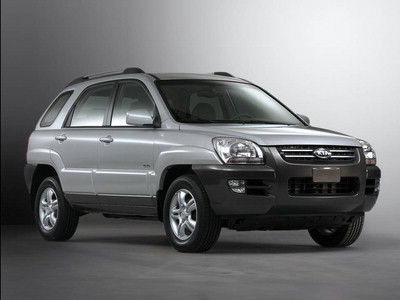
                      2005 Kia Sportage 4X4

                      MODEL: 2005 Kia Sportage 4X4
                      ENGINE: 2.7-liter DOHC V6
                      HORSEPOWER/TORQUE: 173 hp @ 6,000 rpm/178 lb.-ft. @ 4,000 rpm
                      TRANSMISSION: 4-speed automatic
                      WHEELBASE: 103.5 in.
                      LENGTH/WIDTH/HEIGHT: 171.3 x 70.9 x 66.7 in.
                      TIRES: P235/60R16
                      FUEL ECONOMY: 19 mpg city/23 mpg highway/22 mpg test
                      CARGO VOLUME: 23.6 cu. ft/66.6 cu. ft. (rear seat up/down)
                      BASE PRICE/STICKER: $21,990 (includes $590 inland freight and handling charge)
                      I was intrigued by the redesigned Kia Sportage as soon as I knew of its existence. Here was a good small SUV in its original form. What would the redesign be like? Happily, the redesign maintains much of the character of the original. The Kia Sportage has good style, is a good size, and has good utility for a lot of carrying jobs as well as general driving and low-stress off-roading.
                      The Sportage isn't overpowering. Under the hood is a 2.7-liter double overhead cam V6 that delivers 173 horsepower. The Sportage weighs around 3,500 pounds unladen, and there were times when, laden, there was not enough power. However, the transmission is a 4-speed automatic with a manual shifter. It has always been my contention that manual shifters on automatics are necessary with underpowered cars, yet most manufacturers tend to include them in overpowered cars. Here, the manual was a great addition, and gave us the opportunity to downshift when necessary to get higher rpms and move up the power curve. Kudos to Kia for this move.
                      We took the Sportage on a rather long trip. We achieved 22 mpg on mostly highway driving, which is close to the EPA estimate. I would like to have seen better economy for what is essentially and economy vehicle, but 22 mpg is still pretty good for an SUV - of any size. We felt the seats were comfortable for long trips. They were cloth covered and had a nice feel. While we didn't ride in the rear seats, our "test sit" back there showed excellent legroom, even with the front seats pushed back on their stops. There were mesh pockets in the backs of the front seats for additional storage. Also, there were a total of eight cupholders, two in front, two in back, and one in each door that was great for water bottles.
                      Sportage was asked to travel Interstates as well as back-country dirt roads, and it did it well. It handled well on winding roads as well as dirt roads, showing that it was capable of mild off-roading, which is the most that the majority of SUV owners attempt anyway.
                      We enjoyed the audio system (an AM/FM/Cassette/MP3 system was standard). The HVAC was more than adequate. During the height of summer, we actually had to reduce the air conditioning on our longest trip
                      Besides the mesh pockets and cupholders, there were wide pockets in each of the doors, a sliding arm rest/console with deep storage, and a useful glove box. We even had a sunglass holder above the inside rearview mirror that offered utility.
                      The rear seats fold flat, offering excellent carrying capability. With the rear seats up, cargo volume is 23.6 cubic feet. With them folded flat, cargo volume increases to 66.6 cubic feet. This is more than enough. Even my wife couldn't fill it up, although she tried. The rear hatch can be opened in total, or just the window can be opened for loading light objects. The front driver's window had power down, but not power up.


                      iran

                      Comment

                      • Rasputin
                        Senior Member
                        • Jan 2005
                        • 63906

                        #791
                        2006 Saab 9-7X Arc

                        MODEL: Saab 9-7X Arc
                        ENGINE: 5.3-liter V8
                        HORSEPOWER/TORQUE: 300 hp @ 5200 rpm/330 lb.-ft. @ 4000 rpm
                        TRANSMISSION: 4-speed automatic with manual mode
                        WHEELBASE: 113.0 in.
                        LENGTH x WIDTH x HEIGHT: 193.2 x 75.4 x 68.5 in.
                        TIRES: 225/55R18
                        CARGO VOLUME: 80.1 cu. ft.
                        ECONOMY: 15 mpg dity/16 mpg highway
                        PRICE: $40,990 (includes $720 destination charge)
                        Talk about vehicles with split personalities. The Saab 9-7X says "Saab" all over it, yet it's a brother to the Chevrolet TrailBlazer, Buick Rainier, and GMC Envoy. It even has a GM 5.3-liter V8 under the hood, and that's about twice as many cylinders as you usually find in a Saab.
                        Just when you begin to think it's an American car (okay, it is built in the U.S.), you look for the ignition switch and, there it is, right in the middle of the transmission hump, just where any normal Saab should have it. Of course, the 9-7X does have traditional Saab styling cues so you won't mistake it for a Chevy; trapezoidal grille up front with rectangular headlamp covers shielding projector headlamps, for two.
                        But why another SUV? And why a Saab? Well, Saab research showed that when Saab owners trade up, they usually trade up to an SUV. Not having a vehicle of that type in its stable was costing Saab customers, because research also shows that Saab customers are loyal to the brand. In fact, they're almost fanatic. So, Saab talked to parent GM and the 9-7X was born.
                        I had the opportunity to drive the 9-7X home from a GM introduction in upstate New York. With the trip scheduled, I put more than 120 miles on the vehicle, mostly on Interstates. But there was one section on the Blue Mountain Parkway that showed how the Saab could handle winding (and rough) roads. I thought the car had a solid platform. There were no rattles or unnecessary noises.
                        The power seats are very comfortable, especially on long rides. They are leather-faced and you can heat the back, seat, or both. I like having a heated seat back because it tends to reduce any potential backaches on longer trips.
                        Under the hood is GM's new 5.3-literV8, pumping out 300 horsepower. You can also get the 9-7X with a DOHC inline six that delivers 290 hp, but the $2,000 difference in price justifies the larger V8. The difference in fuel economy is only 1 mpg at highway speeds. Oddly, the transmission is only a 4-speed automatic, as opposed to a 5-speed in nearly every other vehicle on the road.


                        iran

                        Comment

                        • Rasputin
                          Senior Member
                          • Jan 2005
                          • 63906

                          #792
                          2005 Honda Element EX

                          SPECIFICATIONS
                          MODEL: Honda Element EX
                          ENGINE: 2.4-liter DOHC inline four
                          HORSEPOWER/TORQUE: 160 hp @ 5,500 rpm/161 lb.-ft. @ 4,500 rpm
                          TRANSMISSION: 5-speed manual
                          WHEELBASE: 109.5 in.
                          LENGTH x WIDTH x HEIGHT: 186.6 x 73.3 x 67.7 in.
                          TIRES: P215/70R16All-Season
                          ECONOMY: 21 mpg city/24 mpg highway
                          PRICE: $21,440
                          By consensus, the Honda Element is not the prettiest car on the highway. In fact, it's close to being the ugliest, simply because of its shape and Honda's tendency to cloth the element in some of the weirdest paint combinations I've seen. The paint schemes only serve to emphasize the unique shape. But then, maybe that's what Honda wanted to do in the first place. Our tester wore the Element's new color - Cargo Khaki. That, along with black highlights over the rear roof and black front fenders, adds to the mystique.
                          Enough about physical beauty. Remember when someone was trying to set you upon a blind date and the date's only asset was a good personality? Well, the Honda Element has personality to spare.
                          The Element isn't for cruising the highway at ungodly speeds. Rather, it's for loading up with all your gear and heading off the highway to camp, or mountain bike, or kayak, or hike, or whatever. The Element has tons of room to carry all your gear, too. Behind the rear seat is 25 cubic feet of cargo volume. The split rear seats fold to give you more cargo volume. And you can remove the rear seats (not an easy chore) to make the element a serious hauler. If you're the only one in the car and you have a surfboard, for example, you can fold down all the seats, including the front passenger's, and carry the board inside.
                          With all the seats removed, there is a flat floor. The floor surface isn't fancy carpet, it's a rubber mat. If necessary, you can actually hose out the element if there's too much mud and gook there. One word of caution, though. When the rubber is wet, it's slippery. We never actually hosed out the Element, but we did drive it in heavy rain, and our shoes were wet when we entered the car. So we simulated hosing out the car.
                          The tailgate opens in two ways. You can lift just the glass, which leaves you with a small ledge to lift over. Or, you can lower the metal part of the tailgate for a flat, wide open, cargo door. Even when the most rugged cargo we carried was a bag of trail mix among our groceries, we chose to open the rear for maximum loading area.
                          Under the hood of the element is a 2.4-liter double-overhead-cam four cylinder engine that's rated at 160 horsepower. Coupled to a 5-speed manual transmission - with the shifter on the dash - there was plenty of power for our applications. We took the Element on our mountain test road, and it climbed with the best of them.
                          The engine tended to be slightly buzzy on hard acceleration, but under a constant load at normal speeds it wasn't noisy at all.
                          The Element has a compliant suspension that offers a smooth ride on smooth roads and can handle curves well. Realize, though, that the Element has the aspect ratio of a sport utility and, therefore, isn't a sports car.
                          I noticed that there wasn't a lot of wind noise at highway speeds, which is nice in a small car, especially this one with its boxy shape.


                          iran

                          Comment

                          • Rasputin
                            Senior Member
                            • Jan 2005
                            • 63906

                            #793
                            2005 Mitsubishi Lancer Evolution MR

                            You say that modern cars are boring? You think they are antiseptically-sterile and have no character? Well, yes, some are that way. Actually, many are that way. But not all - try a quick jaunt in the latest iteration of Mitsubishi's legendary Lancer Evolution series of rally cars for the street, the MR. It's the perfect antidote to the oh-so-wholesome-and-boring modern sedan, and it's about as close as you can come to a race car for the street at a more-or-less affordable price these days.
                            The Evo MR is a statement of Mitsubishi's capabilities in the design and construction of a high-performance car, and is as little changed for daily road use as possible from its World Rally Championship-winning rally car cousin. It is brash, rash, noisy, and pleasantly uncivilized. Toss the stereo (the 315-watt Infinity system offered for the base model is not available in the MR), the cell phone, the nav system, and any other distractions - the Evo MR requires concentration on the part of the driver if it is being used anywhere in the upper reaches of its performance envelope. And that would best be done on a racetrack, not the street. Which is appropriate, as the ``MR'' stands for ``Mitsubishi Racing.''
                            All 2005 Lancer Evo models have some important changes. Engine power has increased from 271 to 276 horsepower (at 6500 rpm) , more importantly, there is more midrange torque (now 286 lb-ft at 3500 rpm) and stronger top-end power, all courtesy of turbo modifications. Maximum boost is 20.3 lbs at 3500 rpm, considerably more than usual in a road car. The front differential is now a helical limited-slip design for improved traction and cornering performance, and there is a three-position active center differential (ACD), all the better for control on a variety of surfaces in a variety of conditions. Like so much in modern cars, the ACD is electronically-controlled, and varies the front-rear torque split from full front-wheel drive to 50/50 front/rear depending on data from acceleration, yaw angle, and steering angle sensors. A three-position switch allows the ACD to be adjusted for the best operation on dry pavement, wet pavement and gravel, or snow.
                            The MR gets more, however. Immediately visible at the trailing edge of the roof is a patch of carbon fiber from which sprout a series of small fins. This is the vortex generator, and it reduces aerodynamic drag and increases the downforce generated by the huge carbon fiber rear wing. You may have seen similar devices on airplane wings. Special dark gray forged-alloy BBS wheels also distinguish the MR, and reduce unsprung weight at each corner by 2.76 lbs to further improve cornering ability.
                            And then there's what can't be seen. The MR's roof panel is aluminum, to reduce weight and lower the center of gravity. Total weight savings from use of lightweight parts is 27.6 lbs, so the MR gets less, too. The suspension features specially-developed Bilstein shock absorbers to improve adhesion. The gearbox is a six-speed, not the five speed of the standard and RS models. As in all Evos, the front seats are genuine Recaros, but the MR has three extra gauges on the center stack - for turbo boost, voltage, and oil pressure. Because of the position of the boost gauge, it's not especially useful for the driver (and that doesn't matter as electronic controls keep the pressure in check) but can amuse the front seat passenger.


                            iran

                            Comment

                            • Rasputin
                              Senior Member
                              • Jan 2005
                              • 63906

                              #794
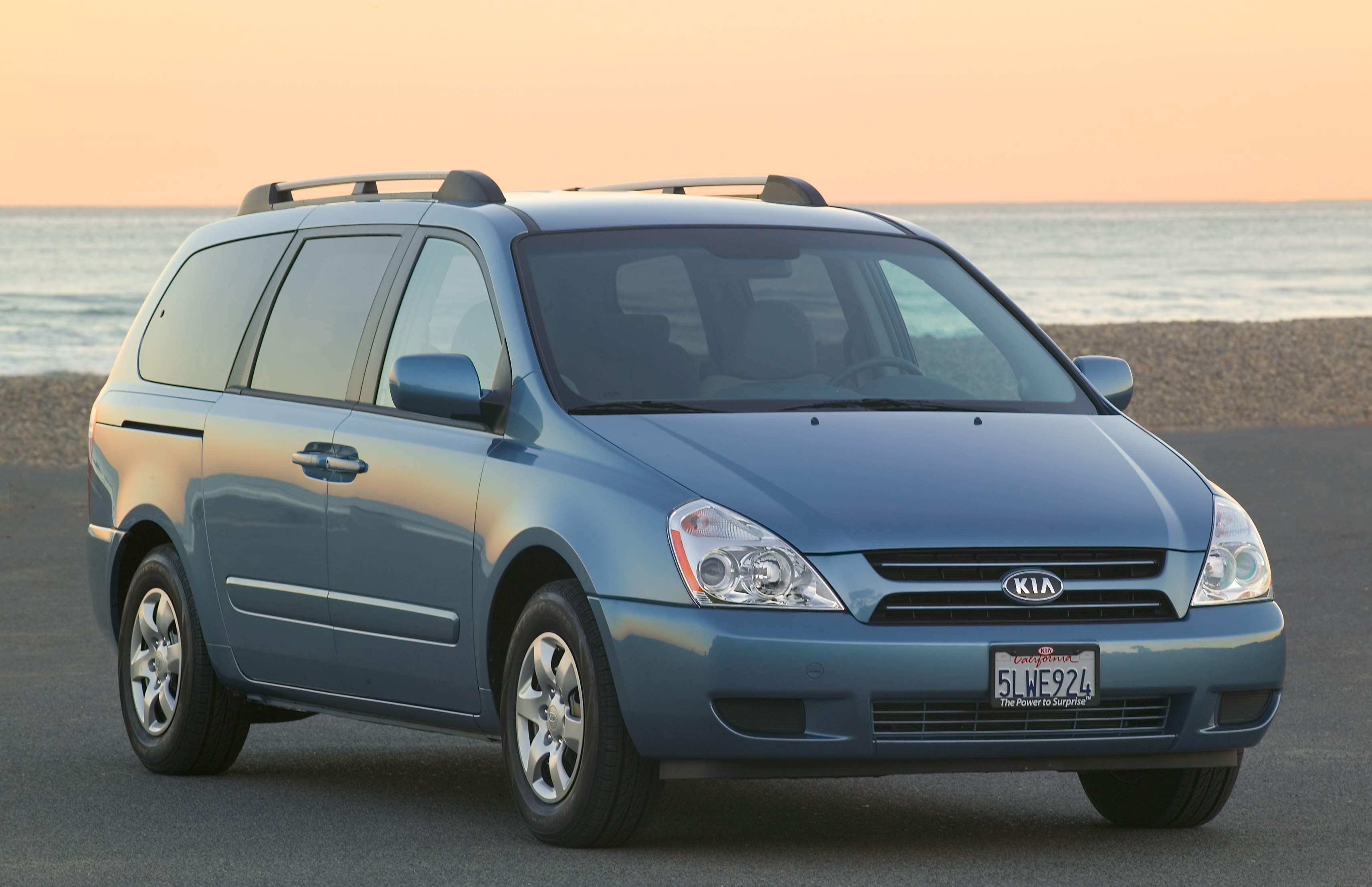
                              2006 Kia Sedona EX

                              SPECIFICATIONS
                              MODEL: Kia Sedona EX
                              ENGINE: 3.8-liter V6
                              HORSEPOWER/TORQUE: 240 hp @ 6000 rpm/250 lb.-ft. @ 4500 rpm
                              TRANSMISSION: 5-speed automatic
                              WHEELBASE: 118.9 in.
                              LENGTH x WIDTH x HEIGHT: 202.0 x 78.3 x 69.3 in.
                              TIRES: P235/60R17 all-season
                              CARGO VOLUME: 141.5 cu. ft.
                              ECONOMY: 18mpg city/25 mpg highway/17.2 mpg test
                              PRICE: $31,365 (includes $670 inland freight and handling charge)

                              One thing you notice about the Kia Sedona minivan is that it is incredibly loaded with features - almost overloaded.
                              With a sticker price of just over $31,000, the Sedona has leather seats, heated front seats, tri-zone automatic climate control to keep passengers in all three rows as comfortable as possible, a backup warning system that's invaluable when rear vision is limited, power sliding doors and a power liftgate.
                              There's more, but you'll have to wait.
                              With a 240 horsepower V6 engine under the hood, the Sedona isn't hurting for power. I remember my old full-size van that (I believe) wasn't that powerful yet was larger and heavier. The engine's power reached the front wheels through a 5-speed automatic transmission with a column shifter. That's important, because a floor-mounted shifter, while "cooler" would clutter up the space between the front seats.
                              As it is, that space is used up by a tray that's convenient for holding a pair of cupholders and assorted smaller objects like cell phones, MP3 players, etc. But, that tray folds out of the way into the side of the passenger seat if it's not needed and you would prefer a clear passageway to the rear seats to attend to misbehaving kids, for example.
                              This is what impressed me about the Sedona; it's use of space. Go around to the back and lift the power tailgate and you'll see a deep well behind the third row seats. You can use this for cargo (we stacked four golf bags vertically, for example) or you can fold the third row seats into the well, leaving a flat floor.
                              The second-row bucket seats don't disappear, but you can always take them out if you need the extra cargo space. Again, in my full-size van, the two benches were removable, but they weighed about 60 pounds apiece and were a chore to remove.
                              Legroom in the second row is excellent. Third row legroom is very good, so you wouldn't be embarrassed to put your boss back there when everyone's headed out for lunch. Seating comfort in all three rows is excellent, with the front two rows offering the best, of course.


                              iran

                              Comment

                              • Rasputin
                                Senior Member
                                • Jan 2005
                                • 63906

                                #795
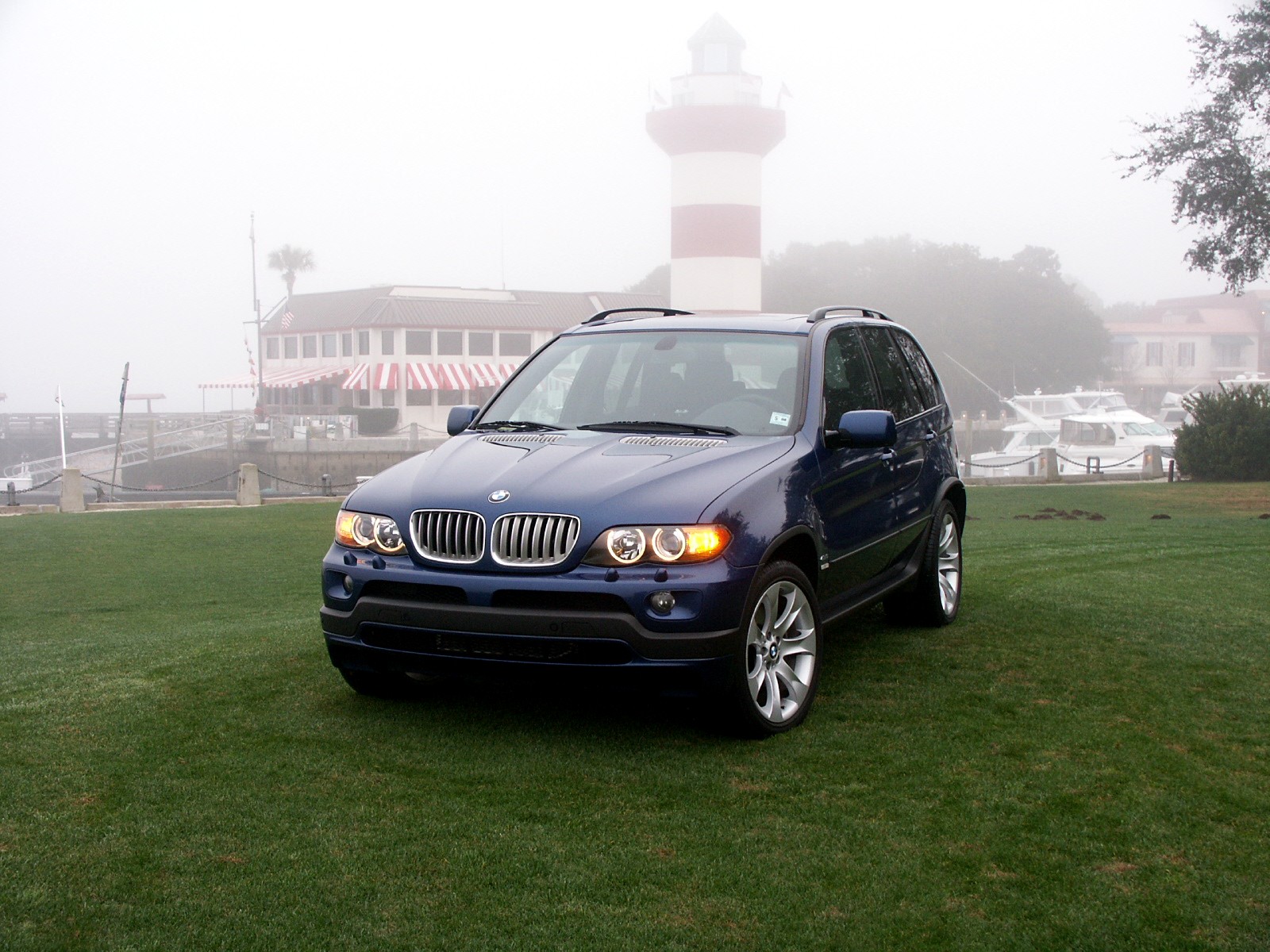
                                2005 BMW X5 4.8is

                                We would have a hard time finding an auto reviewer who did not consider the BMW X5 to be either best in class or mighty close to it. Based on the mid-size 5-Series sedan platform the X5 is the larger of BMW’s two “Sports Activity Vehicles” or SAVs; the smaller being the X-3 based on the 3-Series platform which we’ll test another time.
                                Our loaned X5 is the high-performance 4.8is version in LeMans blue delivered on a bitterly cold winter day here in Michigan. My accomplice, Joe, and I will take her south to Hilton Head, then to Tennessee and back for a good thorough test. We may not get to test her in snow – but you never know.
                                With base price of $68,800 ours stickers out at $72,295, with the $1,800 navigation system being the only listed option, and an $895 destination charge. (Those numbers don’t add up, you say? I noticed that, too.) Standard features on the 4.8is are: 6-speed automatic transmission, digital compass mirror, panorama moon roof, rear door window sun blinds, ski bag, heated rear seats, park distance control, rain sensor, adaptive headlights, and premium sound system. Dozens of other features and amenities are listed in two columns of small type on the sticker - too many to list here (for all of the specs just click on the link at the top of this screen)…just know that it lacks nothing, an a gas-guzzler tax does not apply.
                                Twenty-inch wheels and tires add to the dramatic look of this hot X5. At 275/40R20 front and 315/35R-20 rear, the Michelin Diamaris performance rated tires look like something more appropriate for a Corvette. The book warns “Due to low-profile tires, please note: wheels, tires and suspension parts are more susceptible to road hazard and consequential damages. Performance tires are not recommended for driving in ice and snow.” Ok …we’ll be careful.
                                We loaded our gear, including two full sets of golf clubs, with the rear seats folded down we have room to spare in the now ample cargo area. When not folded down the heated rear seats recline about 15-degrees. If we had rear seat passengers we’re confident they would be perfectly comfortable and happy back there, but then the cargo area would not have been adequate for golf clubs and luggage. Perhaps a small trailer might be needed if we were traveling with four.


                                iran

                                Comment

                                Working...