
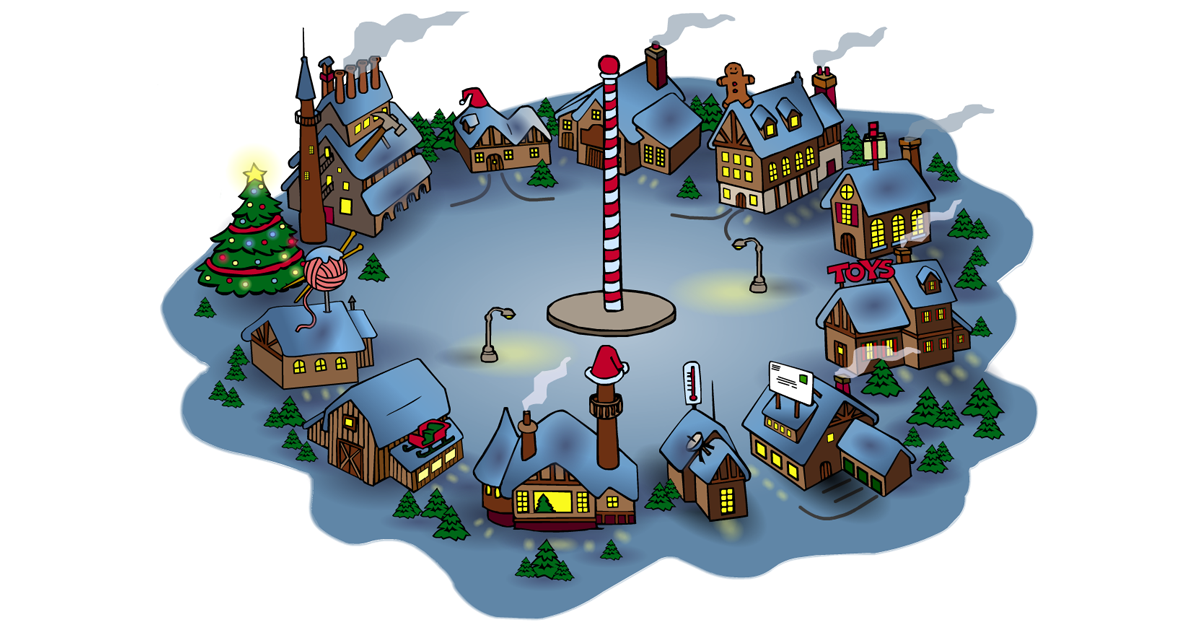
Welcome to Santa's Secret Village
-
iran
-
Regional customs and celebrations
Christmas celebrations include a great number and variety of customs with either secular, religious, or national aspects which vary from country to country:
In the Southern Hemisphere, Christmas occurs during the summer. This clashes with the traditional winter iconography, resulting in images such as a fur-coated Santa Claus surfing in for a turkey barbecue on Australia's Bondi Beach. New Zealanders also commonly celebrate Christmas at the beach, coinciding with the vibrant red flowering of the coastal Pohutukawa or "New Zealand Christmas Tree".
Japan has adopted Santa Claus for its secular Christmas celebration, but New Year's Day is a far more important holiday. In South Korea Christmas is celebrated as an official holiday, and in India it is often called bada din ("the big day"). Celebrations revolve around Santa Claus and shopping.
In Poland, Santa Claus (Polish: Święty Mikołaj) gives gifts on two occasions: on the night of December 5 (so that children find them on the morning of December 6), and on Christmas Eve (so that children find gifts that same day). In addition to the major observances of Christmas, German children also put shoes out at their doors on the night of December 5, and find them filled with candy and small gifts the next morning. Santa Claus (Hungarian: Mikulás), or Father Winter (Hungarian: Télapó) also visits Hungary on December 6, bringing small gifts, and is often accompanied by a black creature called Krampusz; while on Christmas Eve (Holy Night - (Hungarian: Szenteste)) the Little (Baby) Jesus (Hungarian: Kisjézus or Jézuska) delivers the presents.
In Spain, gifts are brought by the Magi on Epiphany (January 6), and in Scotland, presents were traditionally given on Hogmanay, which is New Year's Eve. In recent times, both countries have also adopted gift-giving on Christmas Eve/Christmas Day.

The Declaration of Christmas Peace has been a tradition in Finland from the Middle Ages every year, except in 1939 (due to World War II). The declaration takes place in the Old Great Square of Turku, Finland's official Christmas City and former capital. It is broadcast on Finnish radio and television. Sauna bathing has an important role in Finnish Christmas, often after the visit of Joulupukki on Christmas Eve.
Saint Nicholas' Day remains the principal day for gift giving in the Netherlands while Christmas Day is a more religious holiday.
In Russia, Grandfather Frost brings presents on New Year's Eve, and these are opened on the same night. However, after the Russian Revolution, Christmas celebration was banned in that country from 1917 until 1992. Even today, throughout the U.S. and Europe, several Christian denominations, notably the Jehovah's Witnesses, Puritans, and some fundamentalists, view Christmas as a pagan holiday not sanctioned by the Bible.
In many countries, businesses, schools, and communities have Christmas parties and dances in the weeks before Christmas. Christmas pageants may include a retelling of the story of the birth of Christ. Groups may visit neighborhood homes to sing carols. Others do volunteer work or hold fundraising drives for charities.
On Christmas Day or Christmas Eve, a special meal is usually served. In some regions, particularly in Eastern Europe, these family feasts are preceded by a period of fasting. Candy and treats are also part of Christmas celebration in many countries.
Another tradition is for people to send cards to their friends and family members. The traditional greeting phrase on these cards is "Merry Christmas". Cards are also produced with messages such as "Season's Greetings" or "Happy Holidays", so as to include senders and recipients who may not celebrate Christmas .
iran
Comment
-
There is a portion of the Iranian Diaspora community that is not sure what to make of Christmas. So it haphazardly, half-heartedly, ignores or celebrates it. The nagging concern is how this holiday relates to all that is Iranian, Middle Eastern, or Islamic. Do Iranians lose a part of their identity and heritage by partaking of the festivities alien to their traditional or sacred calendar? In the meanwhile, neighbors, co workers, and – the toughest part – children continue to ask questions.
Whether they take Christmas as a holy-day (a religious occasion) or a holiday (a social ritual), Iranians have reason enough to celebrate it and to add their own story, making it more festive for grownups and more fun for children. Here is the scoop: Iranians enter the Christmas picture four times: three times as Iranians and a fourth time as Muslims. I’ll explain but, first, a few words on the origin and nature of Christmas.
What is today celebrated as Christmas replaced the Roman "Saturnalia", a carnival dedicated to the mischievous God of chaos Saturn, that coincided with an even older celebration, the winter solstice, (December 24th according to the Julian calendar), which, properly calculated, falls on the shortest day -- and the longest night -- of the year; our “Yalda”. So, think about it, we already celebrate the celestial event that signaled the Roman revelry on which Christmas is based.
Rome’s first Christian Emperor Constantine cleverly fixed the biblical story of the birth of Christ (the "anointed" one; Messiah, or Masih) on this date, preserving people’s festive mood while replacing Jesus with Saturn, thus asserting a new religion. Understandably, the Roman Catholic Church followed suit and the rest is Christmas history. The actual time of the birth of Jesus is, of course, unknown, (religious scholars have guessed it closer to spring, the traditional time for census – the task for which, scriptures tells us, Josef and Mary set out on their fateful journey). For all these reasons (uncertainty of the date, remnants of pagan worship, and the frivolity of the festivities) strict Christians have been known to object to the occasion throughout history. They even briefly outlawed it in England in 1647. Even today, some Christian denominations such as Jehovah’s Witnesses refuse to recognize Christmas. They point to the pagan origins of various Christmas rituals: the pine tree, the mistletoe, the lights, you name it. Lack of historical proof, of course, doesn’t dampen the spirits of the faithful who feel they "are" celebrating Christ’s birthday. He must have been born on “some day” right?
Now, As Iranians, Middle Easterners, and Muslims (secular or practicing, minimal or maximal) we are mindful of how we are supposed to integrate ourselves within our host communities during these festive weeks. Neither "assimilation" (melting pot) nor "pluralism" (salad bar) quite describes where we are and what serves our purposes. Fortunately for us, there is a new term: "Incorporation", which means new migrants (or better, “trans-migrants”), do not face the bleak choice of either locking themselves up in their native culture or losing themselves in the habits of their host culture. They can -- thanks to telephone, cheap plane tickets, and internet -- keep contact with their native culture while taking full advantage of the material and cultural resources of the host communities. They are becoming culturally "amphibious" (not "doubly marginalized" as some pessimistic social scientists suspected a few decades ago). As such, Iranians are a "model immigrant community". We do this pretty well, but we could do better!
First, we can spruce up and better advertise our Yalda celebration. It has as much of a right to be part of the season’s colorful celebrations as Hanukah and Kwanza, don’t you think? It is ours, and it is religiously neutral; that is an added advantage in these religiously contentious times!
Second, the very idea of a savior born to the world is originally Iranian. Before there was a Jewish “Messiah” or a Christian “Christ” there was the Zoroastrian “Saoshyant”, the restorer of order and justice to a chaotic and sinful world and the endower of blessings. (Western sources have discussed this but the definitive work on the subject remains “Saoshyant: Mo’ud e Mazdayasna” the masterpiece of the legendary scholar of pre-Islamic Iran, the late Ebrahim Poor Davood). Historians of ideas speculate that Jews who were rescued from the Babylonian slavery and brought to Iran by Cyrus the Great, and who were later authorized to return to ancient Israel took more than the Iranian blessings – and tax revenues -- to rebuild their temple (Ezra, 5); they were also inspired by the Iranian idea of the people’s savior: This explains the appearance of the notion of Messiah, on which Christianity is based, in Jewish scriptures following these events.
Third, scholars have reached a near consensus that the three “wise men from the East” (No, they were not “kings”) who came to adore Jesus (Mathew, 2) in the Christmas story could only have been Magi, Zoroastrian priests (“Mogh”, or “Magus” -- rendered as Magi – were a hereditary priestly class among Medes, who blended in with the clerical “Moobad” ranks of the Zoroastrian era). Anyway, this was what early Christians believed. Centuries later, Marco Polo reported finding the tombs of these magi in “Saveh” a town near today’s Tehran, in Iran. Regardless of the veracity of such a claim (it is, of course, unverifiable), the story indicates the persistence of the belief among Christians concerning the Persian identity of magi.
Finally, as Muslims, we believe in the story of the miraculous virgin birth. Mary is, without doubt, the most revered woman in Quran. Few people realize that there is more about Mary in Quran than there is in the gospels! The Chapter of Maryam in Quran (19, 15-34) contains a detailed and curiously touching rendition of the story of nativity, whose dramatic qualities remain, in my view, unexplored, both in the Islamic and the Christian worlds.
So, as Iranians, Middle Easterners, and Muslim (take your pick, or take all three for the price of one) we come from a culture and a lore intimately intertwined with celestial celebrations (Yalda), the promise a savior (Saoshyant), adoration of Christ (Magi), belief in miracles (virgin birth), and above all, the hope for harmony and peace on earth. Iranians, whether secular or religious (and every religion practiced by Iranians is connected with the story), can appeal to one or more of the above to weave their lives into the joys and hopes of the season. Spread the word, celebrate, and rejoice.
iran
Comment
-
Christmas on the Net -Features recipes, an animation, music, coloring pages, and articles.
http://www.holidays.net/christmas/
iran
Comment
-
Every year around this time a debate flares up among the Iranian Diaspora as to whether we should display Christmas trees in our houses. The issue is discussed ad-nauseam on talk-radio shows and at parties and gatherings. Everyone has their own opinion about this potentially touchy subject. Some favor doing "as Romans do" and advocate displaying the biggest tree befitting the confines of their domiciles. Others consider this an outright act of sacrilege and remind their Moslem brethren (and sistren) that we, as Moslems, should not honor these ridiculous rites of the infidels.
I think the displaying of a Christmas tree should not have any bearing on whether one considers Jesus as one's lord and savior or even believes in the Holly Ghost and the Trinity. (What is the Trinity, anyway? Is monotheism in peril?)
A tree is a tree. It means nothing and it proves nothing. When all is said and done, one is left with nothing but dried up needles on the floor and a bulky trash item to be gotten rid of.
A Christmas tree display will not cause me to send my kids to Sunday school, nor will it compel me to stock up on choice cuts of pork. It will not cause me to give a third of my net income to the neighborhood church. It will neither increase nor decrease my viewing time of Benny Hinn performing his miracles on TV. It will not persuade me to raise all kinds of hell during the week and then go to church on Sundays to get an instant morality carwash because Jesus died for my sins.
For God's sake, we have enough history and tradition to render us immune to influences like this. Christian missionaries have been active in our neck of the woods for hundreds of years and the number of converts they have so far produced is ridiculously low. I don't believe we are in any danger folks.
A friend of mine legitimizes his tree display by tracing most of the Christian rites and rituals to Mithraism and the Mithraic cults of old Rome, and therefore claims to be celebrating the birth of Mithra, which, coincidentally, happens to fall on Christmas.
I say if it makes the kids happy, if it helps them to be less conspicuous at school, if it helps them to fit in, let's do it for them. Let's give them gifts for Christmas, for Hanukah, for Kwanza, and for the Persian New Year. Don't forget that the Persians were famous for their celebrations and feasts. Let's not forget that the Arab's word for "celebration" or "festival" is "mehrejan". Where do you think that came from?
iran
Comment
-
The Nativity
The Nativity refers to the birth of Jesus. According to biblical accounts, Jesus was born to the Virgin Mary, assisted by her husband Joseph, in the city of Bethlehem. The birth took place in a stable, surrounded by farm animals, and the infant Jesus was laid in a manger. Shepherds from the fields surrounding Bethlehem were told of the birth by an angel, and were the first to see the child. Christians believe that the birth of Jesus fulfilled many prophecies made hundreds of years before his birth.
Remembering or re-creating the Nativity is one of the central ways that Christians celebrate Christmas. The Eastern Orthodox Church practices the Nativity Fast in anticipation of the birth of Jesus, while much of the Western Church celebrates Advent. In some Christian churches, children perform plays re-telling the events of the Nativity, or sing carols that reference the event. Many Christians also display a small re-creation of the Nativity, known as a Nativity scene, in their homes, using figurines to portray the key characters of the event. Live Nativity scenes are also performed in some areas, using actors and live animals to portray the event with more realism.
Nativity scenes traditionally include the Three Wise Men, Balthazar, Melchior, and Caspar, who are said to have followed the Star of Bethlehem, found Jesus, and presented gifts of gold, frankincense, and myrrh.
In the U.S., Christmas decorations at public buildings once commonly included Nativity scenes. This practice has led to many lawsuits, as some say it amounts to the government endorsing a religion. In 1984, the U.S. Supreme Court ruled that a city-owned Christmas display, even one with a Nativity scene, does not violate the First Amendment.
iran
Comment
-

iran
Comment
-
in ax akhariye kadoyee bood be ghazvinihaye mohtaram ???!!?

MAHSA


[/CENTER]Comment

Comment