Announcement

Collapse
No announcement yet.

Science Special News

Collapse
This is a sticky topic.
X
X
 
  • Filter
  • Time
  • Show
Clear All
new posts

  • Britons report 'psychic powers'

    More than half of Britons believe in psychic powers such as mind-reading and premonitions, a survey suggests. Of 1,006 adults polled for Readers Digest Magazine, 43% reported reading others' thoughts or having theirs read. More than half had had a dream or premonition of an event before it happened and 26% said they had sensed when a loved-one was ill or in trouble. A fifth said they had seen a ghost and 29% believed near-death experiences were evidence there was an afterlife. Of those questioned, 43% claimed to have tapped into other people's thoughts or to have had their own minds read by someone else. More than two-thirds said they could sense when someone was looking at them and 62% could tell who was ringing before they picked up the phone. More than 10% thought they could influence machinery or electronic equipment using their minds. One in 10 said something bad had happened to another person after they had wished for it to happen.

    Women were more likely to believe in the paranormal than men, though 53% of males said they sometimes knew who was ringing before picking up the phone and 45% had experienced dream or premonition before an event. Despite the high numbers who said they had experienced such phenomena, only 9% described themselves as psychic. Simon Bacon, lecturer at London's College of Psychic Studies and a practising medium, said: "When you say psychic, many people have an image of an old woman in a gown with a crystal ball. They don't associate themselves with that."
    Comment


    • Britain searches for a real life 'Q'

      Britain is looking for a new real-life "Q", the eccentric boffin behind the gadgets designed for fictional superspy James Bond, according to an advert in The Sunday Times. Suitable candidates for the post of chief executive of the Defence Science Technology Laboratory (Dstl) will have strong scientific or engineering credentials as well as senior management experience, it says. If successful, they will take charge of more than 3,000 defence scientists and enjoy an "attractive" six-figure salary and be based "near Salisbury", southwest England. That is thought to be a reference to the government's top secret chemical and biologial facility at Porton Down. In the James Bond films the role of "Q" was played by actor Desmond Llewelyn and latterly by John Cleese. But while 007's "Q" came up with gadgets like underwater or invisible cars and wrist-watch grenades, the real-life scientists are said to have invented spy tools like the high-tech communications device disguised as a rock.

      The rock was described by Russia's intelligence agency as "a miracle of technology" when it was discovered in a Moscow park in January, sparking a diplomatic row with London, the Sunday Times said. Other inventions at the organisation, which has a turnover of 350 million pounds (510 million euros, 640 million dollars) a year, are designed for more widespread use by the British army and intelligence community.

      Comment


      • Fish with 'teeth' caught

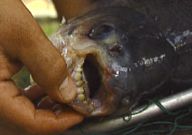
        Late Tuesday afternoon, a fisherman hooked a fish he says he`s never seen before and lake officials are just as amazed: a 20-pound fish with what looks like human teeth. Scott Curry has caught thousands of fish at Buffalo Springs Lake. He knew his catch was something special from the time he hooked it."It took a long time to (reel)in," he says. "I didn`t want to lose it. I was afraid line would break on it."After reeling in the 20-pounder, Curry realized it wasn`t a typical catch. This one had teeth."I haven`t seen anything like it," he says."I`ve lived out here 36-years, and I`ve never seen a fish like that out here in my life," says Greg Thornton, General Manager of Buffalo Springs Lake.On Wednesday, Texas Parks & Wildflife identified the unusual catch as a Pacu, a fish found in South America."Some one likely got rid of it out here," thinks Thornton.

        A game warden has taken pictures and will try to identify it in the next few days. When Curry caught the fish, he said he saw another one just like it. Lake officials have put a bounty on that, anyone catching it will get $100. If you want to see the unusual fish, it can be seen in the spring pond at Buffalo Springs Lake.

        Comment


        • Clone 'would feel individuality'

          A cloned human would probably consider themselves to be an individual, a study suggests. Scientists drew their conclusions after interviewing identical twins about their experiences of sharing exactly the same genes with somebody else. The team said the twins believed their genes played a limited role in shaping their identity. The UK/Austrian research will shortly be published in the journal of Social Science and Medicine. Co-author Dr Barbara Prainsack, from the University of Vienna, Austria, who worked with Professor Tim Spector, from the Twins Research Unit, St Thomas' Hospital, London, UK, said: "The birth of Dolly the sheep triggered many questions about what it would be like to be a clone. "We don't have clones we can interview - but we do have identical twins." Identical twins are created when a single egg, fertilised by a single sperm, splits into two separate, but genetically identical, embryos. The researchers said because twins - like potential clones - shared the same genes, they offered the only existing method of studying the feelings a clone might experience. But they also emphasised twins would differ from clones because they are born at the same time, whereas clones would differ in age.

          The scientists carried out 17 interviews of identical, non-identical and non-twin siblings. The identical twins said being a twin did not compromise their individuality - although they pointed out that people often had preconceptions that they were one of a pair rather than individuals. Those interviewed viewed being an identical twin as a blessing, and said they would not rather be a non-identical twin or a "singleton". They also said they believed their genes had no great bearing on their relationship with their twin and their identity.

          Comment


          • Comment


            • Snake spotting key to human evolution

              The ability to spot venomous snakes may have played a major role in the evolution of monkeys, apes and humans, according to a new hypothesis by Lynne Isbell, professor of anthropology at UC Davis. The work is published in the July issue of the Journal of Human Evolution.Primates have good vision, enlarged brains, and grasping hands and feet, and use their vision to guide reaching and grasping. Scientists have thought that these characteristics evolved together as early primates used their hands and eyes to grab insects and other small prey, or to handle and examine fruit and other foods.Isbell suggests instead that primates developed good close-up eyesight to avoid a dangerous predator -- the snake."A snake is the only predator you really need to see close up. If it's a long way away it's not dangerous," Isbell said.Neurological studies by others show that the structure of the brain's visual system does not actually fit with the idea that vision evolved along with reaching and grasping, Isbell said. But the visual system does seem to be well connected to the "fear module," brain structures involved in vigilance, fear and learning.Fossils and DNA evidence show that snakes were likely the first serious predators of modern mammals, which evolved about 100 million years ago. Fossils of snakes with mouths big enough to eat those mammals appear at about the same time. Other animals that could have eaten our ancestors, such as big cats, and hawks and eagles, evolved much later.Venomous snakes evolved about 60 million years ago, raising the stakes and forcing primates to get better at detecting them.

              "There's an evolutionary arms race between the predators and prey. Primates get better at spotting and avoiding snakes, so the snakes get better at concealment, or more venomous, and the primates respond," Isbell said.Some primate groups less threatened by snakes show fewer signs of evolutionary pressure to evolve better vision. For example, the lemurs of Madagascar do not have any venomous snakes in their environment, and in evolutionary terms "have stayed where they are," Isbell said. In South America, monkeys arrived millions of years before venomous snakes, and show less specialization in their visual system compared with Old World monkeys and apes, which all have good vision, including color.

              Comment


              • Medic reveals baby cloning experiment

                A maverick fertility expert has revealed hard evidence of a controversial attempt to produce the world's first cloned human baby. Panos Zavos, a reproductive scientist, created a storm in 2004 when he called a press conference in London to announce he had cloned a human embryo from the skin cells of an infertile man and transferred it to the uterus of the man's wife. He later said the transfer had failed and the woman did not become pregnant, but many scientists doubted whether he had performed the experiment at all.Most cloning and fertility experts say such a move to create a clone baby would be unethical and dangerous for mother and child - few female animals implanted with cloned embryos carry them to term or give birth to healthy offspring. The idea could not be taken seriously, they said, until Dr Zavos, who is based at the University of Kentucky and runs a private fertility clinic in Cyprus, published his results and methods in a scientific journal. Details have now appeared in this month's issue of the Archives of Andrology - effectively placing the experiments on the scientific record, albeit in a little-known specialist journal.

                In the paper, Dr Zavos and his colleague Karl Illmensee described how they copied the technique used by UK scientists to make Dolly the sheep - known as somatic cell nuclear transfer (SCNT). They said they took DNA from the man's skin cells and fused it inside three eggs taken from the woman's ovaries, which were given a burst of electricity to encourage them to develop as embryos. After three days, the paper said, one of the embryos had reached the four-cell stage and "was subsequently transferred into the patient's uterus". Two weeks later, blood tests showed the 35-year-old woman was not pregnant.

                Comment


                • Computers put telepathy to the test

                  Scientists have created a virtual coThe system, which immerses an individual in what looks like a life-size computer game, has been created as part of a joint project between the University of Manchester's School of Computer Science and School of Psychological Sciences. Approximately 100 participants will take part in the experiment which aims to test whether telepathy exists between individuals using the system. The project will also look at how telepathic abilities may vary depending on the relationships which exist between participants.The test is conducted using two volunteers who could be friends, work colleagues or family.They are placed in separate rooms on different floors of the same building to eliminate any possibility of communication.Participants enter the virtual environment by donning a head-mounted 3D display and an electronic glove which they use to navigate their way through the computer generated world.Once inside, they view a random selection of computer-generated objects, including a telephone, a football and an umbrella. The person in the first room sees one object at a time, which they are asked to concentrate on and interact with.The person in the other room is simultaneously presented with the same object plus three decoy objects.

                  They are then asked to select the object they believe the other participant is trying to transmit to them.The system was designed by Dr Craig Murray of the School of Psychological Sciences, and implemented by Dr Toby Howard and Dr Fabrice Caillette from the School of Computer Science."This system has been designed to overcome the many pitfalls evident in previous studies which could easily be manipulated by participants to produce an effect which looks like telepathy but is not," explained Dr Howard."By creating a virtual environment we are creating a completely objective environment which makes it impossible for participants to leave signals or even unconscious clues as to which object they have chosen."mputer world designed to test telepathic ability.

                  Comment


                  • Comment


                    • Bigfoot deal gets hairy, legally

                      Bigfoot -- that bashful, large lug of a hairy monster -- is causing trouble among his believers. Not that he -- or she, or whichever -- ever did anything to anyone except pose for really fuzzy pictures, leave mammoth footprints in remote areas and never get caught.But late last week, C. Thomas Biscardi, a Redwood City man who bills himself as a "World Renowned Bigfoot Researcher,'' sued the Great American Bigfoot Research Organization, its president and vice president. The group was established last year "to track, study and learn about the Bigfoot creatures that are believed to inhabit North America.''Biscardi, who's been in the Bigfoot business for 33 years, says he was supposed to be paid $250,000 to ``lend his experience, knowledge and reputation,'' to conduct "Bigfoot expeditions,'' and to provide the group with use of his library -- which consists of things such as plaster footprint casts, films, photos and sound recordings.The group, the lawsuit claims, paid him only $65,000 and won't give back his stuff.

                      Dennis Kazubowski, the San Jose lawyer representing Biscardi, said he'd been negotiating with the attorney for the defendants, North Bay residents Carole Rubin and Robert Shorey, for the return of Biscardi's library, but then ``the attorney quit because he wasn't getting paid.''Neither defendant could be reached for comment.``They return Tom's property and the lawsuit is dismissed in a minute,'' Kazubowski said.For the uninitiated, Bigfoot -- sometimes also known by the American Indian name Sasquatch -- supposedly roams the wilds, can be as large as 8 feet tall, 800 pounds . . . and is believed by most of the adult world to be a myth. Nonetheless, there is a core of true believers, including Mike Rugg, who runs a Bigfoot museum in the Santa Cruz Mountains.

                      Comment


                      • Charlotte psychic to be on John Edward's show

                        Sandy Anastasi sat behind her desk and cupped her astrology book like a crystal ball.It is, sort of. She cracked it open and read from it as she told her version of the future and the past."Who's the tall, handsome guy with broad shoulders?" she asked her client.Hmmm, her client wondered: "Could it be that gorgeous guy I met at Club Fly in Sarasota last weekend?"No matter whether her client believes what she says or not, Anastasi's business and others like it have grown as TV shows on the paranormal have multiplied over the past few years. Each week, 15 or more shows involving psychic phenomenon are scheduled on major networks and cable stations.Anastasi, 54, expects to give her career another jolt when she appears in September on John Edward's nationally televised show "Cross Country." The exact date for the show to air has not been set.Edward, a New York Times best-selling author promoted as a psychic medium who can communicate with the dead, traveled to Port Charlotte in June to tape a show with Anastasi, the woman he credits as his first teacher.

                        "I began studying tarot and other metaphysical philosophies with a woman name Sandi Anastasi, who ran a little 'psychic institute' on the south shore of Long Island. She convinced me to try working at psychic fairs," Edward wrote in his book, "Crossing Over: The Stories Behind the Stories," published in 1988.As demand for psychic information has grown, prices have kept pace.Tickets to one of Edward's sold-out seminars in late July in Toronto cost $155 each. The price to attend a smaller "gallery" group with Edward was $175 in New York.Marie Dixon, 56, of Bradenton, charges $50 for what she calls a "life reading," which includes palm and tarot card readings.

                        Comment


                        • Comment


                          • Bigfoot search in northern Texas

                            Bob Hallmark: Is it an elaborate hoax? Or has a team of investigators found actual proof that "bigfoot" is roaming the woods of north Texas. According to researchers, and even game wardens in Lamar county, sightings of a "hairy giant" have been reported periodically for the last 15 years. In just the last week, residents near Paris, Texas reported sightings at a remote area called Lamar Point. That's near the abandoned "camp Maxey" army base, 10 miles north of Paris. Those who live in the remote area are frightened at the sounds and sightings of a mysterious creature. I went along with a group called, "searching for bigfoot", who ultimately plan to prove the beast's existence by "capturing it". The sole purpose of this 12 man research team is to prove the existence of something that, according to science, does not exist. "When you get the sasquatch bug after seeing one of these creatures it stays with you for a long time, i've had 5 encounters over 33 years. I personally believe that this thing is derived from the yeti in the Hymalaya's" said team leader Tom Biscardi. As a reporter i'm not a believer in bigfoot, with technological advances i believe if it was out there we would have found it by now.

                            10 miles north of Paris Texas, is a swamp that looks like something prehistoric , and it's here that locals say a hairy ape-like giant is roaming. "I skate board here a couple of nights, and i saw something fly across the road by where the gates are and it just shoots into the woods" said 15 year old eyewitness Ryan Johnson.Casts have been made of numerous footprints discovered by the swamp shore. Some "18" inches long. The night before, the team had encountered something standing in the swamp, startling some members who were skeptics to begin with. "We started looking at it through the thermal imager and i-r scope , what i saw was something that appeared to stand up real fast then squat back down" said New York private investigator and skeptical team member, Stephen Kulls.

                            Comment


                            • Why do large animals go extinct ?

                              Once upon a time, a 2-ton wombat lumbered across the Australian Outback. Around the same time, mammoths and saber-toothed tigers had the California coastline all to themselves. Millions of years before any of these animals existed, Tyrannosaurus rex and other colossal dinosaurs ruled the world.These and some of the other largest and most fantastic creatures ever to walk the planet are long gone, victims of mass extinctions of large beasts. And for reasons poorly understood, often the animals to fill the voids were tiny by comparison.Scientists generally accept that a giant asteroid slammed into the Gulf of Mexico some 65 million years ago, setting off a chain of catastrophic events that ultimately led to the extinction of dinosaurs. Whether or not an asteroid is to blame, the so-called KT boundary in the in fossil record displays a mass extinction of dinosaurs and other large animals around the world.Small scavenging mammals and birds survived the event, and scientists can't say for sure why dinosaurs did not.

                              Since bigger beasts couldn't take shelter in small protected burrows, perhaps they were done in by fierce environmental conditions. Or maybe with so many plants dying off, big herbivores simply had nothing to eat, and as they died out, so did the big carnivores. Or perhaps with all the stress, dinosaurs simply couldn't reproduce quickly enough to keep up with sexually nimble mammals and were soon outnumbered.

                              Comment


                              • Comment

                                Working...
                                X