Cars & Motors News

Collapse
This is a sticky topic.
X
X
 
  • Time
  • Show
Clear All
new posts
  • Rasputin
    Senior Member
    • Jan 2005
    • 63906

    #571
    Grandprix of Spain - Race Classification
    Circuit de Catalunya today .


    1 Fernando Alonso (Spain,Renault)
    Renault R26 RS26 V8 - Michelin 1h 26' 21'' 759
    2 Michael Schumacher (Germany,Ferrari)
    Ferrari 248F1 056 V8 - Bridgestone + 18'' 502
    3 Giancarlo Fisichella (Italy,Renault)
    Renault R26 RS26 V8 - Michelin + 23'' 951
    4 Felipe Massa (Brazil,Ferrari)
    Ferrari 248F1 056 V8 - Bridgestone + 29'' 859
    5 Kimi Raikkonen (Finland,McLaren)
    McLaren MP4/21 Mercedes FO108S V8 - Michelin + 56'' 875
    6 Jenson Button (England,Honda)
    Honda RA106 RA806E V8 - Michelin + 58'' 347
    7 Rubens Barrichello (Brazil,Honda)
    Honda RA106 RA806E V8 - Michelin + 1 lap
    8 Nick Heidfeld (Germany,BMW Sauber)
    BMW Sauber F1.06 BMW P86 V8 - Michelin + 1 lap
    ----

    Drivers Class. after round Grandprix of Europe Pos. Driver Points
    1 Fernando Alonso (Spain Renault) 44
    2 Michael Schumacher (Germany Ferrari) 31
    3 Kimi Räikkönen (Finland McLaren) 23
    ----
    Attached Files

    iran

    Comment

    • Rasputin
      Senior Member
      • Jan 2005
      • 63906

      #572
      2006 Honda Ridgeline RT

      Think of Honda, and what comes to mind? Economical yet energetic small cars? Yes. Comfortable and commodious mid-size cars? Yes again. High-performance motorcycles? Absolutely. Small and mid-size crossover SUVs? Indeed. And lawnmowers and portable generators and outboard motors, even.

      But not pickup trucks.

      Until now. Until the 2006 Honda Ridgeline.

      Not surprisingly, the Ridgeline is a very different sort of vehicle than any other pickup. By some conservative definitions of pickup, it isn't even a ``real'' pickup. Unlike any other mid- or full-size pickup truck ever built, it is not made with body-on-frame construction, but with car-like unibody construction, a derivation of Honda's ``Global Light Truck'' platform like the Pilot SUV, but with 93 percent of the structural components transformed. The lower part of the structure is comprised of seven high-strength steel crossmembers that create a fully-boxed ladder frame integrated into the structure. Relative to the Pilot, no sheetmetal is shared, and only five percent of the interior is the same. Its pickup bed is comparable in size to that of a crew-cab compact truck, and no other truck has the Ridgeline's extremely useful locking ``In-Bed Trunk''(tm) underneath the rear of the bed and its convenient dually-hinged tailgate. Open it conventionally, with hinges on the bottom, or with hinges on the side, as needed. And, with the tailgate down, the bed is long and wide enough to hold two off-road motorcycles or one ATV.

      Power is supplied by the 3.5-liter V6 also found in the Ridgeline's platform mates, but revised for improved hauling and towing abilities. Three trim levels, RT, RTS, and RTL, are offered. All feature Honda's VTM-4 automatic four-wheel drive system and a locking rear differential for medium-duty off-road abilities. Even the RT is very well-equipped, with all of the important mechanical and safety systems of the more upscale models. The RTS and RTL add comfort, convenience, and even luxury features.

      Which is not to imply that the RT lacks comfort. I've just finished a week with one, which was, unlike most press fleet vehicles, equipped with absolutely no options. None seemed needed, really. The Ridgeline does not feel like a pickup at all. Yes, modern pickups are getting ever more comfortable, but the compact and mid-size ones still feel like trucks, primarily because of their relatively light weight and heavy leaf-sprung live rear axles. The Ridgeline, with its independent rear suspension and rigid unibody construction, feels like a modern midsize crossover SUV - a Pilot, in particular - not a truck. It is very close to a car in ride comfort. Yet it can do all the usual truck things, and adds that oh-so-useful In-Bed-Trunk and dual-position tailgate to its roomy and comfortable interior. It will be interesting to see how it does in the market, and to see how long it takes the competition to play copycat.

      APPEARANCE: Excuse the irresistible punning, but there is something a little Elemental about the Ridgeline's boxy styling. That's from the squarish, chiseled lines at the front and on the bulging bull-nosed grille and hood. Prominent rectangular fender flares and two longitudinal indentations on the doors continue the industrial look. This is a big Honda, although it's shorter than any compact or mid-size crew-cab pickup. The cab is nearly centered, and high bed sides that slope towards the rear give a look that is closer to larger ``sport utility trucks'' than to a traditional pickup. The Ridgeline sits high, with 8.2 inches of clearance. The RT has steel wheels, while the RTS and RTL have aluminum alloy wheels.


      iran

      Comment

      • Rasputin
        Senior Member
        • Jan 2005
        • 63906

        #573
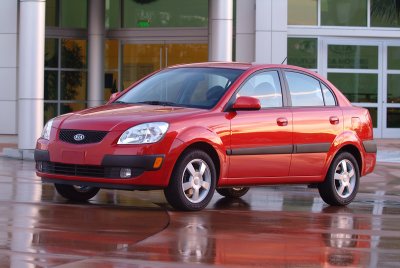
        2006 Kia Rio LX

        2006 Kia Rio LX

        Is America ready for small cars? Gas is $3 a gallon and looks only to rise in the future, making the feeding of a 12 mile per gallon SUV for commuting or running most errands a major financial investment. On the other hand, subcompact cars can get great gas mileage, but they are uncomfortable and cheap, in the most pejorative sense of the word. Right?

        Right only if your experience of subcompact ``economy cars'' stopped after the oil crises of the 1970s. Small car evolution has continued in Asia and Europe, where fuel prices are far higher than here. A fine example of the latest in small cars is the all-new 2006 Kia Rio.

        Although there has been a Kia Rio since 2001, the new one is the same only in name. In the past few years, Kia has been growing its lineup from low-grade entry-level compacts and subcompacts to become a full-line manufacturer, with a minivan, midsize SUV, and even the semi-luxury Amanti sedan. But not only has it has not forgotten its roots, Kia has applied technology and features used in its more expensive models to the new Rio.

        Like the larger Spectra, the Rio is offered in both sedan and five-door hatchback Rio5 body styles. The sedan comes in base and LX grades, with the LX adding standard amenities like air conditioning and available options including power windows, mirrors, and door locks and four-wheel antilock disc brakes at a very reasonable cost. There is only one grade of hatchback, SX, which is equivalent to the LX sedan. All models share a common drivetrain, a 1.6-liter, 110-horsepower four-cylinder twincam engine with variable valve timing matched to either a five-speed manual or four-speed automatic transmission.

        I first drove a new Kia Rio when the car was introduced to the press in Washington state last summer, where I had the opportunity to drive both the sedan and Rio5. While superficially similar, they should appeal to different markets. The Rio5 is sportier, and takes well to a manual transmission and enthusiastic driving. The sedan is perhaps a little more mature, and with the automatic, well-suited to urban and suburban errands as well as the daily commute. It's economical in operation, but don't mistake it for an econobox (a truly disparaging term if there ever was one) of the past. It's a comfortable modern car in every way, and above its modest station.

        APPEARANCE: Form follows function in the Rio's chunky proportions, but the car is styled in a pleasing manner, with a look popular in Europe and Asia. Rounded in basic shape, angular highlights on the hood, corners, and edges add visual interest, as do large flares around the wheel arches and large, bright headlights. The wheelbase is long for its size, giving the Rio sedan short overhangs, especially in front. And the passenger cabin is large and high, although not taken to extremes. Dark textured plastic strips on the bumpers and sides contrast with most body colors and protect against minor parking lot damage.

        COMFORT: The Rio's long wheelbase and large, high passenger cabin are beneficial to interior space, which is greater than in some popular compacts. It also rivals the class above in the high quality of materials used, textured synthetic cloth for upholstery and door trim and a rubber-like material for the rim of the tilt-adjustable steering wheel. The two-tone color scheme looks to be out of a luxury car, not an economy car. The front buckets offer good support and comfort, and the driver's cushion is adjustable for height. Although there is no covered console box, there are a number of other convenient storage spaces, including a large non-locking glove box and two different compartments in the instrument panel to the left of the steering wheel. There are even slots in the visors and instrument panel for bills and parking or toll ticket stubs, definite commuter-friendly features. The rear seat has good space for two on the outside, with adjustable-height headrests. The car is a little narrow for true five-seat duty, but the same could be said of most small sedans. The rear seat back folds 60/40 to help carry items that are too large to fit into the trunk, but that shouldn't often be necessary as the trunk is large for the car's size.


        iran

        Comment

        • Rasputin
          Senior Member
          • Jan 2005
          • 63906

          #574
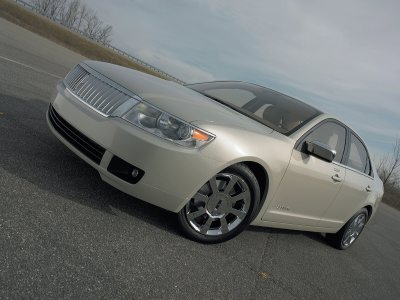
          2006 Lincoln Zephyr

          Lincoln was only selling expensive luxury cars, to an older, established clientele. New, younger buyers were needed. And so the Zephyr, a smaller, less-expensive but still luxurious Lincoln was born. In 1936.

          The 1936 Lincoln Zephyr featured aerodynamic styling inspired by the Art Deco movement and the streamlined trains of its time, with power from a small flathead V12 engine that had some design similarities to the Ford V8 of the day. That, and its innovative use of a unit-construction body on top of its frame, allowed it to be produced and sold for much less than the larger Lincolns.

          Seventy years later there is another Zephyr. It is very much in the mold of the original in concept, if contemporary in execution. The smallest Lincoln since its namesake, the 2006 Zephyr is a platform mate to the Ford Fusion and Mercury Milan, and shares their basic chassis specifications, albeit with its own calibration of the fully-independent suspension. A V12 was not in the plan - like its platform-mates, the Zephyr is powered by the 3.0-liter dual overhead cam Duratec V6. The three share a common wheelbase and greenhouse shape, but no lower body panels. Befitting its Lincoln nature, the Zephyr is much more fully-equipped than the Fusion or Milan, or, indeed, many of its potential rivals in the entry-luxury segment.

          I've just finished a week with a well-equipped Zephyr, and have been impressed by Lincoln's effort to appeal to a broader clientele. It's a fully-featured and comfortable machine with good manners on the highway. Just before taking delivery of the Zephyr, it was available for laps around a well-known racetrack at a press event. Lincolns are not generally thought of as competition cars (the Carerra Panamerica notwithstanding) and I wasn't anywhere near a race pace, but the suspension handled a quicker-than-street-legal driving quite well. The Zephyr is not your grandfather's Continental.

          APPEARANCE: No Art Deco here. The Zephyr is every bit a contemporary Lincoln in its exterior styling. Angular and toned, with the trademark Lincoln chromed waterfall grille and sculpted hood, it's conservative enough to please longtime Lincoln buyers yet fresh enough to attract the younger set that Lincoln desires. Alloy wheels shod with low-profile tires fill the slightly-flared wheel arches for a hint at performance. The long, boxy roof and high trunk lid help both to decrease aerodynamic drag and increase passenger and luggage space. Huge wraparound taillights highlight the rear, and are brightly lit by LEDs. Puddle lamps in the outside rear-view mirrors light the ground at night, adding convenience and safety.

          COMFORT: In a class where standard equipment can mean leatherette and plastic wood, the Zephyr stands out with supple perforated leather and real wood, either ebony or maple depending on interior color scheme. It's tastefully done, and satin-finished aluminum on the center stack gives a contemporary accent. The chrome-bezeled instruments feature bright electroluminescent lighting for easy visibility day or night, and LED backlighting for most controls and switches improves nighttime ease of use. The standard heated, ten-way power-adjustable front seats can be upgraded to be both heated and cooled. Comfort is good, and the all-weather versatility of both heat and cooling is hard to beat. The standard tilt-and-telescope My test car was equipped with both key options - the new Lincoln navigation system and THX II audio sound system - in one package. The standard sound system plays AM, FM, and both regular and MP3 CDs, with a six-disc in-dash changer; the THX system boasts 600 watts through 12 amplified channels and 14 speakers for very high-quality surround sound. Integrated with the nav system, both are controlled via a simple-to-use touch-screen interface. Rear seat accommodations are better than average for the class, and the trunk is one of the largest in its class.

          SAFETY: The Zephyr's safety-cage structure is designed to protect the occupants and meet or exceed all safety standards for the foreseeable future. It has the ``Personal Safety System''(tm), with dual-deployment front airbags, and load-limiting safety belt retractors and pretensioners. Front side and full-length side-curtain airbags are standard, as are antilock brakes and traction control.


          iran

          Comment

          • Rasputin
            Senior Member
            • Jan 2005
            • 63906

            #575
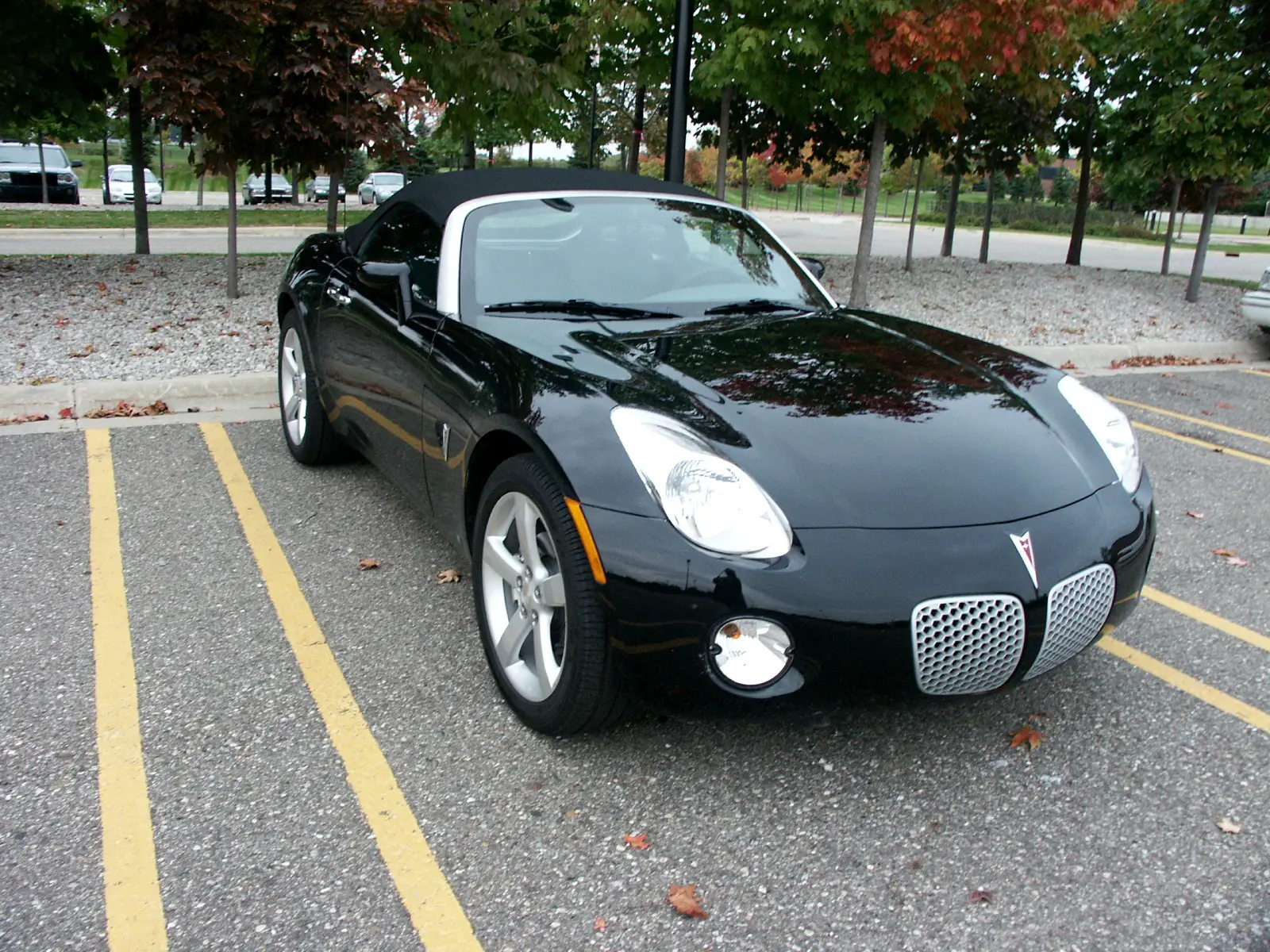
            2006 Pontiac Solstice


            Let’s review GM’s history of producing two-seat sports cars. First, the Corvette was brought out in 1953 considerably underpowered but sexy enough to compete with the popular underpowered British sports cars of the day. Fortunately, the introduction of the small-block V-8 in ‘55 legitimized it just in time to begin its run as an American icon, now in its sixth generation and 54th model year. An amazing success.

            Not so the also underpowered Fiero, put together mostly with off-the-shelf parts from other GM products. The rear suspension was taken directly from the dismally developed X-cars and couldn’t survive the average Michigan pothole without breaking in two. The poorly thought out front suspension caused the sprightly little car to plow in adverse conditions. Though the Fiero was less than well thought out we still must give GM credit for having the courage to produce a mid-engined two-seater in the era of gas shortages and uninspired products. Enthusiasts agree that in its last year of production, with a V-6 engine and suspension upgrades, it became a competent sports car just in time for its plug to be pulled.

            Then there was the lovely Reatta, built at the Lansing Craft Center. It was the first car GM made without an assembly line. The Reatta was misunderstood by the press and much of the public who expected it to be the faster, stiffer sports car. It was meant to be a classy personal luxury two-seater and it did a great job of being just that. My pretty blonde had hers for 11 years we both loved it.

            And now we have the fresh, flashy, fun new Pontiac Solstice, brought to market a bit too quickly perhaps, but an initial hit to be sure. I scored a black one for a long weekend recently to drive in Michigan State University’s sesquicentennial parade. With the popular and charming Alumni Association boss, Keith Williams, sitting on the boot we were the hit of the parade. With its brash and exciting style the Solstice is an amazing crowd pleaser.

            Look at that thing. A modern, masculine shape with wheels way out to the corners and virtually no overhangs give it the stance of a water spider. The two classic humps on the deck behind the seats suggest classic racing cars of the 50s. From inside looking out over the hood it resembles an older Corvette. For style and ambiance Solstice gets a solid A+.

            Solstice is universally seen as Bob Lutz’ baby, the first car fully developed under his watch and expected to reflect his personal love of automotive innovation. Lutz, GM’s chairman of global product development, insisted the car be brought in under $20,000 and in a tight time frame. It was first shown as a concept at the North American International Auto Show in 2002.

            Like the other GM sports cars it comes to market a tad underpowered with the 2.4-litre DOHC longitudinally mounted four-banger rated at 177 horsepower and 166 lb-ft of torque. With port injection, 4 valves-per-cylinder, and variable valve timing it redlines at a respectable 6900 rpm. It feels rather tepid under normal driving but keep the rpms above 4-grand and it’s much more exciting. Zero to 60 in 7.2 seconds - not bad really. There will be no V-6, Bob Lutz told me in an exclusive interview at the Automotive Press Association last week. “The chassis was designed to accept only the 4-cylinder because of cost and time considerations. But we can get 280 horsepower out of that engine with no problem at all,” Lutz insists. So look for GM to pour on the power in the near future.

            Browsing around under the hood I noticed that the battery is buried rather deeply behind the right front wheel well. So deeply, in fact, that it appears the body panel would have to come off to replace the battery. Closing the hood takes a bit of practice as well. Closing it too gently left one side not fully latched.

            All cars in the initial six months of production will have the 5-speed manual transmission that was brought over from the Chevy Colorado pickup. Automatics should be available early next year.

            Handling is impeccable. Suspension is good and stiff. Dive hard into a 90-degree turn and goose it for a precise and gripping experience. Go down the road and jerk the steering wheel back and forth to feel the quick and tight rack-and-pinion power assisted steering. Hit the rough railroad tracks or your favorite country road to feel the stiffness of this entirely new platform called Kappa. Suspension is independent front and rear. Bilstein © Coil-Over shocks are standard, as are the low-profile (45-series) 18-inch Goodyear Eagle RS-A tires. The new chassis gets an A+ too.

            Inside I felt comfortable and quite at home. My pretty blonde, though, felt a bit claustrophobic with the low top and high center console. She got over it quickly. The style and design of the interior is first rate, in my view, though some of my pals disagreed. The smooth swooping instrument panel blends into the center console gracefully. The materials mostly look and feel better than expected, although some rough plastic edges are evident. Seats, based on an Opel design, are supportive and well bolstered. The short shifter feels great and slips into and out of each gear without notchiness or resistance.

            The next order of business is to lower the top. Push the button inside the glove box to release the clam-shell boot. Release the inside handle for the top to let go of the windshield. Get out of the car and lift the boot high, fold the top down in one motion, then push it hard to compress it enough so the boot will close. Then slam - yes slam - the boot. Try to close it gently and the far side will probably not latch properly. The top system needs a bit of work yet to match its competitors in sophistication. At speed with the top up there is a distinct whistle on both sides near the base


            iran

            Comment

            • horiyeh
              Senior Member
              • Oct 2005
              • 4834

              #576
              ohhhhh ohhhhhh mashino!! damesh garm!!!!!!!!

              Comment

              • Rasputin
                Senior Member
                • Jan 2005
                • 63906

                #577
                2006 Mazda Tribute S 4WD

                Consider the juxtaposition of words in ``sport-utility vehicle.'' Most in the category are primarily utility vehicles. ``Sport'' is something done at the destination; it has little or nothing to do with the driving characteristics of the vehicle. The factors that increase utility - ground clearance, the size necessary for useful cargo space, and the heavy-duty construction and four-wheel drive systems for off-road use - work against sport.

                Mazda is well-known as a maker of sports cars. Its MX-5 Miata is the best-selling sports car ever. And Mazda also has several generations of Wankel rotary-piston powered RX-7s and the current RX-8 to its credit. The company likes to say that it puts the soul of a sports car into each of its vehicles. That rings true for its midsized Mazda6 and compact Mazda3 sedans, but for its Tribute SUV?

                True there, too.

                While it's unlikely that a Tribute could best a new MX-5 around a race track, it has been one of the better-handling small SUVs since its introduction five years ago. Credit that to its well-designed car-like unibody construction and a fully-independent suspension that has always been tuned to a more sporting specification than is the norm in the SUV class. The Tribute's size works in its favor, too. It's small enough to be maneuverable, but large enough to fit four or five people and cargo inside with comfort and ease. And the powertrain choices, an economical but relatively powerful four-cylinder and 200-horsepower V6, help, too.

                Introduced for model year 2001, the Tribute got its first major upgrades for the 2005 model year. Trim levels were reduced to two - four-cylinder ``i'' and V6 ``s'' - in keeping with Mazda's current practice. Freshened styling may have been the most apparent change, but the most notable improvement was under the hood of the i: a new four-cylinder that improved on the old by 23 horsepower and 17 lb-ft of torque, with 40 lbs. less weight as a bonus. Both trim levels could be fitted with a new electronically-controlled single-range full-time four-wheel drive system, and antilock brakes with electronic brake force distribution were standard across the line.

                Unsurprisingly, there are no major changes to the 2006 Tribute.

                It's been five years since the last time I drove a Tribute, so I was glad to have the opportunity to spend a recent week with a well-equipped 2006 ``s'' model. The original Tribute suspension tuning was firmer than the SUV average, for very good maneuverability with a sporty ride quality. Mazda has refined that, for even flatter cornering for improved handling. As before, the newest Tribute strikes a near-perfect balance in size, with good interior space in a conveniently small and easily parkable package. With the improved handling, it's even sportier, and proves that there are indeed some sport-utilities in which ``sport'' is not just in the name.

                APPEARANCE: Although the Tribute's overall design is unchanged from the original styling, the details differ. It's a typical two-box SUV, moderately small in size with normal proportions, short overhangs and lower protective and decorative cladding. The front shows the most change. The grille has been reshaped, but is still highlighted by a chromed top bar and a central crossbar with the Mazda logo. The bumper fascia has likewise been restyled, with a sportier foglamp treatment on the ``s''. The headlights are also new. The plastic ``skid plate'' underneath does more for looks and perhaps aerodynamics than protection against rocks. There are minor differences in the side cladding panels, and a new rear bumper fascia and taillights.

                COMFORT: An efficient interior design makes good use of the available space inside the Tribute, and upscale contemporary styling makes it a pleasant place in which to spend time. My test model had the ``Option Package III,'' a pricey - $2,595 - but comprehensive interior upgrade with a power driver's seat, leather-appointed upholstery and steering wheel, fancier interior trim with the look of aluminum and black maple, heated front seats and outside mirrors, a seven-speaker premium AM/FM/cassette/6 CD changer audio system that is prewired for Sirius satellite radio, a moonroof, and more convenience features. Allied with standard additional soundproofing and improved engine mounts, it makes for an upscale driving experience. Seat comfort in front is very good, and the rear seat has plenty of room for two adults, or three for more limited times, width being the constraint. It's split 60/40, with flip-and-fold cushions for a flat load floor, and flip-up glass in the tailgate is convenient for loading lighter items. The space-saver spare is located outside, underneath the rear, as in a ``real'' truck, improving interior space.

                SAFETY: ``Triple-H'' unibody construction provides a strong central safety cell around the passenger area, with front and rear crumple zones. Variable-force front airbags are standard, with seat-mounted side airbags and side head-curtain airbags available. All Tribute models have antilock brakes; the s's are four-wheel discs.


                iran

                Comment

                • Rasputin
                  Senior Member
                  • Jan 2005
                  • 63906

                  #578
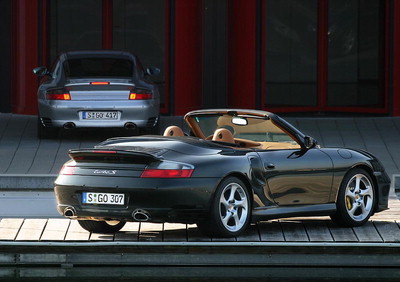
                  Short of a million-dollar lottery winner, an invitation to drive Porsches on a race track runs close second. With a million dollars you can own a Porsche!

                  Thus I, and various other media racer-wannabes gathered for a day of very high speed entertainment at Waterford Hills Road Racing track. After a short business meeting charting Porsche’s latest developments we


                  dropped the tops on all manner of Porsche Cabriolets, donned helmets and started engines. Each of us was—thankfully—accompanied by a professional driver to remind us we are amateurs. BRAKE NOW, is a critical part of instructor’s vocabulary; a loud and commanding voice a necessity.

                  Porsche brought five different open cars: Boxter and Boxter S, the 911 Carrera Cabriolet and Carrera S Cabriolet, and a 600 horsepower (that’s SIX-HUNDRED-HORSEPOWER) 205 mph (yes, TWO-HUNDRED AND FIVE BLOODY MILES PER HOUR!) Porsche Carrera GT priced at $440,000. Excuse me a moment for deep breaths… Fortunately I got up to speed in a Boxter S before driving the GT.

                  Porsche Boxter S $53,100
                  The 2005 Boxter , at eight years old, is in its second generation. This mid-engined ragtop now has brakes from a 911 (bigger and stronger) and improved stability control (Porsche Stability Management.)


                  PSM is far less aggressive than most stability controls—you can slip and slide quite aggressively before it kicks in.

                  There’s room for taller drivers and a 240 horsepower 2.7-liter engine that sprints to 60 mph in under 6 seconds. S models have a larger, 3.2-liter engine with 280 horsepower connected to a six-speed manual. Either incorporates six airbags: driver and passenger, thorax, and head.

                  Motoring out of the pits, into turn 1 (follow along on the track map www.waterfordhills.com) I could feel an improvement in the shifter – it’s 26% shorter throw makes it quick and slick. Accelerating into turn four—uphill, blind—brakes felt smooth, strong and easy to apply in a very graduated amount. Great brakes are a Porsche hallmark.

                  Quickly down the hill and into sweeping turn five, there was no chassis flex, and plenty of torque on exit onto the long back straight.

                  911 Carrera Cabriolet $79,100
                  The next car, an “ordinary” Porsche Carrera Cabriolet, was equipped with Tiptronic, Porsche’s steering-wheel mounted manual


                  automatic. By the middle of turn one we had shifted to third gear and used the torque from the 3.6-liter boxer engine to drive around the track. This vehicle felt a bit looser than the Boxter S, but had way more power. The day was cool, so heated seats were turned on for comfort (though high-Gs with a helmet and comfort are seldom used in the same sentence.) With 325 horsepower it was very easy to go much quicker than the Boxter S. Fortunately the Cabriolet has 318 mm (12.53”) front and 299 mm (11.77”) rear rotors, inner-vented and cross-drilled, with monoblock four-piston calipers.

                  Part of the art of driving well, and fast, involves knowing when to brake, and how much brake to apply. Often the amount of brakes was (to me, not the professional beside me) barely perceptible. A slight change of balance to the front makes tires bite as direction changes. It felt as though I only turned on the brake lights! There are few vehicles with this level of excellence in brakes.

                  911 Carrera S Cabriolet $88,900
                  Unlike the Carrera, the S Cabriolet was equipped with a 6-speed manual, but


                  it was still third gear for “poodling around,” no downshifting of the ultra-smooth transmission. While the added torque and acceleration of second gear might have reduced lap times, my focus was on basics; when to apply gas (as you begin to unwind the wheel,) when to brake (mostly in a straight line, sometimes trailing into the turn,) and when to turn in. These techniques are the essence of driving quickly and well, and can be practiced on every corner in your daily commute.

                  The Carrera S has larger brakes, 330 mm (12.99”) front and rear, with distinctive red four-piston monoblock calipers. It was equipped with Porsche Active Suspension Management. This lowers the car by 10 mm in


                  normal mode (vs. Carrera) and in sport, activates individual dampers continuously. Input comes from a pair of accelerometers (front right , left rear damper dome) for vertical movement, plus input from steering angle, road speed, brake pressure and engine torque. A little math and the suspension reacts to reduce dive, squat, rocking or jumping, and body roll. Craig Stanton, my right-seat race-driver conscience (www.craigstanton.com) switched PASM on and immediately you could feel the car settle and firm, taking a more aggressive stance and attitude.

                  Like a lineman taking a set, or a martial artist exhaling before a blow, the Carrera S felt poised to attack each corner. S models have more horsepower, 355 from a 3.8-liter engine. And all Carreras now have variable-ratio steering. Beyond 15° plus/minus of center, steering changes from 2.98 turns lock-to-lock to 2.62. Steering columns tilt and telescope. You can tell the Carrera from S models by tailpipes. S models have twin round tailpipes and red brake calipers, Carrera’s have two oval pipes and natural-colored calipers.


                  iran

                  Comment

                  • Rasputin
                    Senior Member
                    • Jan 2005
                    • 63906

                    #579
                    2006 Suzuki Grand Vitara

                    The name Suzuki, for me, brings to mind ring-ding-ding motorcycles and tiny, tinny cars. A week with the Grand Vitara has convinced me that Suzuki is a fully modern competitor in today’s automotive scene.

                    From making weaving looms in the 1920s and motor bikes in the 50s, Suzuki built its first automobile in 1955, a stubbly, cartoonesque little thing with rack and pinion steering, tall skinny tires, front-wheel-drive, and independent suspension. Suzuki entered the US market with the Samurai in 1985. And now, in 2005, Suzuki is working on a record sales year.

                    The last Suzuki I drove was a Samurai we rented on the Caribbean island of St. John in the late 80s. It was a competent enough cute-ute, very basic, simple, cheap and plenty fun to drive on those narrow island roads. We had quite an adventure there, trundling to every corner of the island and rescuing a little orange cat named Booker. Remind me to tell you that story sometime.

                    This new Suzuki Grand Vitara came to my driveway unexpectedly. I was scheduled for an Audi. Not a problem. I had seen the new Grand Vitara and was interested in having a closer look. Initial inspection was very favorable. The color took me right away. “Silky silver metallic” they call it and it surely looks silky. I saw the clear beige metallic (gold) at a press event recently and it was just as striking. Certainly the paint and colors are well executed and the finish on my test car was excellent.

                    The Grand Vitara has a sturdy stance at first view. The styling is up-to-date and quite attractive. Suzuki calls it muscular. That’s a bit of hyperbole, I’d say. In fact, I’d still put it in the category called “cute-ute”.

                    lb. The standard Grand Vitara comes quite well equipped. A V6 engine, 5-speed manual transmission, power windows, locks and mirrors, remote entry system, adjustable steering column, steering wheel controls for audio and cruise, three 12-volt power outlets, front and rear automatic climate control, cargo cover, outside temp and fuel consumption gauges, AM/FM/CD/MP3/WMA, XM stereo with 4-speakers and all the airbags you might want. You get all this, in two-wheel-drive configuration, for less than 19-grand. Four-wheel-drive adds $2,200. Premium, sport and luxury packages could bring the price as high as $24,399 with everything. Our test vehicle is has the premium package and lists out at $22,600.

                    Off to town for a first drive, I liked its feel, solid and smooth, but I was not impressed with the Grand Vitara’s power. The DOHC, 2.7-litre, 24-valve V6 is rated at 185-horsepower. It sure didn’t feel like 185. Checking the specs again I find that horsepower comes on at 6,000 rpm. I didn’t wind it up that tight. Maximum torque is 184 ft. at 4,500 rpm. Heading onto the freeway on our cloverleaf ramp I could barely make 70 mph at the end of the acceleration lane with foot to the floor. Of course I couldn’t get much of a head start either since the modest body lean and jumpiness were disconcerting on the tight cloverleaf. Once used to the Vitara’s handling I could probably push it a bit more.

                    Fuel economy is rated at 18-city and 23-highway on regular fuel for the manual transmission and 19 and 24 for the automatic. Don’t ask me why. Usually a manual gets a bit better mileage than an automatic. The tank holds 17.4 gallons. Expect about a 400-mile range. Though I wasn’t able to put enough miles on the Vitara to check the mileage accurately these numbers represent a reasonable expectation.

                    At speed the Vitara felt fine – steady, tight and firm. The ride, both on the freeway and on the rough two-lanes, felt balanced and well damped. I was most impressed as I passed briskly across a notoriously rough set of railroad tracks between me and the city. I could feel no squirm or flex – just a nice tight jump. The chassis, a reinforced unibody design, is rigid and tough.


                    iran

                    Comment

                    • Rasputin
                      Senior Member
                      • Jan 2005
                      • 63906

                      #580
                      BMW 1200 ST

                      If you’re going to test new motorbikes, you may as well head for the deserts of Palm Springs and surrounding mountains, the California riding nirvana equivalent of the Scottish highlands, but with a little less (but still surprisingly prevalent) fauna. BMW brought 50 odd models of the new 1200 ST and RT, plus a smattering of others from the range, to whet the assorted journalists’ whiskers, such as the 1200 S and R – a stripped down, naked version of the S which is by far the most radical street bike BMW has ever offered.

                      The ST and RT are vastly improved over the previous 1150 models they replace. BMW refers to them as 100% new, which theoretically is true, however they both share many of the best components from the GS including the new 1170cc four-value-per-cylinder Boxer twin and few bits from the outgoing 1150’s. The new engine produces 110bhp, 15 hp more than the outgoing model’s motor, 10 hp more than the current GS and this, combined with a weight saving of 70 pounds on the RT and 55 pounds on the RS, equals significantly enhanced performance and handling characteristics.

                      I started the day with the RT – wisely I thought, as the ST was sure to be a dynamically more nimble and faster bike and I didn’t want to prejudice my appraisal. The RT is certainly dramatically different in styling then anything that’s gone before. Designed in the wind tunnel with integrated and large rearview / turn signal mirrors, a larger windscreen that is both taller and wider creates a large ‘rider window’ for better protection from the elements. The layout of the controls and riding position will be familiar to any RT owner. Though the controls have been updated, the handlebar is a carryover and filled with buttons for heating the grips and seat, the optional ESA ($750), volume controls for the radio, cruise control, indicators and emergency flashers. Onboard the riding position is upright and comfortable with various seating positions available - BMW has made efforts to accommodate everyone. The electrically-adjustable screen works very well, especially in the raised position. The radio and speakers are excellent and the volume is automatically speed adjustable. Vibrations from the engine have been significantly reduced with the employment of a counterbalancing shaft to eliminate ‘rocking couple’ – a term I would previously have associated with Pamela Anderson and Tommy Lee. Of course vibrations are all relative, and the fact remains that both the ST and RT leave their mark on your endoskeleton as your hands communicate the unique sensations of the boxer through your body.


                      iran

                      Comment

                      • Rasputin
                        Senior Member
                        • Jan 2005
                        • 63906

                        #581
                        2006 Mercedes-Benz CLS500

                        MODEL: Mercedes-Benz CLS500
                        ENGINE: 5.0-liter V8
                        HORSEPOWER/TORQUE: 302 hp @ 5,600 rpm/339 lb.-ft. @ 2,700-4,250 rpm
                        TRANSMISSION: 7-speed automatic
                        WHEELBASE: 112.4 in.
                        LENGTH/WIDTH/HEIGHT: 193.3 x 73.7 x 55.2 in.
                        TIRES: 245/40R18 (front)/ 275/35R18 (rear)
                        CARGO VOLUME: 15.8 cu. ft.
                        FUEL ECONOMY: 16 mpg city/22 mpg highway/ 23.5 mpg test
                        STICKER: $69,535 (includes $775 destination and delivery charge and $1,300 gas guzzler tax).

                        In an automotive writing career that has reached 40 years and more than 1,500 different cars (some of them repeats, of course), it’s easy to be blasé. In all seriousness, there aren’t many cars that are capable of setting themselves apart form most of the others. There are just so many “another SUV” or “another four-door sedan” or “another sporty car” variations out there.

                        That is, until recently. I was in Palm Springs, California, at the introduction of a luxury car. I went for my morning walk/jog when I was stopped in my tracks by the most beautiful modern automobile I believe I have ever seen. It was pale blue in color and was sleek and swoopy. Since I was near a Mercedes-Benz dealership and there was a three-corner star in the center of the grille, I at least knew the manufacturer. Being a Mercedes-Benz, I also knew the vehicle’s identification would be on the left rear of the trunk.

                        It was a CLS500.

                        Mercedes-Benz likes to promote the CLS as a “four-door coupe,” which is an oxymoron, since coupes are, by definition, two-door models. But the CLS has coupe-like styling, and if you look at the car quickly and don’t notice the rear doors, it does appear to be an elongated coupe. The rear slopes down smoothly from the midpoint of the car, near the B-pillar, to the end of the rear decklid. In addition, the front of the CLS is equally sleek, sloping forward into a new variation of the classic Mercedes-Benz grille.

                        I love it.

                        Naturally, I couldn’t wait to get my hands on a CLS, and the opportunity finally came. The best part of the tester was that it was the same robins egg blue that was the color of the first CLS I saw. Mercedes calls the color “granite grey,” but it has blue undertones that are as subtle as the shape of the car.

                        And our tester was the 500, with a 5.0-liter V8 engine. There’s a CLS55 with an AMG-tuned supercharged 5.4-liter V8, but I feel that engine delivers almost too much power for a car that is more elegance than performance. TheCLS500’s engine delivers 302 hp, which is more than enough for excellent performance and smoothness. The CLS55, on the other hand, offers 469 hp, which is 50 percent more and I believe too much.

                        The engine drives the rear wheels through a 7-speed automatic transmission that is smooth as silk. It’s perfect for the car itself.

                        The engine/transmission combination delivered the power and it was just as much as I’d want, although by now you must realize that I was prejudiced from the start. Handling was excellent as well. We tried to toss the CLS through some of our favorite winding roads and hillclimbs and it performed like a champ.

                        The CLS is based on the E-Type, but is sleeker and more expensive. Like the E-Type, there are “halo lights” in front surrounding the overhead console. There’s another set of halo lights in the rear for rear passengers who want to use reading lamps or other advantages.


                        iran

                        Comment

                        • Rasputin
                          Senior Member
                          • Jan 2005
                          • 63906

                          #582
                          2007 Toyota FJ Cruiser

                          Think ``Toyota,'' and what comes to mind? Probably not style. For the most part, the styling of Toyota's cars and trucks has been either conservative to the point of blandness or just plain strange.

                          But Toyota's new FJ Cruiser will sell on style, as well as its on- and off-road prowess and value. As other manufacturers have done, Toyota mined its past for an auto-show circuit concept vehicle, which debuted at the 2003 Detroit auto show. And, as is often the case today, that concept vehicle turned heads, and became a production reality with little change.

                          Inspiration for the FJ Cruiser is the FJ40 Land Cruiser, sold here from 1960 through 1983 and now a very collectible vehicle. And the new FJ is a real Land Cruiser at heart, as it is built on the same Land Cruiser Prado chassis as the current Toyota 4Runner and Lexus GX470. The FJ Cruiser is shorter than those vehicles, and fills a hole in the Toyota SUV lineup that was created when the 4Runner went upscale. For, despite its eye-catching style, the FJ Cruiser is Toyota's entry-level seriously off-road capable body-on-frame SUV. After all, there isn't much point in making a vehicle designed to appeal to young and young-at-heart people if it's not affordable to its target market, and with base prices starting at $21,710 for the 4x2 model, the FJ is affordable for its intended buyers.

                          Being a real Land Cruiser, the FJ is a body-on-frame vehicle, built to be at the front of the pack in the rough stuff and also to provide first-rate comfort on pavement. Power for both 4x2 and 4x4 versions is from a 4.0-liter, 239-horsepower V6 similar to that found in the 4Runner. I've just finished a week of city and highway driving in a well-equipped 4x4 automatic model, and am very impressed with its solidity and civility. But my introduction to the FJ was at media off-road event, where a very technical course was set up on loose gravel and dirt, with steep grades, extreme breakovers, and plenty of tricky maneuvering. The FJ worked as well as anything else out that day, and better than some well-regarded machinery. It's more than merely a styling exercise; Toyota's new FJ Cruiser is a fine addition to the Land Cruiser legacy.

                          APPEARANCE: The FJ Cruiser is a larger vehicle than it appears to be in photos, where it seems RAV4-sized. Its face is familiar. The FJ40 was distinguished by the oval surround piece around its grille and round headlights, a small scoop in its hood, and white roof. All of those styling cues are prominently displayed on the FJ Cruiser, giving instant recognition, although the overall shapes of the two vehicles are completely different and the FJ Cruiser's hood ``scoop'' is merely cosmetic. The old FJ had body panels that were either flat or made with simple curves, separate front fenders, and a flat windshield. The new FJ has somewhat more complex panels and a low, near-vertical, but curved windshield. It's also much longer, and has four, rather than two, doors. But the rear doors are of the extended-cab pickup-type rear-opening variety, to try to preserve the impression of the original's two door style. The FJ Cruiser's high beltline, low roof, wide window pillars, and slightly sloping rear roofline give it the look of a contemporary military vehicle. The angular shape of its flexible plastic wheel arch and lower-body trim echoes the old FJ's front fenders and running boards. At the rear, the externally-mounted spare tire gives it the classic utility vehicle look.

                          COMFORT: Inside, the FJ Cruiser is as stylish as outside, but it's also very functional. Its simple geometric forms and multiple materials and textures give it a retro-modern look, which is enhanced by the body-colored center stack and (optional) door panels. The flat instrument panel appears to be suspended between two tubes, and both its shape and the silvery trim at its ends and the sides of the center stack give it a rack-mount impression. The black-on-white instruments are easy to see, and the oversize climate controls and auxiliary buttons in the center stack are easily gripped. Don't be afraid to get dirty - the seats are covered with a synthetic material that is water-repellent, breathable, and easy to clean, and the floor is a simple, easily-cleaned textured and rubberized plastic. Seat comfort is very good, both front and rear, although rear head and leg room are limited. As in an extended-cab pickup, the front doors must be opened first to open the rear doors. With the spare tire mounted on the side-hinged tailgate, cargo space is very good, and even better when the 60/40 split rear seat is folded flat. The optional subwoofer is mounted on the right side of the cargo area, where it is out of the way. The upgraded audio system in my test vehicle as part of the upgrade package provided high-quality sound, and the system plays both regular and MP3 CDs and has a jack for an external audio player - with a power outlet to connect the player to close by. Speaking of power, another part of that option package is an inverter that allows the Cruiser to be used as a generator, with a 400-watt, 115-volt grounded outlet at the rear of the cargo area.

                          SAFETY: Dual-stage front airbags can be supplemented with optional front side and full-length side curtain airbags. Like all Toyota SUVs, the FJ Cruiser is equipped with the Star Safety System, comprised of the Vehicle Stability Control (VSC) system, traction control, antilock brakes, electronic brake-force distribution, and brake assist. Brakes are large, strong four-wheel ventilated discs.


                          iran

                          Comment

                          • Rasputin
                            Senior Member
                            • Jan 2005
                            • 63906

                            #583
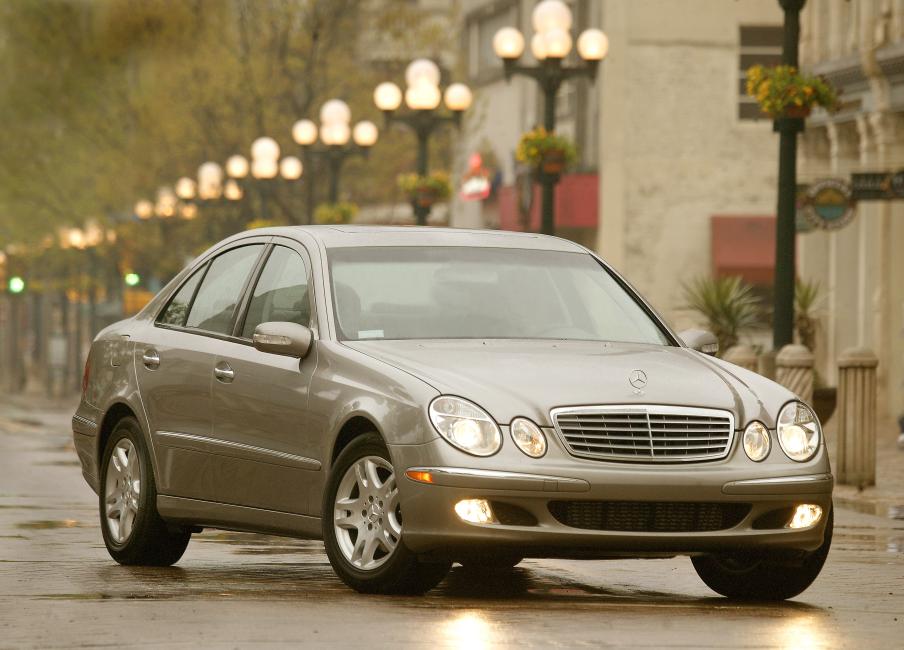
                            2006 Mercedes-Benz E350

                            SPECIFICATIONS
                            MODEL: Mercedes-Benz E350
                            ENGINE: 3.5-liter V6
                            HORSEPOWER/TORQUE: 268 hp @ 6,000 rpm/258 lb.-ft. @ 2,400-5,000 rpm
                            TRANSMISSION: 5-speed automatic
                            WHEELBASE: 112.4 in.
                            LENGTH x WIDTH x HEIGHT: 189.7 x 71.3 x 57.0 in.
                            TIRES: P245/45R17 all-season
                            CARGO VOLUME: 15.9 cu. ft.
                            ECONOMY: 18 mpg city/24 mpg highway
                            PRICE: $56,965 (includes $775 destination and delivery charge)

                            This is the second of three consecutive vehicles we have driven with Mercedes-Benz’s new 3.5-liter V6 engine that replaces the 3.2-liter. Putting this engine in the E-Class creates the E350, which I feel is as close to perfect as you can make a midsize sedan. You pay for it, of course, but it still is near perfect.

                            The 3.5-liter V6 is a good engine for this platform. The E-class weighs in at about 3700 pounds, heavy enough to be sturdy but still light enough not to require an enormous engine to propel it. I felt that acceleration was good, as was the ability to attain and maintain highway speeds without effort.

                            The engine is hooked to a 5-speed automatic transmission that was smooth. Some Mercedes-Benz models offer as many as seven speeds in their automatics, but five is plenty, unless you’re a shift fanatic. This transmission also had a touch-shift to convert it to a manual mode if you wanted, but I feel in a sedan such as this, the manual mode is really there for show and not for go.

                            Handling is excellent, as one usually expects from a Mercedes-Benz. The front suspension is an independent double wishbone geometry with an anti-dive feature. The rear is Mercedes’ usual independent 5-arm multi-link geometry that has worked for years.

                            We took the E350 on a couple of hilly winding roads and it behaved itself well. Of course, while it was behaving itself, the passengers rode in comfort. We had speed-sensitive power steering to help us along the way. My sole complaint with the E350 was that at lower speeds the power steering was almost imperceptible, and steering was heavy. Speed-sensitive usually means that steering is lighter at lower speeds.


                            iran

                            Comment

                            • Rasputin
                              Senior Member
                              • Jan 2005
                              • 63906

                              #584
                              2006 Mazda MX-5 Miata

                              Zippy yet refined, flashy yet restrained, bigger yet still smallish feeling, sports car look yet big car comfort, the 2006 Mazda MX-5 is a bundle of contradictions and another winner of the coveted The Auto Channel’s “Practally-Practacal” * Luggage Carrying Award...what more could anyone want in a two seat moderately-priced personal vehicle?

                              With my road trip to Detroit and Toronto already scheduled...and the price of gas climbing...the late summer sun shining...and a song in my heart...and a long test drive on my mind...I was fortunate to have the reliable folks from Specialty Transport bring me a shiny new “true red” (and they really mean RED) 2006 Mazda MX-5 (nee Miata) for a couple of weeks.

                              As many of my (ir) regular readers know, I am a MAZDA MAN. In fact just two weeks ago I brought home a cherry 1990 RX-7 Convertible. I needed this second RX-7 convertible, when my first love decided that enough was enough and after 196,000 enjoyable miles under her s***t she decided to self immolate, and broke my heart in the process. But thanks to E-Bay Motors and my quick (over?) bidding technique I am once again the proud and happy (so far) 3rd owner of a lovely arctic white wankel- powered sports car.

                              The good news and bad news for car makers concerning my testing and reviewing two- passenger topless sports cars...is that I always compared them to my 1988 and now my 1990 RX-7...how they ride, sound, feel, look, get noticed, and can they carry enough luggage for a weekend away or for a trip home from the airport.

                              Enough of the background of my prejudices.

                              The 2006 MX-5 had lost the Miata name, but sure still looked like one. Why I wonder did Mazda invest so much to make the many thoughtful and appreciated changes but did not alter the sheet metal (aluminum and steel) and plastic enough to SCREAM that this IS NOT YOUR SISTER’S MIATA.

                              Oh well I guess the boys and girls in Hiroshima collaborated with their counterparts in Dearborn to come up with that design decision.

                              The MX-5(Miata) is a nice car...its peppy, cool looking, smooth, tame and very finely finished.

                              I look for and really appreciate these attributes in a sedan or even a sports sedan, BUT in my opinion the new MX-5 may just be too smooth and too tame and too finely finished for a low to the ground sports car...I wished it was a little less “prissy” and a little more edgy.

                              As an example, step on the accelerator and the ample engine quietly does its thing, the MX-5’s exhaust sounds do not include the kind of throaty raspy growl that I like to hear in my sports cars.

                              The ride and handling were exemplary, the additional torsion rigidity, virtual mid-ship engine placement and 4-wheel independent suspension allowed the MX-5 to handle all conditions and situations on the trip, safely and comfortably, while delivering the promised 30 mpg driving at or above the speed limit on both interstate and back-country roads.

                              The MX-5’s interior is “big car” complete


                              iran

                              Comment

                              • yayara
                                Newbie
                                • May 2006
                                • 22

                                #585
                                The Ford Mustang is a popular American automobile, originally based on the Falcon. The first production Mustang was a white convertible with red interior that rolled off the assembly line in Dearborn, Michigan on March 9, 1964. Introduced to the public at the New York World's Fair on April 17, 1964, and via all three American television networks on April 19, it was the most successful product launch in automotive history, setting off near-pandemonium at Ford dealers across the continent. The original Mustang inspired the term pony car and prompted many imitators. Because the Mustang showed good value with a good balance of a sporty design, price, and overall performance, the Mustang stomped on sales records.

                                The prototype first conceived by Ford product manager Donald N. Frey and championed by Ford Division general manager Lee Iacocca showed us a two-seat, mid-engine roadster. This later would be remodeled as a four-seat car penned by David Ash and Joseph Oros in Ford's Lincoln–Mercury Division design studios, which would be the winning design in an intramural design contest called by Iacocca. The base, yet well-equipped Mustang hardtop with its 105 hp (78 kW), 156 ft•lbf (212 N•m) 170 in³ (2.8 L) inline six-cylinder engine and three-speed manual transmission listed for US$2,368. Looking like it cost hundreds of dollars more with its "long hood/short deck" styling, the Mustang earned a number of prestigious auto industry awards and accolades its first year. Including those are Motor Trend Car of the Year, pace car duties for the 1964 Indianapolis 500, and the Tiffany Design Award for "excellence in design," the first automobile so honored. This shows the quality placed in the Mustang. Borrowing minor design cues from the Lincoln Continental and two-seat Ford Thunderbird with an intentional touch of Ferrari at the grille, the Mustang can be regarded as a true master of engineering.

                                Surprisingly, for all its style and well-marketed sporty design, the Mustang was based heavily on familiar, yet simple components. Much of the chassis, suspension, and drive train was derived from the Ford Falcon and Ford Fairlane. The car had a unitized platform-type frame from the 1964 Falcon, and welcoming box-section side rails, including five welded crossmembers. Although hardtop Mustangs were the majority in sales, durability problems with the new frame led to the unusual step of engineering the (necessarily less rigid) convertible first, which ensured adequate stiffness. Overall length of the Mustang and Falcon was identical, at 181.6 in (4613 mm), although the Mustang's wheelbase at 108 in (2743 mm) was slightly shorter. With an overall width of 68.2 in (1732 mm), it was 3.4 in (86 mm) narrower, although wheel track was nearly identical. Shipping weight, about 2570 lb (1170 kg) with six-cylinder engine, was also similar. A full-equipped, V8 model weighed about 3000 lb (1360 kg).

                                Much of the appeal (and the profit) in such a low-priced car came from the options list. Ford utilized this to their advantage. The Mustang's long list of optional equipment list enabled buyers to fully customize their cars to their tastes and budgets. It also resulted in typical transaction prices hundreds of dollars above the base price, making the Mustang a profitable not only for the dealer but also for the manufacturer.

                                The option list included several power train combinations; the buyer could choose a four-speed manual transmission ($115.90 or $188.00 with six-cylinder or eight-cylinder engines, respectively) or the three-speed Cruise-O-Matic automatic transmission ($179.80 or $189.60). The standard six-cylinder engine could be replaced with a 164 hp (122 kW) 260 in³ (4.2 L) for $116.00 or a 210 hp (157 kW) 289 in³ (4.7 L) V8. Boasting the V8 and four-speed manual, the Mustang Road & Track recorded a 0-60 mph (0-96 km/h) time of 8.9 seconds, with the standing quarter mile in 17 seconds at 85 mph. Starting in June 1964, the new 271 hp (202 kW) "K-code" High Performance engine became available, including a handling package with stiffer springs, shock absorbers, stiffer front anti-roll bar, fast-ratio steering, and wider tires also optional on other Mustangs. At $442.60 (not counting the mandatory four-speed transmission) it was the single most expensive Mustang option, and only 7,273 of the 680,992 Mustangs sold in 1965 were equipped. With a skilled driver, K-code/4-speed equipped Mustangs could do 0-60 in around 6 seconds, and put down mid 14-second ¼ mile times with ease.

                                Other options included: limited-slip differential, styled wheels and wheel covers, power steering, power brakes, air conditioning, center console, a vinyl top, various radios, a bench seat, and various other accessories. Disc brakes for the front wheels became optional later in 1965. The list would continue to grow through much of the Mustang's history, in which added trim packages like the Interior Decor Group (or "pony interior") and GT package (which included disc brakes, handling package, and other items), became a must for enthusiasts. Additional engine choices and convenience items are well known for the Mustang.

                                Because the timing of the car's introduction coincided perfectly with the first wave of the postwar "baby boom", the Mustang entered the market with a strong force, which was heading off to work in a strong economy. Incredibly, no domestic manufacturer up until that time had anything that remotely resembled an affordable, yet youthful and sophisticated automobile aimed at this burgeoning market, and Iacocca knew it. Despite his repeated attempts to receive the go-ahead to produce such a car, his proposals fell on mostly deaf ears. Although the company was still smarting financially after the demise of the Edsel Division in late 1959, upper management at Ford under Robert McNamara (later United States Secretary of Defense under Lyndon Johnson) wasn't willing to take such a major risk.

                                Still, Iacocca persevered and was given the green light to produce the Mustang in mid-1962, which gave the design team only eighteen months to design and develop the car. Not only did the project wrap up in under eighteen months, it wrapped up under budget, thanks to the decision for the use of many existing mechanical parts as possible. As far as the design itself was concerned, Ford stylists basically threw out the company handbook on design limitations. This single handedly pushed the stamp of technology of the time to its limit in such design areas as the sweep of the rear lower valence and the remarkably complicated front end stampings and castings. Curved side glass was used as well, but at a stern price considering the technology to produce distortion-free curved safety glass was still in its early stages. Though most of the mechanical parts were directly taken from the Falcon, the Mustang's body shell was completely different from the Falcon's, sporting a longer wheelbase, wider track, lower seating position, and overall height. An industry first, The "torque box," was an innovative structural system that greatly stiffened the Mustang's unitized body construction and further helped contribute to its excellent handling; at least compared to other cars of the time.

                                When the Mustang hit the market, there was nothing like it. It was perfect for young hip adults and the talk of the new teen power scene.

                                Comment

                                Working...