
-
-
A sixth sense for a wired world
What if, seconds before your laptop began stalling, you could feel the hard drive spin up under the load? Or you could tell if an electrical cord was live before you touched it? For the few people who have rare earth magnets implanted in their fingers, these are among the reported effects -- a finger that feels electromagnetic fields along with the normal sense of touch. It's been described as a buzzing sensation, a tingling, an oscillation, movement, pure stimulation and, in the case of body-modification expert Shannon Larrett's encounter with a too-powerful antitheft gateway at a retail store, "Like sticking your hand in an ultrasonic cleaner."Body-mod artists Jesse Jarrell and Steve Haworth's original idea was to implant a magnet to carry metal gadgets. It turns out that doesn't work: If you try to carry something magnetic on your implant regularly, the pinched skin between the magnets dies and your body rejects the implant. But they came up with a new application when a mutual friend suffered an accident that left a shard of iron in his finger.
He worked with audio equipment, and found that he could tell which speakers were magnetized from the sensation that passed through his finger at close range.That gave Jarrell and Haworth a new direction: Could they obtain that effect deliberately, extending the sense of touch into a sense of magnetism?Todd Huffman, a graduate student at Arizona State University with a background in neuroscience, joined the project and brainstormed with Jarrell and Haworth about how, and where, to best implant a powerful magnet. He helped come up with the most effective design for an implant, and eventually became the first recipient. "The fingertip was chosen because of the high nerve density, and because the hands are constantly interacting with the environment, increasing the chances of sensing electromagnetism in the world," Huffman says.Comment
-
Comment
-
Report fuels spy plane theories
The UK knows more than it is saying about top secret American aircraft projects, recently declassified documents reveal. Deep inside a previously secret Ministry of Defence report are a few pages which will reignite one of the biggest internet conspiracy questions - Is the US Air Force building secret spy planes which can cross the sky at 3,000mph? The plane, which is often referred to as Aurora, is supposed to be a follow on from the U2 spy plane and the 2,000mph SR71 Blackbird, both of which were first developed and flown in secrecy as 'Black' projects. The MoD report from 2000 says the USAF plans to produce "highly supersonic vehicles at Mach 4 to 6" and hypersonic unmanned craft which will fly in the upper atmosphere and in space. In 2003, the USAF revealed it had been working on a hypersonic unmanned craft - the Falcon - but denied building an Aurora-like Mach 4 to 6 aircraft. The Aurora has 100,000 web pages devoted to it - a lot for an aircraft which may not exist. According to Jane's Defence Review a third of USAF spending on research and development and procurement goes on classified projects. Some of that helps pay for the development of spy satellites and intelligence activities.
But a sizable proportion goes on the development of secret manned and unmanned aircraft. For more than 50 years some of the world's most exotic aircraft have been developed at Groom Lake in Nevada - otherwise knows as Area 51 - where the appearance of strange shapes in the sky - planes which officially did not exist - led to rumours that captured UFOs were being flown out of there by the US military. The U2 first took to the sky at Groom Lake in 1955 and stayed secret for five years till the Russians shot one down over Svedlovsk and captured the pilot Gary Powers. The Blackbird SR71 spy plane also secretly flew from Groom Lake in the early 1960s and the F117 Stealth Fighter and its prototypes flew from there for ten years before they were publicly revealed.Comment
-
Comment
-
First photos obtained of 'living fossil'
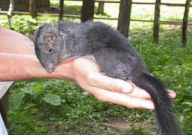
The first pictures showing a live specimen of a rodent species once thought to have been extinct for 11 million years have been taken by a retired Florida State University professor and a Thai wildlife biologist. They took video and still photographs of the "living fossil," which looks like a small squirrel or tree shrew, in May during an expedition to central Laos near the Thai border.Known as Diatomyidae, scientists have nicknamed it the Laotian rock rat. The creature is not really a rat but a member of a rodent family once known only from fossils.The pictures show a docile, squirrel-sized animal with dark dense fur and a long tail but not as bushy as a squirrel's. It also shows that the creature waddles like a duck with its hind feet splayed out at an angle _ ideal for climbing rocks."I hope these pictures will help in some way to prevent the loss of this marvelous animal," said David Redfield, a science education professor emeritus.He and Uthai Treesucon, a bird-watching colleague, befriended hunters who captured a live rock rat after four failed attempts.
They returned the animal, which the locals call kha-nyou, to its rocky home after photographing it.The long-whiskered rodent was branded as a new species last year when biologists first examined dead specimens they found being sold at meat markets. But they had never seen a live animal until Redfield and Treesucon photographed it.
Comment
-
New glacier theory on Stonehenge
A geology team has contradicted claims that bluestones were dug by Bronze Age man from a west Wales quarry and carried 240 miles to build Stonehenge. In a new twist, Open University geologists say the stones were in fact moved to Salisbury Plain by glaciers. Last year archaeologists said the stones came from the Preseli Hills. Recent research in the Oxford Journal of Archaeology suggests the stones were ripped from the ground and moved by glaciers during the Ice Age. Geologists from the Open University first claimed in 1991 that the bluestones at one of Britain's best-known historic landmarks had not come from a quarry, but from different sources in the Preseli area. The recent work was conducted by a team headed by Professor Olwen Williams-Thorpe, who said she and her colleagues had used geochemical analysis to trace the origins of axe heads found at Stonehenge and this backed up the original work.
"We concluded that the small number of axes that are actually bluestone derive from several different outcrops within Preseli," she said. "Axes found at or near Stonehenge are very likely to be from the same outcrops as the monoliths, and could even be made of left-over bits of the monoliths."Comment
-
Missing link in birds believed found
Separating the layers of sediment from an ancient lake was like turning the pages of a book to get a glimpse of life in the time of dinosaurs, an international team of scientists said Thursday. "A world lost for more than 100 million years was being revealed to us," said Hai-lu You of the Chinese Academy of Geological Sciences. What they found is being called the missing link on the evolution of birds, a loon-like creature that lived in northwest China and is the earliest example of modern birds that populate the planet today. Before their discovery, reported in Friday's issue of the journal Science, the only evidence for this creature Gansus yumenensis was a single, partial leg discovered in the 1980s. Now researchers have dozens of nearly complete fossils of Gansus, said a beaming Matt Lamanna of the Carnegie Museum of Natural History in Pittsburgh. "Most of the ancestors of birds from the age of dinosaurs are members of groups that died out and left no modern descendants.
But Gansus led to modern birds, so it's a link between primitive birds and those we see today," Lamanna said. Previously there was a gap between ancient and modern species of birds, and "Gansus fits perfectly into this gap," added Jerald D. Harris of Dixie State College in Utah. It was about the size of a modern pigeon, but similar to loons or diving ducks, the researchers said. One of the fossils even has skin preserved between the toes, showing that it had webbed feet. "We were lucky far beyond our expectations" in finding these fossils, added You. "Gansus is the oldest example of the nearly modern birds that branched off of the trunk of the family tree that began with the famous proto-bird Archaeopteryx," said Peter Dodson of the University of Pennsylvania.

Comment
-
UFO film exposes government cover-up ?
It began with a Colorado farmer seeing a strange, oval-shaped object zip across the sky over his house, kicking off one of the most amazing UFO incidents in the history of the world. But did this really happen?It did according to "The Top Secret UFO Project," R. J. Thomas' mock-documentary about a UFO incident in Colorado in the summer of 1956."Many people have been curious for decades about the Roswell, New Mexico Incident of 1947," Mr. Thomas said. "My film is inspired by stories like that."Based on Thomas' 2004 novella of the same name, "The Top Secret UFO Project" chronicles the UFO-related events experienced by a tiny Colorado hamlet called Jasper. According to the film, the town dealt with one unusual event after another in the summer of 1956. After the farmer's spaceship sighting, scientists rushed into Jasper to investigate, reporters rushed in looking for stories, and government officials rushed in to keep it a secret from the world. Billed as "the movie the government does not want you to see," "The Top Secret UFO Project," is a parody of specials you might find on the Sci-Fi Channel or Discovery, and the cheesy UFO documentaries of the 70's and TV programs like "In Search Of."
Mr. Thomas plays a documentary filmmaker who, in 2003, discovered (by accident) some top secret government films pertaining to the Jasper Incident of 1956. This inspired him to make a documentary about Jasper's UFO story, and to discover the truth behind what really happened that mysterious summer in Colorado."Not everyone is a UFO buff," Mr. Thomas said, "but everybody loves a good campfire story."And as far as the film portraying fiction as fact?"The film is told with a straight face, no matter how ridiculous the information may be," Mr. Thomas said. "But, even seven years later, 'The Blair Witch Project' is still seen by some people as fact."Comment
-
So where are all the crop circles ?
Hay fever, different crops, tragedy, emigration and yet more argument. Yes, the 2006 crop circle season is now under way... or is it? The rumours spreading around the wacky crop-circle world of Wiltshire are that there might not be as many of the mysterious formations this year as in previous summers.While some people who claim to make the crop circles say they are hanging up their planks and ropes to have time out, others in the furtive world of the circlemakers pledge that this year will be the biggest yet.And then, of course, there are the crop-circle devotees. They scoff at such planks-of-wood nonsense and say the more other-worldly circle- makers are sure to carry on.One thing is certain, the possibility that there will be fewer, or even no crop circles this year, has sent the close-knit croppie community into a geometric vortex.It was prompted by probably the most famous circlemaker in Wiltshire, Matthew Williams, announcing he would be taking a year off because hay fever, probably sparked by the increase in oil seed rape fields, was getting the better of him.
Mr Williams, still the only person in the world to be found guilty of crop circle criminal damage, said: "I'll not be out this year, it really is getting too bad. After a night in the fields, it takes me at least a day to recover."He, and other crop circlemakers were also stunned by the death of one of their number, Paul Obee, who was found dead in a car at Erlestoke, near Devizes, last month.Comment
-
Comment
-
Comment
-
Comment
-
UT professor debunks chupacabra myth
UT professor Pamela Owen can add one more title to her resume: educator, scientist and supernatural investigator. The producers of "Mystery Hunters," an educational TV program for kids, asked Owen to help identify bones reported to belong to the mythical chupacabra. The chupacabra, whose name means goat-sucker in Spanish, is a fabled creature which attacks and mutilates live-stock, sucking the blood of its prey.The bones belong to rancher Devin Macanally who shot the animal while it was attacking chickens on his ranch in Elmendorf. Photos of the animal, which later became known as the "Elmendorf Beast" show a small, hairless, dog-like creature.Owen, who holds a doctorate in mammalogy with a specialization in carnivores, said that when she first heard about the "Elmendorf Beast," she agreed with biologists' initial findings that it was some kind of coyote with severe mange.Owen's suspicions were later confirmed when the show's producers e-mailed her a photo of the creature's exhumed skull.
Owen, who has been identifying bones for the Texas Memorial Museum for six years, was able to recognize the skull almost instantly."I wrote back and said, 'Nice coyote.'" she said.Owen said she could understand how an average person could mistake the creature for a new species."What [Macanally] described was certainly not like any coyote," she said. "It was this hairless blue-skinned thing with disfigured teeth. This was a sick animal."What is called supernatural phenomena can often be explained within the context of a natural world, Owen said."I still think the stories are great, but they are based on interesting natural phenomena," she said.Comment
-
Discovery to launch July 1st
NASA decided Saturday to schedule the launch of the shuttle Discovery for July 1, despite the concerns of some top safety officials that the space agency has not solved the problem with flaky insulating foam, which brought down the shuttle Columbia in 2003. Two members of the shuttle-management team, chief engineer Christopher Scolese and head safety officer Bryan O'Conner, recommended the launch be delayed because of worries that foam on 37 brackets attached to the shuttle's giant external tank could fall off and pose a hazard to the craft.But at the end of the two-day Flight Readiness Review, they were outvoted by the rest of the management team. The team thought that even if foam comes off, it would not endanger the seven-person crew.After going on record recommending a delay, the dissenting officials said they did not oppose launching July 1.National Aeronautics and Space Administration officials agreed that recommending against a launch but not opposing it sounded contradictory. Shuttle-program manager Wayne Hale said this was proof that NASA has changed in the wake of the Columbia accident.
After the loss of Columbia, it came out that some officials had been worried about the 1.7-pound piece of foam that could be seen hitting the left wing during launch. Their concerns were brushed aside.Now, said Hale, every voice is heard, even if it sends a somewhat confusing message to the public.About 35 pounds of insulating foam have been removed from the fuel tank after a 1-pound piece of foam came off during the launch of Discovery last year.Concern remains about the potential loss of foam from a part of the tank known as the ice-frost ramps. Some engineers want those pieces of foam removed before the upcoming launch. NASA decided to leave them until they see how the shuttle performs during this mission.NASA Administrator Michael Griffin said no large pieces of foam have ever come off the ice frost ramps during 114 shuttle missions.Comment

 Tweet
Tweet
Comment