
-
-
Scientists find possible planet-forming disk
Scientists think they have solved the mystery of how planets form around a star born in a violent supernova explosion, saying they have detected for the first time a swirling disk of debris from which planets can rise. The discovery is surprising because the dusty disk orbiting the pulsar, or dead star, resembles the cloud of gas and dust from which Earth emerged. Scientists say the latest finding should shed light on how planetary systems form. "It shows that planet formation is really ubiquitous in the universe. It's a very robust process and can happen in all sorts of unexpected environments," said lead researcher Deepto Chakrabarty, an astrophysicist at the Massachusetts Institute of Technology. Details appear in Thursday's issue of the journal Nature. Using NASA's infrared Spitzer Space Telescope, MIT scientists observed bright radiation released by a disk of rubble around a young pulsar 13,000 light years from Earth. The pulsar was once a giant star that collapsed in a supernova explosion about 100,000 years ago. While researchers didn't directly see planets forming in the disk, they believe the building blocks are present. In 1992, another team of scientists found planets circling a different pulsar, but they didn't observe a disk and couldn't tell how the planetary system formed. Chakrabarty said the debris disk most likely formed from metal-rich material that failed to escape the supernova.

Comment
-
Comment
-
Large ice slab drops on Oakland
Did it come from outer space? Was it a transport vehicle for illegal aliens of the extraterrestrial kind? The tail of a comet grabbed by gravity? Jokes were flying Saturday morning after a block of solid ice, measuring more than two feet on a side, crashed to earth with a tremendous bang, digging a three-foot hole in the grass at Bushrod Park, 5800 Shattuck Ave. But when the laughing stopped, an expert theorized it probably fell from the wheel well of a plane landing at Oakland or San Francisco International airports. It also could be an unexplained "ice fall," one expert said. Big balls of ice sometimes fall from the sky without any real explanation. Wherever it came from, it's arrival was heart-stopping and dramatic. Brooks and Judith Mencher said they were standing on their back porch on 59th Street near the park when they heard a sound like a very loud rocket. "It kind of went 'whoosh!'" Brooks Mencher said. The impact hole looked like it was created by a hand grenade, said Oakland Police Sgt. Ron Lighten. "It knocked turf 20 feet away." Lt. Charles Glass of the Oakland Fire Hazardous Materials Team said the ice was pure water. " It didn't come from a toilet on a plane or anything like that."

Comment
-
Korea bid to ban Da Vinci Code movie
A South Korean Christian group has filed for a court injunction to stop a movie distributor from showing The Da Vinci Code, saying it defiles the sanctity of Jesus Christ and distorts facts. "The Da Vinci Code is a movie which belittles and tries to destroy Christianity," said the Rev Hong Jae-chul of the Christian Council of Korea, an umbrella group of over 60 Korean Protestant denominations. Sony Pictures Releasing of Korea, the movie's local distributor, wasn't immediately available for comment but its public relations agency, News Communications, said it would wait for the outcome of the legal action.Hong indicated the Christian group plans other steps in case the movie, starring Tom Hanks and Ian McKellen, is released as scheduled on May 18, but declined to give further details. The Da Vinci Code is based on Dan Brown's international bestseller, which has sold more than 40 million copies since it was released in March 2003.
Allegations in the novel that Jesus married Mary Magdalene and has descendants have outraged many Christians and been dismissed by historians and theologians. The Christian Council of Korea also asked other Christian organisations around the world to join efforts to block the screening of the movie. South Korea, with a population of 48 million, has 13 million Protestants and 4.6 million Roman Catholics.

Comment
-
UFO ignorance
It's not often one sees an article about UFO's in the mainstream print press or on television these days; when one does, it's usually filled with terms like "believers, pseudo-science, fringe, paranormal, cult, hoax," etc. On television the reporting of UFO events is generally done in a light comical manner, complete with the "winks, nods and guffaws included."That said, it's no surprise how ignorant the American public "of today" is on the subject of UFO's. Moreover, when attempts are made by independent sources, via television, the bulk of these productions come complete with organ music, smoke machines and are narrated by an eerie character with a British accent.Occasionally when a reporter from the mainstream press does gather the courage to broach the subject of UFO's, more often then not we see an individual who approaches the subject from the afore mentioned education received by his fellow colleagues; that's not to say there haven't been some reporters/newsmen etc., who have done some good publicized research; but those individuals, and instances are far and in-between!Comment
-
Saturn's moon 'best bet for life'
Saturn's tiny moon Enceladus may be the best place to look for life elsewhere in the Solar System. That is the view of a senior scientist working on the Cassini spacecraft, which has been studying Saturn and its moons for nearly two years. Dr Bob Brown told a major conference in Vienna, Austria, Enceladus contains simple organic molecules, water and heat, the ingredients for life. He raised the possibility of future missions to probe inside the moon. Other research presented at the European Geosciences Union (EGU) annual meeting suggests that Enceladus may have a core of molten rock reaching temperatures of 1,400K (above 1,100C). In July 2005 Cassini completed a spectacularly close flyby of Enceladus, passing just 173km above its surface. From this flyby came confirmation that the moon has an atmosphere, and strong evidence that the gases which make up the atmosphere are coming from cracks in the surface, nick-named "tiger stripes", near the south pole. It appears that the gases are being forced through the surface, as they emerge in jets which shoot upwards for hundreds of kilometres before dispersing, eventually forming Saturn's E-ring. Most of the gas is water vapour, suggesting strongly that liquid water lies under the moon's icy surface.Comment
-
Drug firms 'inventing diseases'
Pharmaceutical firms are inventing diseases to sell more drugs, researchers have warned. Disease-mongering promotes non-existent diseases and exaggerates mild problems to boost profits, the Public Library of Science Medicine reported. Researchers at Newcastle University in Australia said firms were putting healthy people at risk by medicalising conditions such as menopause. But the pharmaceutical industry denied it invented diseases.Report authors David Henry and Ray Moynihan criticised attempts to convince the public in the US that 43% of women live with sexual dysfunction. They also said that risk factors like high cholesterol and osteoporosis were being presented as diseases - and rare conditions such as restless leg condition and mild problems of irritable bowel syndrome were exaggerated. The report said: "Disease-mongering is the selling of sickness that widens the boundaries of illness and grows the markets for those who sell and deliver treatments. "It is exemplified mostly explicitly by many pharmaceutical industry-funded disease awareness campaigns - more often designed to sell drugs than to illuminate or to inform or educate about the prevention of illness or the maintenance of health." The researchers called on doctors, patients and support groups to be aware of the marketing tactics of the pharmaceutical industry and for more research into the way in which conditions are presented.Comment
-
Comment
-
man ketabesh ro khondam vali filmesh to englis taze az may to cinema ha gozashte mishe , kheili dost daram filmesho bebinam merc redwine jan
Originally posted by RedWineComment
-
Venus Express enters orbit
Europe's Venus Express probe has gone into orbit around our nearest planetary neighbour after a five-month journey. Early on Tuesday, mission controllers fired its main engine to reduce its speed and allow it to be caught in the planet's gravitational pull. Venus Express will orbit our nearest planetary neighbour for about 500 Earth days to study its atmosphere, which has undergone runaway greenhouse warming. The mission should shed light on the mechanisms of climate change on Earth. The main engine burn was initiated by controllers at the European Space Agency (Esa's) operations centre in Darmstadt, Germany at 0717 GMT. The critical 49-minute-long manoeuvre was designed to reduce the spacecraft's velocity relative to Venus by 15%, allowing it to be pulled into orbit around the planet. Mike Healy, UK director for EADS-Astrium, the spacecraft's main contractor, said it had to be perfect. "If it burns for too long you could end up crashing into the planet," he explained. At 0745 GMT, with its engine still firing, Venus Express disappeared behind the planet, severing contact between the craft and Earth. After about 10 minutes, mission controllers picked up the spacecraft's signal - an early indication that the manoeuvre had worked and it was in orbit around Venus. Scientists, engineers and officials in the control room clapped, cheered and embraced each other.Comment
-
Developing true artificial intelligence
Machines lack the creativity for novel ideas and have no feelings and no fond memories of their youth. But recent technological advances are narrowing the gap between human brains and circuitry. At Stanford University, bioengineers are replicating the complicated parallel processing of neural networks on microchips. Another development--a robot named Darwin VII--has a camera and a set of metal jaws so that it can interact with its environment and learn, the way juvenile animals do. Researchers at the Neurosciences Institute in La Jolla, Calif., modeled Darwin's brain on rat and ape brains. The developments raise a natural question: If computer processing eventually apes nature's neural networks, will cold silicon ever be truly able to think? And how will we judge whether it does? More than 50 years ago British mathematician and philosopher Alan Turing invented an ingenious strategy to address this question, and the pursuit of this strategy has taught science a great deal about designing artificial intelligence, a field now known as AI. At the same time, it has shed some light on human cognition. So what, exactly, is this elusive capacity we call "thinking"? People often use the word to describe processes that involve consciousness, understanding and creativity. In contrast, current computers merely follow the instructions provided by their programming.Comment
-
Making a fast buck from info on Bigfoot
Information on Bigfoot, according to biodiversity researcher and Bigfoot enthusiast Vincent Chow, is coming at a price as more people clamour to learn about the creature said to be lurking in the jungles of Johor. Chow claimed that villagers were not as forthcoming with information as before but the minute they were paid, they become very helpful and vocal.He said villagers were asking for between RM20 and RM200, depending on the kind of information they had or the length of time they spend with the interviewer."I think it is reasonable because these villagers are mainly farmers and we need them to bring us to the spot where the footprints are found," Chow said.He said he had forked out much of his own money researching Bigfoot.He said the villagers also lashed out at the media for making use of them to get information which sold newspapers without paying them a cent."Not even a cup of coffee," was one complaint Chow had heard.Chow also said he could not understand why some people were complaining of virgin jungles being raped by researchers searching for evidence of Bigfoot.Comment
-
Telescope to search for ET light signals
A new telescope at an observatory outside Boston will become a key tool in the search for extraterrestrials as scientists try to detect light signals from distant civilizations. An optical telescope dedicated Tuesday at the Oak Ridge Observatory, about 35 miles west of Boston, is the first to be used exclusively for a project called the Search for Extraterrestrial Intelligence.The 22-year-old SETI project has largely relied on radio telescopes to search for radio signals from outer space that could indicate the presence of intelligent beings.While some scientists are skeptical that such an approach could yield such evidence, the scientists who will use the Oak Ridge telescope believe extraterrestrials may be just as likely to communicate with high-intensity, tightly focused light beams carrying information as they are to use radio transmissions."If I were a betting man, I'd bet radio would work before light," said Paul Horowitz, a Harvard physicist who heads a SETI project at the university. "But we've done that for 20 years, and we haven't explored much with light."Scientists began using optical telescopes on the SETI project in 1998 at Oak Ridge and other sites. Until now, they've had to share time on optical telescopes with other astronomers doing different work. The new telescope will be scan the night skies uninterrupted and exclusively for SETI.Comment
-
'DNA origami' creates map of the Americas
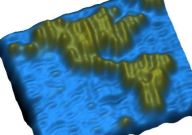
A map of the Americas measuring just a few hundred nanometres across has been created out of meticulously folded strands of DNA, using a new technique for manipulating molecules dubbed "DNA origami". The nanoscale map, which sketches out both North and South America at a staggering 200-trillionths of their actual size, aims to demonstrate the precision and complexity with which DNA can be manipulated using the approach.According to the map's creator, Paul Rothemund at Caltech in Pasadena, US, DNA origami could prove hugely important for building future nano-devices including molecular machines and quantum computer components. The technique exploits the fact that complementary base pairs of DNA will automatically stick together and involves folding a single strand of DNA in many different ways.To make the nano-map, Rothemund first needed to create a suitable "canvas". He used a single strand of DNA from a bacteria-destroying virus called M13 mp18. The strand was folded over and over at regular intervals using smaller strands of complementary DNA, which pull two parts of the strand together to create each fold. The result is a flat surface made from a long double helix, comprised of the single long strand and more than 200 shorter strands stuck along its length, "stapling" it together at key locations.
If this helix was a perfectly formed, the canvas would appear blank. But by using short strands of DNA, containing bits that do not stick to the main strand, it is possible to cause parts of the canvas stand out . Precisely controlling the location of these extra bits made it possible for Rothemund to draw out the shape of the map.To make the design process less complicated, Rothemund created software that works out which short-strand sequences will generate different shapes. Rothemund says it should be possible to precisely arrange quantum dots or carbon nanotubes after chemically binding them to DNA, using the method.William Shih at the Biomolecular Nanotechnology Group at Harvard Medical School in Boston, US, says this offers the most flexible method yet for building nanoscale structures. Shih is experimenting with the technique as a means of making molecular 3D cages, which could be used to build molecular motors.
Comment

 Tweet
Tweet

Comment