
-
-
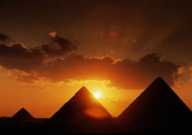
Eclipse prompts meditation at pyramids
Balancing on his head in the shadow of the ancient pyramids of Giza, a Dutch visitor tries to connect to the spiritual forces he says are swirling around the monuments during Wednesday's solar eclipse. "The eclipse is a special moment in time and the shape of the pyramids attracts a universal energy spiral," Robin, who did not give his full name, said after meditating at the foot of the largest of the pharaonic mausoleums in the desert outside Cairo."We are all made of light. Light is what binds us all and makes all us humans one, so this is a very important time to be here," said the Dutchman while standing barefoot in a circle of people meant to symbolize the sun.In the far west of Egypt, thousands of people, including Egyptian President Top of Form 1Bottom of Form 1Hosni Mubarak, gathered at the border town of Salloum to witness the full solar eclipse.At the pyramids, outside the track of the total eclipse, the light dimmed and the air cooled as the moon passed in front of the sun without hiding it completely from view."There is a lot of mystery about the pyramids.
There are things about the pyramids that the scientists don't recognize," said Robin, sitting next to the 4,500-year-old Cheops Pyramid.Knowing the prominence of the sun in ancient Egyptian religion, researchers visiting the site said it was exciting to witness the eclipse at the pyramids, which some archaeologists have said may have been aligned to the stars."The only thing that would have kept me away was being dead," Blair Wilkins from Britain said.Wilkins, a researcher of ancient myths and legends, said he had been waiting 18 years for the event since finding a stone artefact at nearby pyramids depicting an eclipse in the area thousands of years ago.
Comment
-
NASA restores funds to search for alien life
NASA is planning to restore about $30 million to its astrobiology research programme over three years, agency officials said on Monday. Astrobiologists welcomed the news but vowed to put pressure on US lawmakers to reinstate all of the $160 million or so that has been cut from the programme over the next five years.Astrobiology research grants were $32.5 million per year in NASA's 2007 budget request to Congress, half of funding levels in 2005. The request, announced in February 2006, called for funding to remain constant through 2011.The cuts meant that NASA could still afford to fund the three-year grants it had already committed to through 2006, but not any research proposals it had solicited in 2005 or any new proposals in 2006, said Carl Pilcher, NASA's senior scientist for astrobiology. But now some of those projects may be funded, he told scientists on Monday at a NASA-sponsored astrobiology conference in Washington DC, US. "During the past week, a plan was developed to add money back into the astrobiology budget," he said.
He said the plan, which has yet to be finalised, would allow NASA to fund about half of the proposals it had solicited in 2005. That amounts to restoring about $10 million per year for the three years from 2006 to 2008, he said. But he added that the plan would not allow NASA to solicit new research proposals in 2006.Researchers said NASA was responding to protests from scientists and lawmakers and called for the pressure to continue. "It seems to me that instead of going away quietly with what we were given, we ought to be emboldened to ask for more," said Jill Tarter, director for the Center for SETI Research in Mountain View, California, US.Comment
-
Comment
-
Image of Jesus' crucifixion may be wrong
The image of the crucifixion, one of the most powerful emblems of Christianity, may be quite erroneous, according to a study which says there is no evidence to prove Jesus was crucified in this manner. Around the world, in churches, on the walls of Christian homes, on crucifixes worn as pendants, in innumerable books, paintings and movies, Jesus Christ is seen nailed to the cross by his hands and feet, with his head upwards and arms outstretched. But a paper published by Britain's prestigious Royal Society of Medicine (RSM) says this image has never been substantiated in fact. Christ could have been crucified in any one of many ways, all of which would have affected the causes of his death, it says. "The evidence available demonstrates that people were crucified in different postures and affixed to crosses using a variety of means," said one of the authors, Piers Mitchell of Imperial College London. "Victims were not necessarily positioned head up and nailed through the feet from front to back, as is the imagery in Christian churches."
The authors do not express any doubt on the act of Jesus' crucifixion itself. But they note that the few eyewitness descriptions available today of crucifixions in the 1st century AD show the Romans had a broad and cruel imagination. Their crucifixion methods probably evolved over time and depended on the social status of the victim and on the crime he allegedly committed, says the paper in April's issue of the RSM journal. The cross could be erected "in any one of a range of orientations", with the victim sometimes head-up, sometimes head-down or in different postures.

Comment
-
Scientists at odds over longevity
The increase in life expectancy enjoyed by many societies is a triumph of modern science. Our understanding of the human body and how to repair it when it breaks down have continued to push "old age" into the distance - and researchers intend to keep pushing. But the claims made by Dr Aubrey de Grey, a scientist at the University of Cambridge, UK, that lifespan can be increased by over 1,000 years, have proven too much for some; and a dispute has now broken out within the gerontology community. The argument, which has been played out through academic journals, and most recently at a "life extension" conference, has culminated in the unusual step of a cash prize on offer for anyone who can disprove de Grey's science. Dr de Grey's claims for long life centre on SENS (Strategies for Engineered Negligible Senescence); essentially, strategies to prevent and cure ageing. SENS is based upon repairing the molecular and cellular damage that accumulates throughout life; so as to prevent age-related illness and frailty. It focuses on addressing seven different types of cell damage, including mutations to chromosomes and mitochondrial DNA, and cell loss.Comment
-
Comment
-
Comment
-
Tracking a tall tail
They're as old as time, perhaps inhabitants of this planet longer than us. Some native North American tribes refer to them as naxnox, or supernatural beings, and have encountered them for centuries. Fishermen, loggers, hikers and day trippers claim to have seen them on occasion.We're talking about Sasquatch, Bigfoot or Wildman -- it doesn't matter what you call them, it appears they're here, living among us. Unless, that is, you think every one of the thousands who claim to have seen them are charlatans. April fools? Hardly.For five years now, Sasquatch enthusiasts, or those simply looking for an unusual adventure experience, can head out into Vancouver Island's deep woods on expeditions inspired by a man who has spent more than three decades obsessed by the mysterious creature. For 35 years, during a career as a wildlife biologist, John Bindernagel has collected Sasquatch lore and "evidence." He has written numerous papers on the subject and a recent book, North America's Great Ape: The Sasquatch.He's so serious about his passion that he doesn't even like the term Bigfoot. "I use Sasquatch instead of Bigfoot, because the latter has such a jestful connotation.
Bigfooters see the creature behind every tree," Bindernagel told me late at night, in a bed and breakfast owned by Michael and Elly Ruge in Cowichan Valley, on the shores of Shawnigan Lake about 45 kilometres north of Victoria. Michael has set up a unique tour business under Bindernagel's guidence. The latter's mother was Ruge's nanny once and, though he's now in his mid-forties, he has maintained close ties to the bright, affable and deadly serious Bindernagel."Knowing him as I do, I really believe in John's work, so I wanted to create a business around his research," Ruge says. "Bigfoot Safari was the answer."Comment
-
Comment
-
Himalayas far older than thought
A new study of a fossil-rich region in the Himalayas confirms that mountain building started there far, far earlier than thought, along a long-lost storm-tossed coastline, perhaps a billion years ago. Rocks of the Parahio Valley in the Spiti region of India contain the remains of a half-billion-year-old river delta filled with shallow coastal marine fossils and debris washed out of a very early mountain range. The findings are another blow to the general impression that the first mountain building involving the rocks of today's Himalayas began just 50 million years ago. "When you look at the Himalaya you often get the impression that everything happened in the Cenozoic" (later than 50 million years ago), said geologist Paul Myrow of Colorado College in Colorado Springs. "But there's an earlier period of mountain building that took place in the Cambrian" (542-488 million years ago) or even earlier.Comment
-
Comment
-
Emotion sensor 'detects boredom'
Scientists are developing an "emotion sensor" to show if someone is finding your conversation interesting or not. It is being developed to help people with autism, who tend to be less skilled at interacting with others. New Scientist magazine reports researchers at the Massachusetts Institute of Technology (MIT) have developed the headset. A camera on a pair of glasses is linked to a hand-held computer which "reads" the emotional reactions of a listener.The device uses image recognition software and emotion-reading software to decode the images. If the wearer appears not to be engaging with their listener, the software makes the computer in their hand vibrate. Previous research by the team has shown the device could detect if someone was agreeing, disagreeing, concentrating, thinking, unsure or interested from just a few seconds of film. Previous computer programmes have only been able to detect six basic states of happiness, sadness, anger, surprise and disgust.
The MIT system was "primed" with 100 clips of actors displaying particular emotions. It detects movements of the eyebrows, lips and nose and tracks head movements such as nodding, shaking or tilting. In recent tests, the device correctly identified people's emotions in video clips 90% of the time. When it was tested with members of the public, it was right 64% of the time. The team are about to begin the first tests of day-to-day use with volunteers, some of whom have autism.Comment
-
Perth's mystery 'flying car'
Eagle eyed users of the satellite imaging service Google Earth have spotted what appears to be a car hovering above the ground in a suburban Perth car park. The photo is of a car park just off Honour Avenue at Point Walter in the affluent south western suburb of Bicton. The spot is a popular picnic location on the banks of the Swan River.A number of cars are shown in parking bays and the vehicle in question appears to hovering above the ground nearby, its shadow clearly visible beneath.Google Earth images are mostly taken by satellites - and sometimes by aircraft - within the past three years and there are no "live" images on the site.The intriguing image was reported last week by the British IT news website, The Register.One the the website's readers subsequently visited the very spot and sent in photos showing that there were no unusual structures there that could explain the phenomenon.Other sceptical readers wrote in insisting the image was an optical illusion and was either a bus shelter, a pergola, a hole in the ground.
One said it was obviously "Harry Potter and his friends on vacation".Google Earth, launched last year, allows users to zoom across the planet and drill down to a height of about 300 metres. The program also has "tilt" function to give a side or angled view of an area or object.Cars and boats are clearly visible at this level and in some areas, where even higher definition images are available, people can be seen.The Google service has spawned a group of devoted followers who scour the satellite images for strange sightings. Users in the past have spotted a Stealth bomber parked on a runway in California, commercial planes in mid-flight and an image of what appears to be a ship on its side in a river estuary in Scotland.

Comment
-
Exploring the oceans of our Solar System
In 1996, for the first time since Balboa spotted the shimmering Pacific from a high Panamanian hill in 1513, a vast new ocean was discovered -- an ice-covered body of water that entirely envelops Jupiter's enigmatic moon Europa. The divining of a huge extraterrestrial ocean in our very solar system seemed both improbable and fortuitous, as the robot Galileo -- named after the astronomer who first discovered Jupiter's four largest moons nearly 400 years ago -- was the first spacecraft ever to orbit one of the outer planets.Then just last month, the second outer-planets orbiter, Cassini, currently looping around Saturn, sent back headline news. Cassini scientists announced they'd spotted unmistakable evidence of liquid water venting from the south polar region of Saturn's moon Enceladus.Given the clear signs of organic compounds, sources of energy and liquid water on Europa, many believe life to be more likely there than on Mars. And preliminary analysis of Enceladus's south pole indicates that it, too, may well have been warm enough, for long enough, that sub-surface water could have fostered life there.

Comment

 Tweet
Tweet
Comment